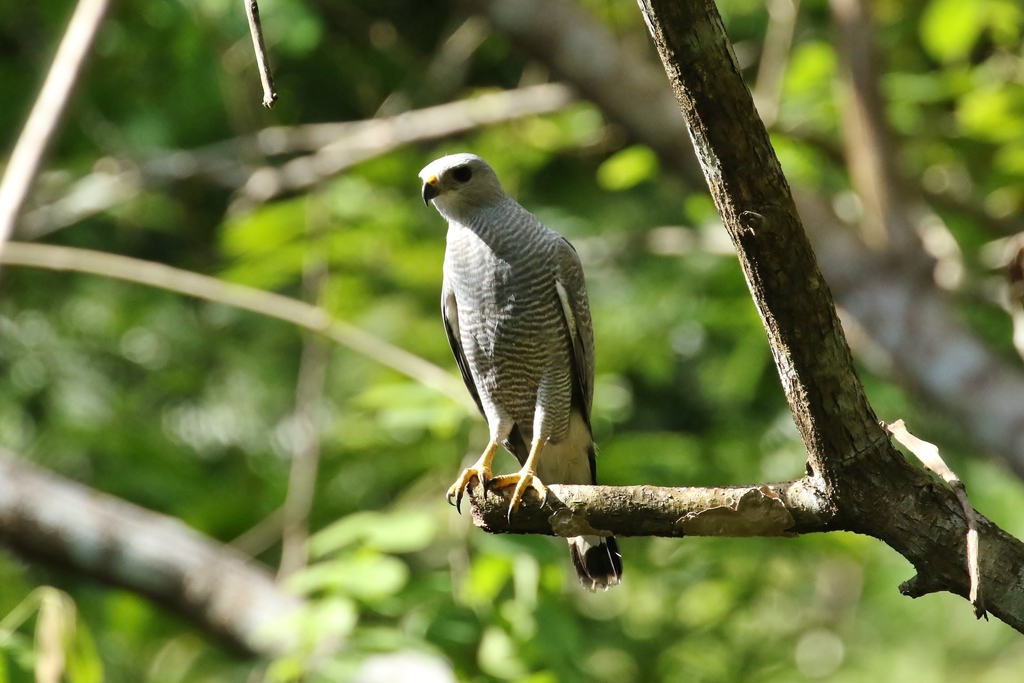
Busardo gris meridional
Photo © Thibaud Aronson
Photo © Thibaud Aronson — CC BY-SA 4.0 — Source: iNaturalist photo #31377840El busardo gris meridional (Buteo nitidus), también conocido como aguilucho gris, gavilán gris, gavilán barrigrís o gavilán saraviado, es una especie de ave accipitriforme de la familia Accipitridae autóctona de la región neotropical, desde Centroamérica hasta el norte de la Argentina.
Manuel Antonio National Park
Quepos, Costa Rica
+125 aves+30 mamíferos
White sand beaches curve between steep jungle walls where the Pacific laps against Costa Rica’s most biodiverse coastal sanctuary. Rainforest […]
VER PARQUE NACIONALSanta Rosa National Park
Santa Elena, Costa Rica
+129 aves+30 mamíferos
Dawn breaks over a mosaic of dry forest and humid woodland where Costa Rica’s northwestern peninsula juts into the Pacific. […]
VER PARQUE NACIONALVolcán Poás National Park
Toro Amarillo, Costa Rica
+132 aves+30 mamíferos
Where volcanic peaks pierce the Costa Rican highlands, a landscape of primordial drama unfolds. The Poás volcano dominates this 6,506-hectare […]
VER PARQUE NACIONALMapinguari National Park
Brasil
+120 aves+30 mamíferos
Where the Amazon’s southwestern frontier meets the Xingu Basin, vast tracts of pristine tropical forest rise and fall across nearly […]
VER PARQUE NACIONALSerra do Divisor National Park
Brasil
+132 aves+30 mamíferos
Where the Ucayali River carves its ancient path through northwestern Brazil, rainforest canopy rises in unbroken waves across nearly 27,000 […]
VER PARQUE NACIONALDarién National Park
Tucutí, Panamá
+132 aves+30 mamíferos
Where rainforest swallows the horizon and rivers carve through primordial wilderness, one of Central America’s last great untamed frontiers unfolds […]
VER PARQUE NACIONALPortobelo National Park
Portobelo, Panamá
+115 aves+16 mamíferos
Where Caribbean waters dissolve into rainforest, a protected realm of pristine coastal wilderness unfolds across 570 square kilometers of northern […]
VER PARQUE NACIONALAún no hay fotos de la comunidad. Inicia sesión para añadir la primera.
Aún no hay observaciones de la comunidad de esta especie.