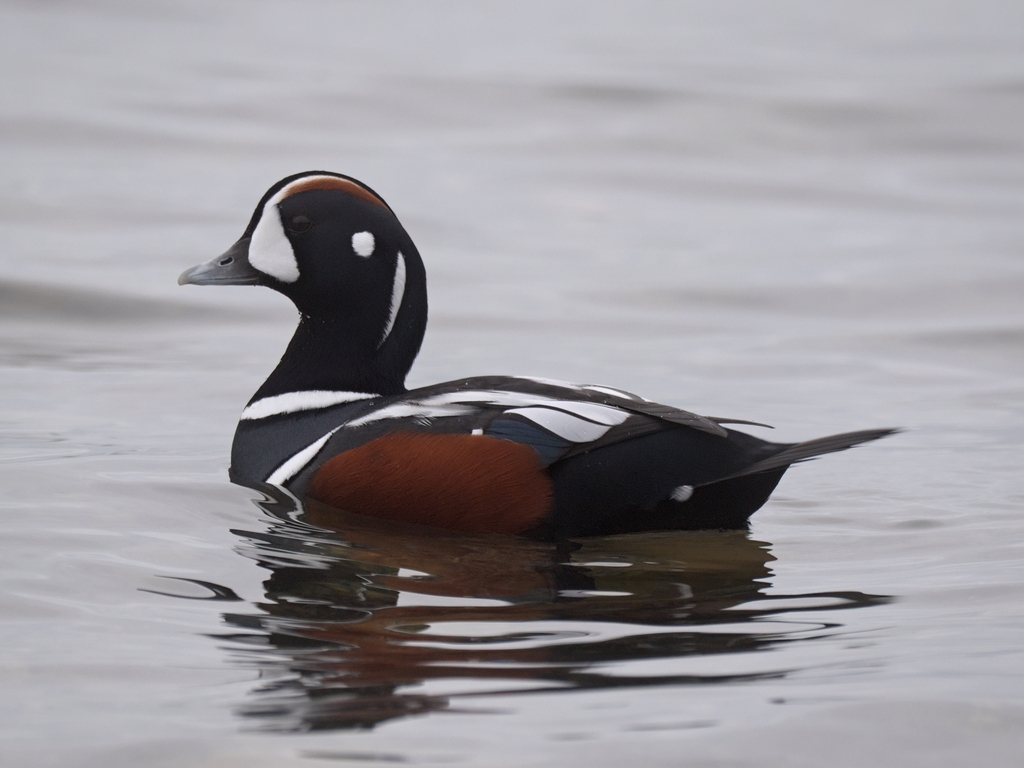
Pato arlequín
Photo © Kevin Krebs
Photo © Kevin Krebs — CC BY 4.0 — Source: iNaturalist #326880446Identification
The harlequin duck is a small sea duck with strikingly different plumage between males and females. Adult breeding males are unmistakable, sporting a complex and colorful pattern that inspired their theatrical name. The head and neck are dark slate blue, adorned with distinctive white markings: a large crescent in front of the eye that extends upward, a small round dot behind the eye, and a larger oval spot on the side of the neck. A black crown stripe runs across the top of the head with chestnut patches on either side, while a black-bordered white collar separates the head from the breast. The body is lighter slate blue with chestnut sides and a black-bordered white bar dividing the breast. The tail is black, long and pointed, with a metallic blue speculum and white inner secondary feathers visible when folded. The bill is blue-grey and the eye is distinctly reddish.
Females are considerably less colorful, wearing brownish-grey plumage with three white head patches: a round spot behind the eye, a larger patch extending from the eye to the bill, and a small spot above the eye. Their subdued appearance contrasts sharply with the males' theatrical dress, though both sexes share the characteristic buoyant, cork-like floating posture that defines this charming species.
Range & Habitat
Harlequin ducks breed in cold, fast-moving streams across northwestern and northeastern North America, Greenland, Iceland, and eastern Russia. They favor well-concealed nesting sites on the ground near streams, typically in areas characterized by pounding surf and white water. As short-distance migrants, most birds winter near rocky shorelines along the Atlantic and Pacific coasts, though they occasionally appear as rare migrants to western Europe.
The species faces conservation challenges, particularly the eastern North American population, which is considered endangered. Habitat loss from hydroelectric projects and coastal mortality from oil spills represent significant threats to their survival.
Behaviour & Diet
Harlequin ducks are accomplished underwater foragers, feeding by swimming submerged, diving, and dabbling. Their diet consists primarily of molluscs, crustaceans, and insects. One of their most remarkable adaptations is their exceptionally dense, smooth feathers that trap substantial amounts of air, providing vital insulation in the chilly waters they inhabit. This dense plumage makes them extraordinarily buoyant, causing them to bounce like corks after dives—a delightful characteristic to observe.
These ducks follow a monogamous mating system with multi-year pair bonds formed during the winter mating season. Both males and females exercise mate choice preference and pair-bond defense to demonstrate fidelity, though either partner can dissolve the bond to pursue a higher-quality option. Notably, males rarely participate in paternal care. Females typically achieve breeding success by their second year, while males rarely establish persistent bonds before their fourth winter.
Best Time & Places to See It
Harlequin ducks are best observed during their winter season when they congregate near rocky shorelines on both Atlantic and Pacific coasts of North America. Their preference for turbulent waters near pounding surf makes them particularly accessible to travelers visiting coastal regions during winter months. The western and eastern coasts of North America offer the most reliable viewing opportunities, especially near areas with dramatic white-water conditions and rocky outcrops.
Photography Tips
The dramatic plumage of breeding males makes harlequin ducks exceptionally photogenic subjects. Capture males during the winter mating season when they display their full alternate plumage with all its intricate markings. Photograph them in their characteristic habitat near turbulent waters and white water, which provides dramatic context and showcases their adaptation to challenging environments. Their buoyant, cork-like floating behavior after dives offers amusing photo opportunities. Winter coastal locations with rocky shores provide excellent backdrops that complement their coloration. Be patient in capturing the subtle details: the white facial markings, the chestnut patches, and the distinctive reddish eye are all worth isolating with telephoto lenses.
Gulf Islands National Park Reserve
Southern Gulf Islands Electoral Area, Canadá
+130 aves+24 mamíferos
Where the Pacific Northwest’s temperate rainforest meets the Salish Sea, an archipelago of over 15 islands and numerous islets creates […]
VER PARQUE NACIONALGlacier National Park
Glacier, Canadá
+123 aves+30 mamíferos
Where the Columbia Mountains rise in British Columbia’s interior, temperate rainforest gives way to alpine meadows scattered with late-lying snow. […]
VER PARQUE NACIONALCape Breton Highlands National Park
Cape Breton Highlands National Park, Canadá
+115 aves+23 mamíferos
Where the Cabot Trail winds through Nova Scotia’s northern reaches, weathered plateaus rise dramatically above the Atlantic, their cliff faces […]
VER PARQUE NACIONALBanff National Park
Improvement District No. 9, Canadá
+121 aves+30 mamíferos
Where turquoise glacial lakes mirror jagged peaks and coniferous forests sweep across vast alpine plateaus, one of North America’s most […]
VER PARQUE NACIONALJasper National Park
Improvement District No. 12, Canadá
+127 aves+32 mamíferos
Where the Canadian Rockies erupt into a wilderness of turquoise glacial lakes and precipitous valleys, nearly 11,000 square kilometres of […]
VER PARQUE NACIONALL’Île-Bonaventure-Et-Du-Rocher-Percé National Park
Le Rocher-Percé, Canadá
+146 aves+3 mamíferos
Where the St. Lawrence River crashes against Quebec’s Gaspésie Peninsula, a pierced limestone monolith rises 88 metres from churning Atlantic […]
VER PARQUE NACIONALKenai Fjords National Park
Kenai Peninsula Borough, Estados Unidos
+27 aves
Where tidewater glaciers calve into emerald waters and temperate rainforest cloaks the coastal mountains, one of Alaska’s most dramatic wilderness […]
VER PARQUE NACIONALDenali National Park
Denali Borough, Estados Unidos
+102 aves+22 mamíferos
Where subarctic wilderness sprawls across nearly 31,000 square kilometres of interior Alaska, six million acres of raw, untrammelled landscape define […]
VER PARQUE NACIONALYellowstone National Park
Park County, Estados Unidos
+120 aves+31 mamíferos
Geothermal plumes rise from an alien landscape where boiling springs feed crystalline pools and geysers erupt with clockwork precision across […]
VER PARQUE NACIONALMount Rainier National Park
Pierce County, Estados Unidos
+105 aves+27 mamíferos
Where volcanic slopes rise dramatically from temperate rainforest to alpine tundra, a landscape of raw geological power unfolds across 1,322 […]
VER PARQUE NACIONALOlympic National Park
Jefferson County, Estados Unidos
+122 aves+29 mamíferos
Where temperate rainforest meets alpine meadow and windswept coastline, a remarkable wilderness unfolds across Washington’s Olympic Peninsula. This 10,765-square-kilometre sanctuary […]
VER PARQUE NACIONALWaterton Lakes National Park
Improvement District No. 04, Canadá
+127 aves+30 mamíferos
Where the Rocky Mountains plunge dramatically into the turquoise waters of two pristine glacial lakes, one of North America’s most […]
VER PARQUE NACIONALNahanni National Park
Dehcho Region, Canadá
+24 aves+14 mamíferos
Where granite gorges slice through the remote wilderness of Canada’s northwest territories, a landscape of superlative drama unfolds across nearly […]
VER PARQUE NACIONALYoho National Park
Area A (Kicking Horse/Kinbasket Lake), Canadá
+81 aves+26 mamíferos
Where granite peaks claw at British Columbia’s sky, turquoise glacial rivers carve through valleys of old-growth forest, creating a landscape […]
VER PARQUE NACIONALFundy National Park of Canada
Alma Parish, Canadá
+131 aves+27 mamíferos
Where the Bay of Fundy’s tidal rhythms sculpt the Maritime landscape, a compact wilderness of 345 square kilometres unfolds across […]
VER PARQUE NACIONALGros Morne National Park
Canadá
+128 aves+19 mamíferos
Where granite peaks rise dramatically above fjord-carved valleys, one of Canada’s most geologically spectacular wilderness areas commands nearly 4,000 square […]
VER PARQUE NACIONALGwaii Haanas National Park Reserve and Haida Heritage Site
Area E (Moresby Island), Canadá
+61 aves+9 mamíferos
Where temperate rainforests plunge into the Pacific and mist clings to ancient cedar groves, one of North America’s most pristine […]
VER PARQUE NACIONALForillon National Park
Gaspé, Canadá
+131 aves+11 mamíferos
Where the Gaspé Peninsula meets the Gulf of Saint Lawrence, rugged cliffs plunge into churning Atlantic waters, sculpting a dramatic […]
VER PARQUE NACIONALSt. Paul Island
Saint Paul, Estados Unidos
+131 aves+2 mamíferos
Windswept tundra rolls across this remote Pribilof island, where volcanic basalt cliffs plunge into the Bering Sea and fog rolls […]
VER PAISAJE PROTEGIDONalychevo National Park
Nalychevo, Rusia
+86 aves+10 mamíferos
Where volcanic peaks pierce the mist of Russia’s far northeast, a primordial landscape of steaming geothermal springs and pristine river […]
VER PARQUE NACIONALTombstone Territorial Park
Dawson City, Canadá
+86 aves+17 mamíferos
Where granite peaks pierce the Yukon sky and tundra stretches endlessly toward the Arctic horizon, the Tombstone Range commands attention […]
VER RESERVA NATURALAún no hay fotos de la comunidad. Inicia sesión para añadir la primera.
Aún no hay observaciones de la comunidad de esta especie.