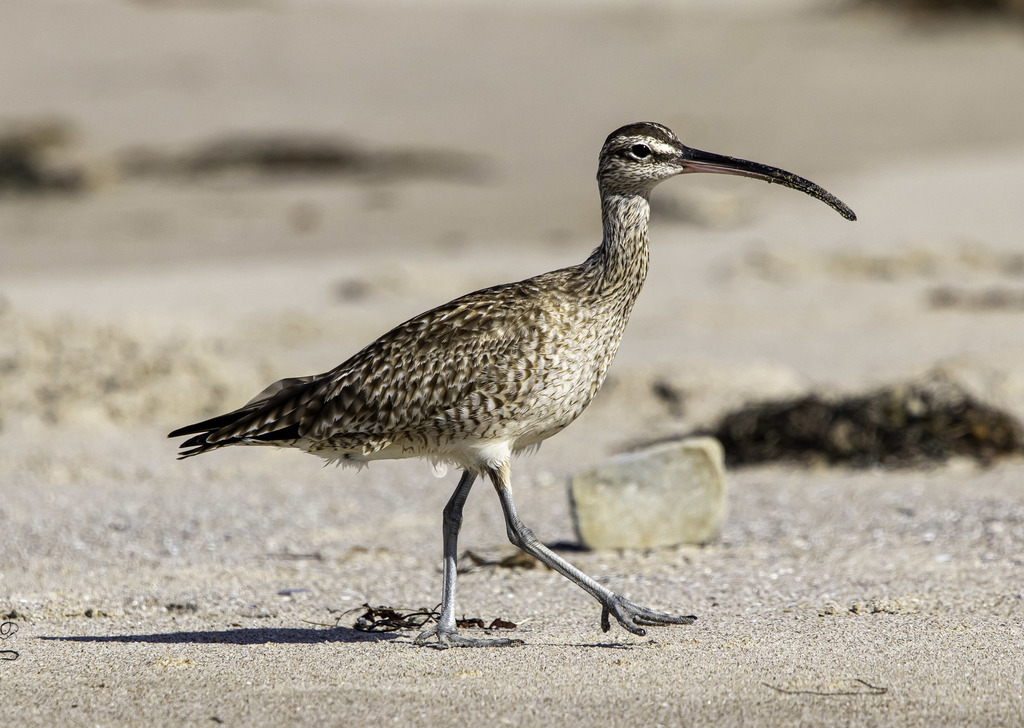
Chorlo Trinador
Photo © Zack Abbey
Photo © Zack Abbey — CC BY 4.0 — Source: iNaturalist photo #62769447Identification
The Hudsonian whimbrel is a fairly large wader, mid-sized within the curlew genus, measuring 37–47 cm in length with a wingspan of 75–90 cm. Its most distinctive feature is a long, curved bill with a characteristic kink rather than a smooth curve—longest in adult females. The plumage is mainly greyish brown with a uniform rump pattern matching the upperparts. A central crown stripe and strong supercilia (eyebrow markings) are key identifying features that distinguish it from the larger curlews sharing its range.
The bird's English name captures its distinctive rippling whistle call, which extends into a trill during song. These vocalizations are one of the most reliable ways to identify the species in the field, particularly during breeding season.
Range & Habitat
The Hudsonian whimbrel is one of the most widespread of all curlews, breeding across much of subarctic North America. Two subspecies are recognized: Numenius hudsonicus rufiventris breeds in Alaska and northwestern Canada, while Numenius hudsonicus hudsonicus (also called the Hudsonian curlew) breeds from the Hudson Bay area to northeastern Canada. This is a migratory coastal bird, wintering on coasts in southern North America and South America.
During the non-breeding season, whimbrels favour coastal habitats and mangrove areas. In the mangroves of Colombia, roost sites are typically located close to feeding territories and positioned away from potential mainland predators, though they show tolerance for areas of human disturbance.
Behaviour & Diet
Hudsonian whimbrels are specialist feeders, probing soft mud for small invertebrates and picking small crabs and similar prey directly from the surface. This foraging strategy makes them particularly dependent on undisturbed coastal mudflats and shallow waters. Before migration, their diet shifts considerably, with berries becoming an important seasonal food source to build energy reserves for long-distance travel.
During breeding season, these birds nest on bare scrapes on tundra or Arctic moorland, where they lay three to five eggs. Adults are extremely territorial and defensive, known to attack humans who approach their nesting area too closely. Near the end of the 19th century, hunting pressure along migration routes severely impacted populations, though numbers have since recovered; the species remains classified as of High Conservation Concern in North America.
Best Time & Places to See It
For northern birders and photographers, breeding birds can be found in subarctic regions during summer months. However, most observers encounter Hudsonian whimbrels during migration periods on coastal mudflats and beaches in North America, or in winter quarters along southern coasts and in mangrove habitats from southern North America through South America.
Coastal areas with extensive mudflats and mangrove habitats offer the best viewing opportunities. The species' migratory nature means timing is critical—arrival and departure dates vary by location, making local knowledge essential for planning a sighting.
Photography Tips
Photograph whimbrels in their natural feeding habitat along mudflats and shallow water edges where probing behaviour is most visible. The bird's long, kinked bill and distinctive head markings are best captured with side-on or three-quarter angles during good light. Early morning or late afternoon light enhances the subtle greyish-brown plumage tones.
Listen for their distinctive rippling whistle calls to locate birds, particularly during migration periods. When photographing in mangrove roost sites, approach carefully and respectfully to avoid disturbing these increasingly valued but still vulnerable birds. A telephoto lens is essential, as whimbrels are often wary and prefer to maintain distance from observers.
Gulf Islands National Park Reserve
Southern Gulf Islands Electoral Area, Canadá
+130 aves+24 mamíferos
Where the Pacific Northwest’s temperate rainforest meets the Salish Sea, an archipelago of over 15 islands and numerous islets creates […]
VER PARQUE NACIONALTijuca National Park
Brasil
+127 aves+30 mamíferos
Where Atlantic rainforest clings to steep granite slopes mere kilometres from Rio de Janeiro’s urban sprawl, one of Brazil’s most […]
VER PARQUE NACIONALCorcovado National Park
Puerto Jiménez, Costa Rica
+132 aves+30 mamíferos
Rain hammers the canopy as moisture-laden clouds collide with the Osa Peninsula’s mountainous spine, birthing one of the planet’s most […]
VER PARQUE NACIONALManuel Antonio National Park
Quepos, Costa Rica
+125 aves+30 mamíferos
White sand beaches curve between steep jungle walls where the Pacific laps against Costa Rica’s most biodiverse coastal sanctuary. Rainforest […]
VER PARQUE NACIONALTortuguero National Park
Roxana, Costa Rica
+124 aves+30 mamíferos
Where emerald waterways thread through impenetrable rainforest and pristine Caribbean beaches merge with lagoons, one of Costa Rica’s most biodiverse […]
VER PARQUE NACIONALPiedras Blancas National Park
Golfito, Costa Rica
+132 aves+30 mamíferos
Where misty lowland rainforest plunges toward the Pacific through a labyrinth of river valleys, one of Costa Rica’s most pristine […]
VER PARQUE NACIONALSanta Rosa National Park
Santa Elena, Costa Rica
+129 aves+30 mamíferos
Dawn breaks over a mosaic of dry forest and humid woodland where Costa Rica’s northwestern peninsula juts into the Pacific. […]
VER PARQUE NACIONALPointe-Taillon National Park
Lac-Saint-Jean-Est, Canadá
+135 aves+24 mamíferos
Where the St. Lawrence River widens into the Gulf, a slender peninsula of boreal forest and wetland emerges from the […]
VER PARQUE NACIONALDenali National Park
Denali Borough, Estados Unidos
+102 aves+22 mamíferos
Where subarctic wilderness sprawls across nearly 31,000 square kilometres of interior Alaska, six million acres of raw, untrammelled landscape define […]
VER PARQUE NACIONALRedwood National Park
Humboldt County, Estados Unidos
+126 aves+29 mamíferos
Where ancient titans pierce the California fog, the tallest trees on Earth create a primordial landscape unlike anywhere else. Spanning […]
VER PARQUE NACIONALOlympic National Park
Jefferson County, Estados Unidos
+122 aves+29 mamíferos
Where temperate rainforest meets alpine meadow and windswept coastline, a remarkable wilderness unfolds across Washington’s Olympic Peninsula. This 10,765-square-kilometre sanctuary […]
VER PARQUE NACIONALWrangell-Saint Elias National Park
Unorganized Borough, Estados Unidos
+77 aves+19 mamíferos
Where granite peaks thrust skyward and tidewater glaciers calve into fjords, North America’s largest subpolar wilderness commands absolute attention. Spanning […]
VER PARQUE NACIONALCerros de Amotape National Park
District of San Jacinto, Ecuador
+117 aves+6 mamíferos
Where granite peaks pierce the tropical sky above northwestern Ecuador, a landscape of extraordinary ecological complexity unfolds across nearly 4,800 […]
VER PARQUE NACIONALNatural Utría National Park
Alto Baudó (Pie de Pató), Colombia
+144 aves+15 mamíferos
Where the Chocó rainforest plunges headlong into the Pacific, a pristine coastal wilderness unfolds across 1,287 square kilometers of Colombia’s […]
VER PARQUE NACIONALMorrocoy National Park
Municipio Silva
+91 aves+4 mamíferos
Where crystalline Caribbean waters meet Venezuela’s northern coast, a mosaic of coral reefs, white-sand beaches, and mangrove forests creates one […]
VER PARQUE NACIONALParque Nacional de Galápagos
Santo Tomás, Ecuador
+88 aves+12 mamíferos
The Galápagos National Park is one of the world’s most extraordinary wildlife destinations, offering visitors an unparalleled opportunity to experience […]
VER ISLA Y ARCHIPIéLAGONatural Uramba Bahía Málaga National Park
Buenaventura, Colombia
+75 aves+4 mamíferos
Where misty lowland rainforest plunges into the Pacific’s embrace, a 990-square-kilometre sanctuary guards one of Colombia’s most biodiverse coastal ecosystems. […]
VER PARQUE NACIONALWapusk National Park
Unorganized Division No. 23, Canadá
+47 aves+7 mamíferos
Where Hudson Bay’s southern edge meets the boreal forest, subarctic tundra unfolds across nearly eighteen thousand square kilometres of pristine […]
VER PARQUE NACIONALBic National Park
Rimouski, Canadá
+119 aves+17 mamíferos
Granite cliffs plunge toward the churning Saint Lawrence River, where salt marshes and boreal forest converge in an explosive collision […]
VER PARQUE NACIONALForillon National Park
Gaspé, Canadá
+131 aves+11 mamíferos
Where the Gaspé Peninsula meets the Gulf of Saint Lawrence, rugged cliffs plunge into churning Atlantic waters, sculpting a dramatic […]
VER PARQUE NACIONALPeixe National Park Lagoon
Brasil
150+ aves+5 mamíferos
Coastal lagoons and barrier-island ecosystems unfold across southern Brazil’s Rio Grande do Sul, where freshwater meets Atlantic salt in an […]
VER PARQUE NACIONALCoiba National Park
Montijo, Panamá
+104 aves+7 mamíferos
Where the Pacific swallows a crown of emerald islands and pristine jungle canopy, one of Central America’s most biodiverse sanctuaries […]
VER PARQUE NACIONALSarigua National Park
Parita, Panamá
+69 aves+3 mamíferos
Where the Pacific’s tidal rhythms sculpt Panama’s coastline, a mosaic of mangrove forests, deciduous woodlands, and seasonally flooded wetlands creates […]
VER PARQUE NACIONALMarino Golfo de Chiriquí National Park
Boca Chica, Panamá
+94 aves+8 mamíferos
Where mangrove-fringed islands emerge from turquoise shallows and volcanic peaks anchor the horizon, Panama’s Gulf of Chiriquí reveals one of […]
VER PARQUE NACIONALChiloé National Park
Dalcahue, Chile
+41 aves+4 mamíferos
Where temperate rainforests meet rugged Pacific coastlines, a landscape of extraordinary ecological complexity unfolds across Chile’s Chiloé archipelago. This 1,201-square-kilometre […]
VER PARQUE NACIONALPan de Azúcar National Park
Chañaral, Chile
+40 aves+5 mamíferos
Where the hyperarid Atacama Desert plunges dramatically into the Pacific, 727 square kilometres of raw coastal wilderness unfold across northern […]
VER PARQUE NACIONALEl Vizcaíno
Laguna San Ignacio, México
+101 aves+15 mamíferos
Where the Baja California peninsula thins into a tapestry of salt lagoons and coastal desert, one of Mexico’s most biodiverse […]
VER RESERVA DE LA BIOSFERATombstone Territorial Park
Dawson City, Canadá
+86 aves+17 mamíferos
Where granite peaks pierce the Yukon sky and tundra stretches endlessly toward the Arctic horizon, the Tombstone Range commands attention […]
VER RESERVA NATURALAún no hay fotos de la comunidad. Inicia sesión para añadir la primera.
Aún no hay observaciones de la comunidad de esta especie.