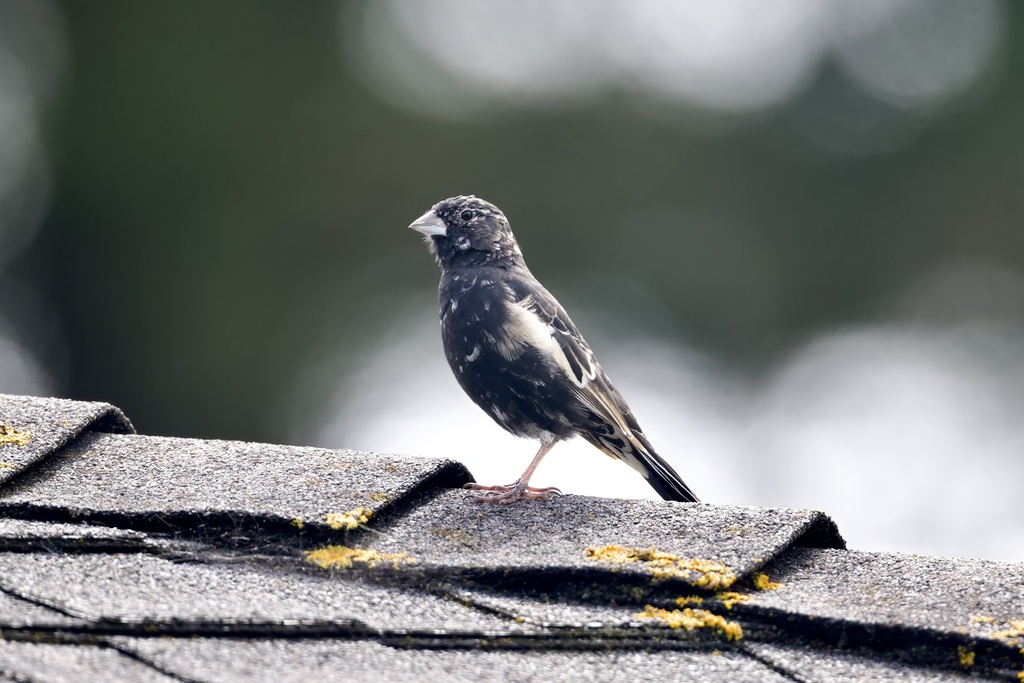
Chingolo Albinegro
Photo © Dario Taraborelli
Photo © Dario Taraborelli — CC0 1.0 — Source: iNaturalist photo #488606210The lark bunting (Calamospiza melanocorys) is a medium-sized American bunting native to central and western North America. It was designated the state bird of Colorado in 1931. == Taxonomy == The lark bunting is monotypic, the only member of the genus Calamospiza, and is not closely related to any other genera. It was first described by J. K. Townsend in 1837, from a specimen collected on a trip he took with Thomas Nuttall, under the name Fringilla bicolor. This is a preoccupied name, so Leonhard Hess Stejneger renamed the species in 1885 Calamospiza melanocorys. By then, the lark bunting had already been given its own genus, the one it is still placed in, by Charles Lucien Bonaparte in 1838. == Description == Lark buntings are small songbirds, with a short, thick, bluish bill. There is a large patch of white on the wings and they have a relatively short tail with white tips at the end of the feathers. Breeding males have an all black body with a large white patch on the upper part of the wing. Nonbreeding males and females look similar and are grayish brown with white stripes. Measurements: Length: 5.5–7.1 in (140–180 mm) Weight: 1.3–1.5 oz…
Big Bend National Park
Brewster County, Estados Unidos
+121 aves+29 mamíferos
Where the Rio Grande carves a serpentine boundary between Texas and Mexico, the Chisos Mountains rise abruptly from desert scrubland […]
VER PARQUE NACIONALCarlsbad Caverns National Park
Eddy County, Estados Unidos
+131 aves+27 mamíferos
Where limestone towers pierce the New Mexico desert, an underground realm rivals the grandeur of any above-ground landscape. Spanning 518 […]
VER PARQUE NACIONALSaguaro National Park – Tucson Mountain District
Pima County, Estados Unidos
+134 aves+26 mamíferos
Granite peaks rise abruptly from the Sonoran Desert floor, their bajadas cloaked in a forest of colossal saguaro cacti that […]
VER PARQUE NACIONALAún no hay fotos de la comunidad. Inicia sesión para añadir la primera.
Aún no hay observaciones de la comunidad de esta especie.