Gavilán griego
Photo © Марина
Photo © Марина — CC BY 4.0 — Source: iNaturalist #94010327Identification
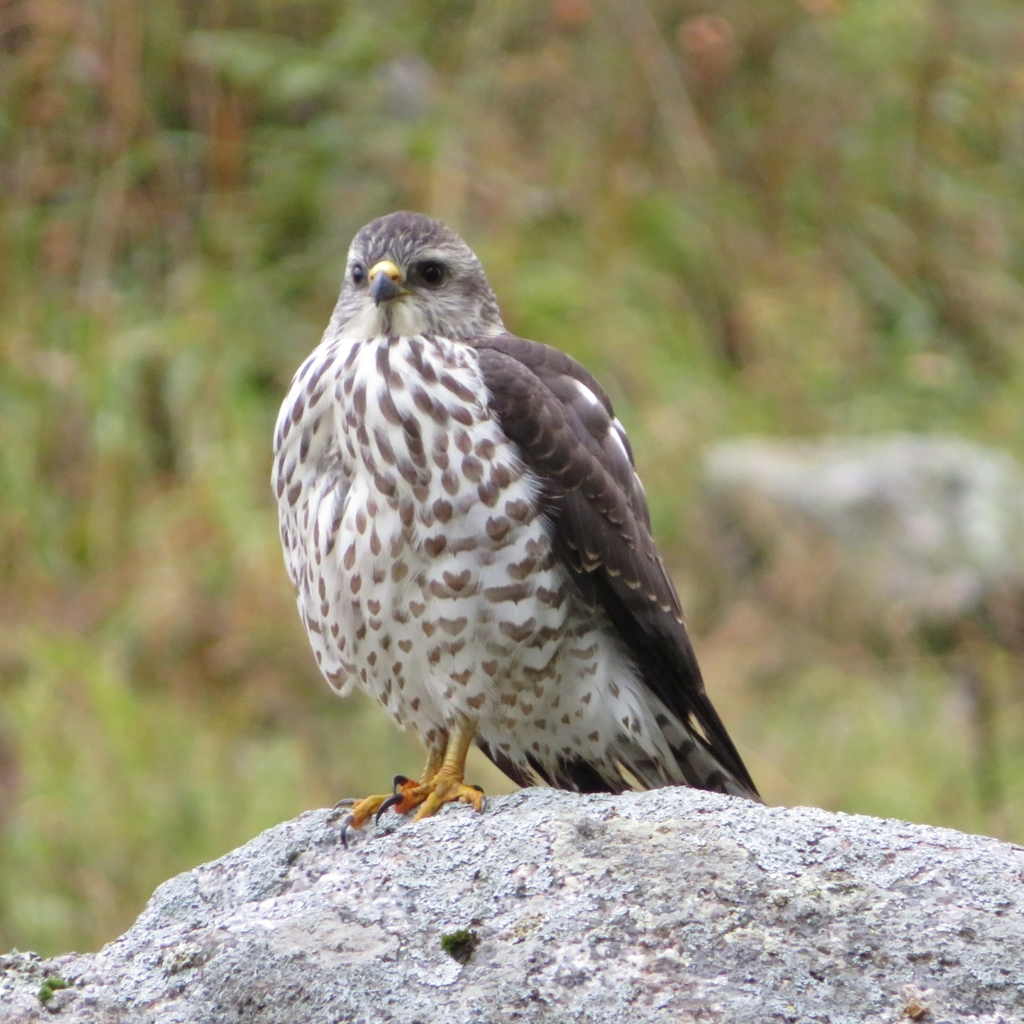
The Levant sparrowhawk is a small and agile raptor, measuring 32–38 cm in length with a wingspan of 65–75 cm. It is similar in appearance to the more widespread Eurasian sparrowhawk, but its shorter tail and more pointed wings give it a distinctly more falcon-like silhouette. The species has short, broad wings and a longish tail—both adaptations for manoeuvring through trees where it hunts.
Adult males are blue-grey above with dark wingtips and pale underparts finely barred in rufous and white, along with a blue-grey head marked by a white throat bisected by a dark central stripe. Females are slate-grey above with darker wingtips and reddish-brown barring below; they may also display a dark throat line. Both sexes have distinctive orangish-yellow legs and a yellow cere. Juveniles are dark brown above with dark-streaked underparts and a dark throat line. As with all birds of prey, females are noticeably larger than males, though the difference is less pronounced than in the Eurasian sparrowhawk.
Range & habitat
The Levant sparrowhawk breeds in forests from Greece and the Balkans east to southern Russia. It is a migratory species, wintering across a broad range from Egypt through to southwestern Iran. Unlike the more sedentary Eurasian sparrowhawk, this species migrates in large flocks, making it a conspicuous traveller during seasonal movements.
During the breeding season, it favours open woodland, forest edges, and isolated clumps of trees, typically near running water. When hunting, it frequents both woodland and semi-desert areas where it can surprise small prey from a concealed perch.
Behaviour & diet
The Levant sparrowhawk is a skilled hunter that preys on small birds, insects, rodents, and lizards, relying on surprise attacks as it darts from a perch to catch unsuspecting prey. During migration, the species typically uses soaring-and-gliding flight, making use of thermals when available, and occasionally hovers while hunting.
Breeding occurs from mid-May through August, with pairs performing high-circling aerial displays while territorial. The female constructs a new nest each year—a small structure of twigs lined with green leaves, typically located 5–10 m above the ground in a broad-leaved tree. She lays 2–5 eggs and incubates them alone for 30–35 days. Nestlings fledge after 40–45 days and become independent approximately 15 days later.
Best time & places to see it
The breeding season from mid-May through August offers the best opportunity to observe this species in its European range, particularly in Greece, the Balkans, and southern Russia. During this period, territorial displays and breeding activity make birds more conspicuous. Migration periods also present excellent viewing opportunities, as the species travels in large flocks—a behaviour that distinguishes it from its more solitary relative, the Eurasian sparrowhawk.
Winter visitors to Egypt and southwestern Iran may encounter this species during the winter months. Its secretive nature and relatively small population mean that sightings require patience and knowledge of preferred habitats, though its gregarious migration behaviour increases the chances of observation during seasonal movements.
Photography tips
Photographing the Levant sparrowhawk demands patience and familiarity with its behaviour. During breeding season, watch for high-circling aerial displays to anticipate photo opportunities. The bird's pointed wings and shorter tail make it distinctive in flight—capture these features in silhouette or against the sky to highlight its falcon-like profile.
The species' preference for perching before striking makes it possible to photograph from concealed positions near suitable hunting habitat in woodland and semi-desert areas. The orangish-yellow legs and cere provide useful identification features when visible in close-ups. During migration, watch for flocking behaviour, which offers opportunities for dynamic flight photography. Early morning or late afternoon light will best reveal the males' blue-grey plumage and the females' slate-grey tones.
Racha-Lechkhum-Kvemo Svaneti Planned National Park
Zeskho, Georgia
+91 aves+11 mamíferos
Where granite gorges cut through the southern Caucasus, pristine alpine meadows cascade downward into temperate beech forests of extraordinary primeval […]
VER PARQUE NACIONALTbilisi National Park
Tezami, Georgia
150+ aves
Where the Caucasus foothills descend toward Georgia’s capital, pristine river valleys and limestone cliffs create a remarkable patchwork of habitats […]
VER PARQUE NACIONALKolkheti National Park
Nigvziani, Georgia
+149 aves+6 mamíferos
Where the Caucasus descends to meet the Black Sea, a mosaic of wetlands, reed beds, and coastal lagoons creates one […]
VER PARQUE NACIONALZemo Svaneti Planned National Park
Hamashi-Totoleshi, Georgia
+107 aves+8 mamíferos
Where granite peaks pierce the clouds above the Caucasus, sweeping alpine meadows give way to pristine beech and spruce forests […]
VER PARQUE NACIONALTrialeti Planned National Park
Tbisi, Georgia
+130 aves+21 mamíferos
Where limestone plateaus rise above the Caucasian foothills, a mosaic of oak forests, alpine meadows, and beech woodlands creates one […]
VER PARQUE NACIONALJavakheti National Park
Bozali, Georgia
+148 aves+6 mamíferos
Dawn breaks over a high-altitude plateau where volcanic peaks pierce the Caucasian sky, their slopes cloaked in alpine meadows that […]
VER PARQUE NACIONALMachakhela Planned National Park
Skurdidi, Georgia
+138 aves+12 mamíferos
Where the Lesser Caucasus mountains plunge toward the lowlands of southern Georgia, a landscape of dramatic contrasts unfolds. Steep limestone […]
VER PARQUE NACIONALPirin National Park
Bansko, Bulgaria
+133 aves+21 mamíferos
Where jagged limestone peaks pierce the Macedonian sky, ancient glacial valleys cradle some of Bulgaria’s most pristine wilderness. This southwestern […]
VER PARQUE NACIONALOlympos National Park
Pieria Regional Unit, Grecia
+133 aves+17 mamíferos
Where the Thessalian plains meet the Mediterranean, granite peaks thrust skyward in defiant majesty, their slopes cloaked in a mosaic […]
VER PARQUE NACIONALKerkini Lake National Park
Serres, Grecia
+132 aves+25 mamíferos
Where the Strymon River winds through northeastern Greece, a sprawling freshwater lake mirrors the dramatic Belasitsa Mountains, creating one of […]
VER PARQUE NACIONALAún no hay fotos de la comunidad. Inicia sesión para añadir la primera.
Aún no hay observaciones de la comunidad de esta especie.