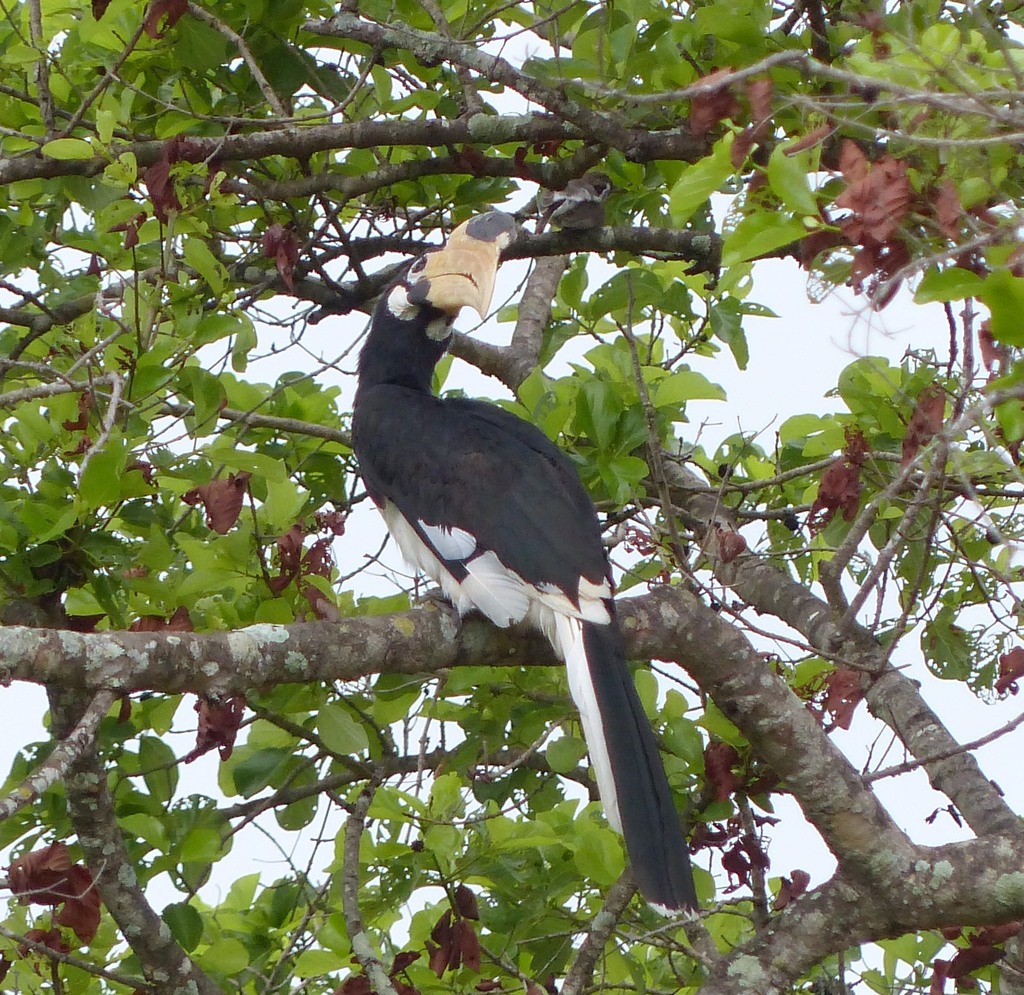
Cálao coronado
Photo © Pieter Prins
Photo © Pieter Prins — CC BY-SA 4.0 — Source: iNaturalist #35547484Identification
The Malabar pied hornbill is a large hornbill measuring 65 cm in length and weighing around 1 kg. Its most striking feature is its bold black and white plumage: predominantly black upperparts contrasting sharply with a white belly, throat patch, tail sides, and trailing wing edges. The bird's most distinctive feature is its prominent yellow bill topped with a large, mainly black casque. Sexual dimorphism is evident in the white orbital skin of females, which males lack entirely. Juveniles can be distinguished by the absence of a casque. With its striking coloration and substantial size, this species may be confused with the oriental pied hornbill, though careful observation of plumage patterns will distinguish between them.
Range & Habitat
The Malabar pied hornbill is a common resident breeder across India and Sri Lanka, distributed across three distinct geographical regions. In Central and Eastern India, it ranges from western West Bengal through Jharkhand, Chhattisgarh, Odisha, Madhya Pradesh, northern and eastern Maharashtra, northern Andhra Pradesh, and the northeastern tip of Telangana. Along the Western Ghats, populations are found in scattered pockets along the eastern slopes, in the Konkan belt, and along the west coast from western Maharashtra through Goa, western Karnataka, Tamil Nadu, and Kerala. In Sri Lanka, it occurs mainly in low country and dry zone forests as well as home gardens.
This species favors evergreen and moist deciduous forests, often settling near human settlements where suitable habitat exists. The bird's adaptability to forest edges and cultivated areas has made it relatively common throughout its range.
Behaviour & Diet
The Malabar pied hornbill exhibits the remarkable breeding behavior characteristic of hornbills. The female lays two or three white eggs in a tree hole, which the pair then seal with a cement-like substance made from mud, droppings, and fruit pulp. Only a single narrow aperture remains, just wide enough for the male to pass food to the incubating female and developing chicks. Once the chicks outgrow the confined space, the female breaks through the wall, which is then rebuilt, allowing both parents to feed the growing young.
This species is omnivorous, taking fruits, small mammals, birds, small reptiles, and insects, swallowing prey whole. Figs are particularly important, comprising 60% of their diet during the non-breeding season (May to February) and up to 75% of food delivered at nests during breeding season (March and April). The birds also consume fruits of Strychnos nux-vomica, which are toxic to many other vertebrates.
Best Time & Places to See It
The Malabar pied hornbill is a year-round resident throughout its range, making it observable in all seasons. The township of the Kaiga Atomic Power Station near Karwar in India is a particularly productive location, where the rich biodiversity of surrounding forests supports good populations. Dandeli, also in central India, is another reliable site for observing this species. Western Ghats locations in Kerala, Karnataka, and the Konkan region of western India offer excellent opportunities for sightings, particularly in forest patches and along forest edges near settlements.
Photography Tips
The Malabar pied hornbill's bold black and white plumage and prominent casque make it an attractive photographic subject. Early morning light enhances the contrast between dark and light plumage. Position yourself near fruiting fig trees during the non-breeding season (May to February), when the birds spend considerable time feeding. The bird's substantial size and relatively bold behavior near human settlements make approach possible, but patience is essential. Look for characteristic silhouettes perched prominently in canopy trees, and listen for calling birds to locate them in dense forest habitat. The striking facial features of females—with their white orbital skin—provide distinguishing details worth capturing separately from males.
Lunugamvehera National Park
Sri Lanka
+129 aves+30 mamíferos
Where scrubland meets open water beneath the dry zone sky, one of Sri Lanka’s most underrated wilderness sanctuaries reveals itself […]
VER PARQUE NACIONALMinneriya National Park
Sri Lanka
+123 aves+30 mamíferos
Dawn breaks over a sprawling tapestry of dry deciduous woodland and freshwater marshland where ancient granite outcrops punctuate the landscape […]
VER PARQUE NACIONALWasgamuwa National Park
Sri Lanka
+122 aves+30 mamíferos
Dawn breaks over a landscape where ancient riverine forests meet sprawling grasslands, carved through by the Mahaweli River’s serpentine passage […]
VER PARQUE NACIONALAngamedilla National Park
Polonnaruwa, Sri Lanka
+122 aves+30 mamíferos
Where granite outcrops rise dramatically from dry deciduous forest, Sri Lanka’s central highlands reveal one of the island’s most rugged […]
VER PARQUE NACIONALMaduru Oya National Park
Sri Lanka
+123 aves+30 mamíferos
Granite monoliths rise abruptly from dense dry lowland forest in Sri Lanka’s eastern interior, creating a mosaic of rocky outcrops, […]
VER PARQUE NACIONALKanha Tiger Reserve
Kanha Kisli F.V., India
+126 aves+29 mamíferos
Where sal forests give way to emerald meadows and crystalline streams carve through ancient valleys, one of India’s finest wilderness […]
VER PARQUE NACIONALBandhavgarh National Park
Garhpuri, India
+127 aves+26 mamíferos
Where granite ridges rise dramatically above sal and bamboo forests, one of India’s most pristine tiger reserves unfolds across the […]
VER PARQUE NACIONALAún no hay fotos de la comunidad. Inicia sesión para añadir la primera.
Aún no hay observaciones de la comunidad de esta especie.