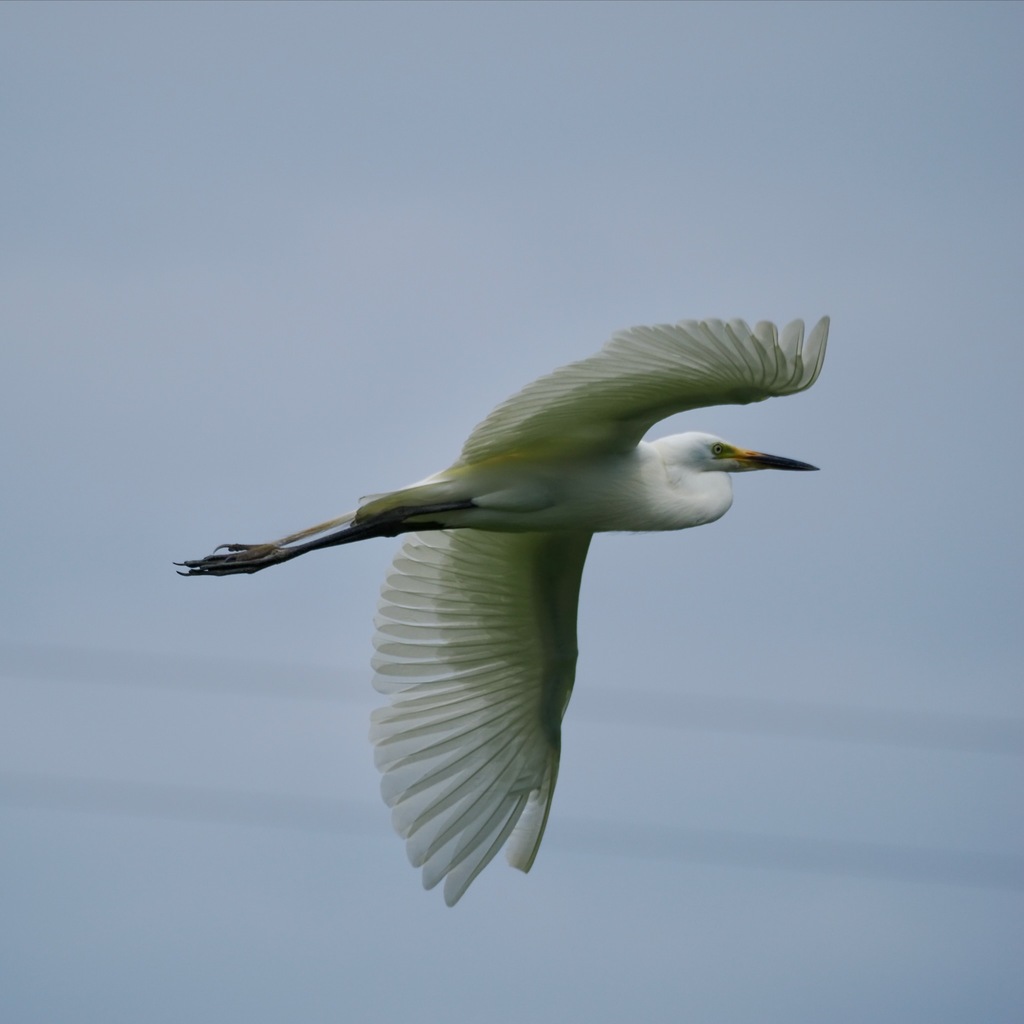
Garceta Intermedia
Photo © ITÔ, Hiroki
Photo © ITÔ, Hiroki — CC BY 4.0 — Source: iNaturalist #368525248Identification
The medium egret is a medium-sized heron with all-white plumage, standing 56–72 cm long with a wingspan of 105–115 cm and weighing around 400 g. As its name suggests, it is intermediate in size between the great egret and smaller white egrets such as the little egret and cattle egret, though it is closer in size to the little egret. The bird has generally dark legs and a thickish yellow bill in non-breeding plumage. During breeding season, birds develop distinctive features including a reddish or black bill, greenish-yellow gape skin, and loose filamentous plumes on the breast and back, with dull yellow or pink coloration on the upper legs—though these breeding characteristics vary regionally.
Distinguishing the medium egret from similar species requires careful observation. Unlike the great egret, which has a noticeable kink in its neck and a longer bill that aligns with a flat head, the medium egret has a neck length slightly less than its body length, a slightly domed head, and a shorter, thicker bill. The gape line of the medium egret ends below the eye, whereas the great egret's extends behind it. The medium egret's upright stalking posture with extended neck differs from the great egret's more patient, sideways-leaning stance. Little egrets, by contrast, have distinctive yellow-soled feet and black bills, and they are known for running after fish in shallow water.
Range & Habitat
The medium egret is a resident breeder across southern and eastern Asia. The Asian subspecies ranges from the Russian Far East and Japan in the north to India and the Greater Sundas in the south. Related forms occur in sub-Saharan Africa and in eastern Indonesia, New Guinea, and Australia, though these are now recognized as separate species following taxonomic revision in 2023.
This species favors shallow coastal and freshwater habitats, including flooded fields where it methodically stalks its prey. It often nests in colonies alongside other herons, typically constructing stick platforms in trees or shrubs.
Behaviour & Diet
The medium egret is a methodical hunter that stalks prey in shallow water. Its diet consists of fish, frogs, crustaceans, and insects. The species is colonial, nesting in groups with other herons on stick platforms in trees or shrubs. Clutch size typically ranges from 2 to 3 eggs, though up to 6 eggs may be laid. The eggs are pale green with a smooth, slightly pitted shell and are incubated by both parents for 24–27 days, hatching asynchronously.
Young are brooded by adults for 12 days after hatching and are defended vigorously from aerial predators, with parents crouching over nests, raising their plumes, and pointing their bills toward threats. Chicks develop pinfeathers as early as 4 days old and can leave the nest at 24 days, though they return to be fed. Fledging occurs around 40 days, with young leaving the colony after approximately 70 days. The species shows higher breeding success in wet years than dry years, with African and Australian populations achieving fledging success rates of 96% and 88% respectively.
Best Time & Places to See It
The medium egret is a year-round resident across its Asian range, from the Russian Far East and Japan southward through India and Indonesia. Prime viewing locations include coastal wetlands, freshwater marshes, and flooded agricultural fields throughout southern and eastern Asia. Colonial breeding sites offer particularly rewarding viewing opportunities during the breeding season, when birds display their striking breeding plumage and nest-building behavior.
Photography Tips
Photographing the medium egret requires patience and careful positioning, as the bird stalks methodically through shallow water. Early morning light will best showcase the bird's pure white plumage and the subtle details of its posture and bill shape. During breeding season, focus on capturing the distinctive loose filamentous plumes on the breast and back, along with the colored gape and leg coloration that vary by subspecies and individual. Use the bird's characteristic upright stalking posture and extended neck as identifying features in your images, and photograph from a low angle to emphasize these postural traits and separate the bird from background vegetation.
Lunugamvehera National Park
Sri Lanka
+129 aves+30 mamíferos
Where scrubland meets open water beneath the dry zone sky, one of Sri Lanka’s most underrated wilderness sanctuaries reveals itself […]
VER PARQUE NACIONALMinneriya National Park
Sri Lanka
+123 aves+30 mamíferos
Dawn breaks over a sprawling tapestry of dry deciduous woodland and freshwater marshland where ancient granite outcrops punctuate the landscape […]
VER PARQUE NACIONALWasgamuwa National Park
Sri Lanka
+122 aves+30 mamíferos
Dawn breaks over a landscape where ancient riverine forests meet sprawling grasslands, carved through by the Mahaweli River’s serpentine passage […]
VER PARQUE NACIONALAngamedilla National Park
Polonnaruwa, Sri Lanka
+122 aves+30 mamíferos
Where granite outcrops rise dramatically from dry deciduous forest, Sri Lanka’s central highlands reveal one of the island’s most rugged […]
VER PARQUE NACIONALMaduru Oya National Park
Sri Lanka
+123 aves+30 mamíferos
Granite monoliths rise abruptly from dense dry lowland forest in Sri Lanka’s eastern interior, creating a mosaic of rocky outcrops, […]
VER PARQUE NACIONALValmiki National Park
Ramnagar, India
+128 aves+30 mamíferos
Where the Himalayan foothills soften into the Ganges plains, dense sal forests rise above meandering rivers and grassland mosaics that […]
VER PARQUE NACIONALRanthambhore National Park
Sawai Madhopur, India
+126 aves+25 mamíferos
Where granite fortresses rise from the Aravalli Hills, a sprawling mosaic of dry deciduous forest, grassland, and ten interconnected lakes […]
VER PARQUE NACIONALMu Ko Ang Thong National Park
Tailandia
+105 aves+18 mamíferos
Limestone karsts pierce an emerald sea, their weathered peaks rising abruptly from turquoise waters where mangrove forests cling to tidal […]
VER PARQUE NACIONALHat Noppharat Thara-Mu Ko Phi Phi National Park
Ao Nang, Tailandia
+127 aves+21 mamíferos
Limestone cliffs plunge into emerald waters where mangrove forests crown the shoreline and coral gardens flourish beneath transparent shallows. This […]
VER PARQUE NACIONALKanha Tiger Reserve
Kanha Kisli F.V., India
+126 aves+29 mamíferos
Where sal forests give way to emerald meadows and crystalline streams carve through ancient valleys, one of India’s finest wilderness […]
VER PARQUE NACIONALBandhavgarh National Park
Garhpuri, India
+127 aves+26 mamíferos
Where granite ridges rise dramatically above sal and bamboo forests, one of India’s most pristine tiger reserves unfolds across the […]
VER PARQUE NACIONALKaziranga National Park
Kohora, India
+129 aves+30 mamíferos
Dawn breaks over the floodplains of the Brahmaputra, where tall grasslands stretch endlessly beneath monsoon-heavy skies. This sprawling wilderness of […]
VER PARQUE NACIONALKeoladeo National Park
Shreenagar Rural, India
+135 aves+19 mamíferos
Where shallow wetlands shimmer beneath vast Rajasthani skies, one of Asia’s finest bird sanctuaries pulses with extraordinary life. This former […]
VER PARQUE NACIONALPeriyar National Park
Mlappara, India
+131 aves+30 mamíferos
Dawn breaks over mist-shrouded ridges where the Western Ghats tumble toward Kerala’s spice-scented lowlands. Here, ancient tropical forests envelope a […]
VER PARQUE NACIONALNagarahole Tiger Reserve
Nalkeri Forest, India
+120 aves+30 mamíferos
Where granite escarpments rise above dense deciduous forests and the Kabini River carves through pristine wilderness, one of India’s most […]
VER PARQUE NACIONALBako National Park
Kuching, Malasia
+112 aves+18 mamíferos
Weathered sandstone cliffs rise dramatically from the South China Sea, their ochre faces sculpted by millennia of wind and tide […]
VER PARQUE NACIONALKuching Wetlands National Park
Kuching, Malasia
+135 aves+21 mamíferos
Where brackish waters meet mangrove stilts and freshwater swamps blend into coastal mudflats, one of Southeast Asia’s most dynamic wetland […]
VER PARQUE NACIONALPenang National Park
Balik Pulau, Malasia
+125 aves+30 mamíferos
Granite peaks rise abruptly from the Andaman Sea where tropical rainforest clings to steep slopes in one of Malaysia’s oldest […]
VER PARQUE NACIONALTaman Negara Bukit Lambir National Park
Miri, Malasia
+137 aves+15 mamíferos
Rainforest cascades down sandstone ridges where crystal streams carve through ancient geology, creating a landscape of profound biological richness in […]
VER PARQUE NACIONALGunung Mulu National Park
Long Seridan, Malasia
+128 aves+29 mamíferos
Where granite monoliths pierce the rainforest canopy of Sarawak, an ancient limestone karst landscape reveals one of Southeast Asia’s most […]
VER PARQUE NACIONALWest Bali National Park
Gerokgak, Indonesia
+142 aves+12 mamíferos
Where limestone cliffs plunge into crystalline waters and monsoon forests cling to volcanic slopes, Indonesia’s northwestern frontier reveals one of […]
VER PARQUE NACIONALWay Kambas National Park
Lampung Timur, Indonesia
+148 aves+28 mamíferos
Swamps and dipterocarp forests interweave across Sumatra’s southeastern lowlands, creating a mosaic of habitats that few conservation areas in Southeast […]
VER PARQUE NACIONALAún no hay fotos de la comunidad. Inicia sesión para añadir la primera.
Aún no hay observaciones de la comunidad de esta especie.