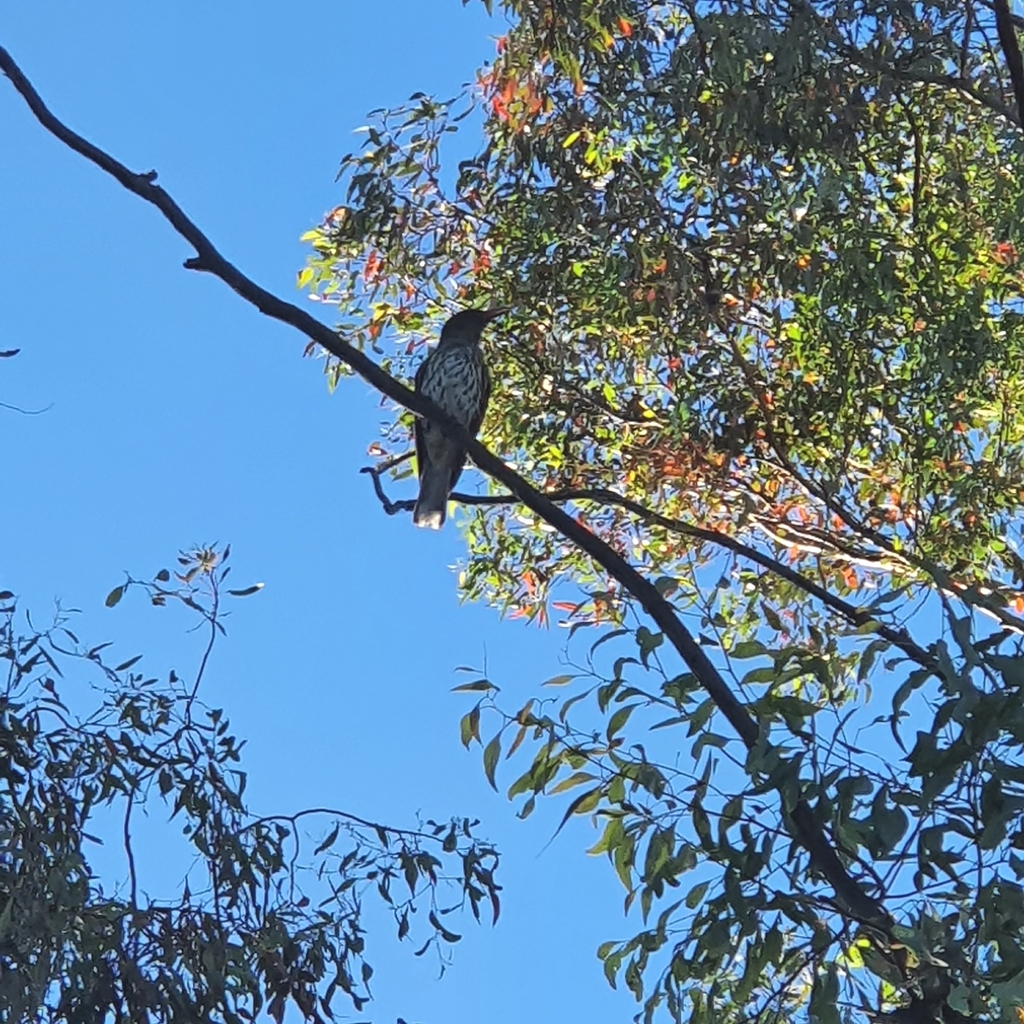
Oropéndola estriada
Photo © Claudia Schipp
Photo © Claudia Schipp — CC0 1.0 — Source: iNaturalist #68267921Identification
The olive-backed oriole is a medium-sized passerine with understated plumage that belies its conspicuous nature. Its most distinctive feature is its olive-coloured back with small dark streaks, contrasting with a light chest marked by black streaks. Both males and females share a striking reddish bill and reddish eyes that stand out against their muted upperparts. Females can be distinguished by cinnamon-edged wings, a subtle but useful field mark for keen observers.
Range & habitat
The olive-backed oriole is the most wide-ranging of the Australasian orioles, native to northern and eastern Australia and south-central New Guinea. Its distribution spans from the far north of Western Australia across the east and south coasts to Victoria and the corner of South Australia. Unlike the more specialized green oriole, which favours damp, thickly vegetated tropical habitats, the olive-backed oriole is remarkably versatile, preferring open woodland environments and tolerating drier climates—though it avoids true desert.
Population density varies geographically: the species is common to very common in the north, becoming less frequently encountered towards the south. Nevertheless, its adaptability and broad range make it one of Australia's most successful oriole species.
Behaviour & diet
The olive-backed oriole is notably noisy and conspicuous despite its sombre colouring, drawing attention through vocal activity rather than visual drama. Most birds breed during the tropical wet season, but some populations show migratory behaviour, moving south to breed during the southern summer. This flexibility in breeding strategy reflects the species' adaptability to varying climatic conditions across its vast range.
Best time & places to see it
The breeding season during the tropical wet season offers the best opportunity to encounter this vocal species, as increased activity makes detection easier. For southern populations that migrate to breed during summer, that season presents prime viewing opportunities. The species' preference for open woodland habitats makes it more accessible to observers than many other oriole species, though patience and listening skills will reward birdwatchers, as the birds are often located by ear before they are seen.
Photography tips
The olive-backed oriole's reddish eyes and bill provide excellent focal points for photography, and these features should be prioritized for sharp focus. The subtle streaking on the chest and back can be challenging to render well; shooting in soft, even light will better reveal these details than harsh midday sun. Listen for the bird's distinctive calls to locate individuals in open woodland, then position yourself with the light behind you to illuminate the head and eye detail. The cinnamon wing-edges on females offer a particularly photogenic detail worth capturing in profile shots.
Cania Gorge National Park
Australia
+76 aves+7 mamíferos
Where sandstone cliffs rise dramatically from eucalyptus woodland, rare geological formations create a hidden sanctuary in Queensland’s inland reaches. Cania […]
VER PARQUE NACIONALCarnarvon National Park
Philadelphia, Australia
+93 aves+21 mamíferos
Where granite gorges slice through Queensland’s semi-arid interior, ancient sandstone walls tower above crystalline waterhole oases in an landscape that […]
VER PARQUE NACIONALMount Coolum National Park
Sunshine Coast, Australia
+75 aves+5 mamíferos
Steep volcanic ridges rise abruptly from Queensland’s coastal plain, their weathered slopes cloaked in open eucalyptus woodland and heathland that […]
VER PARQUE NACIONALWickham National Park
Brisbane, Australia
+123 aves+30 mamíferos
Rugged sandstone plateaus rise dramatically across this compact yet ecologically rich corner of Western Australia’s Kimberley region, where ancient weathered […]
VER PARQUE NACIONALBunya Mountains National Park
Australia
+77 aves+20 mamíferos
Where subtropical rainforest canopies rise above weathered volcanic peaks, Queensland’s Bunya Mountains hold some of Australia’s most ancient and biodiverse […]
VER PARQUE NACIONALKakadu National Park
Kakadu, Australia
+130 aves+20 mamíferos
Kakadu National Park is Australia’s largest national park and one of the world’s most remarkable protected areas, covering nearly 20,000 […]
VER PARQUE NACIONALGreater Bendigo National Park
Bendigo, Australia
+135 aves+16 mamíferos
Where granite tors pierce the undulating woodlands of central Victoria, a landscape of surprising ecological complexity unfolds across nearly 1,100 […]
VER PARQUE NACIONALChiltern-Mt Pilot National Park
Australia
+135 aves+17 mamíferos
Where granite peaks rise sharply above undulating eucalypt woodlands, the landscape reveals a mosaic of ecological treasures spanning nearly 870 […]
VER PARQUE NACIONALKinglake National Park
Australia
+106 aves+22 mamíferos
Where eucalyptus-clad ridges rise above fern-filled gullies, the landscape unfolds in a patchwork of wet forest, dry sclerophyll woodland, and […]
VER PARQUE NACIONALSpringbrook National Park
Australia
+131 aves+30 mamíferos
Where subtropical rainforest cascades down steep volcanic escarpments and mist clings to ancient tree ferns, one of Australia’s most biodiverse […]
VER PARQUE NACIONALLamington National Park
Australia
+122 aves+30 mamíferos
Where subtropical rainforest cloaks volcanic plateaus in Queensland’s Gold Coast hinterland, one of Australia’s oldest national parks unfolds across 541 […]
VER PARQUE NACIONALSydney Harbour National Park
Sydney, Australia
+131 aves+21 mamíferos
Crystalline waters lap against weathered sandstone headlands where native bushland clings to steep escarpments overlooking one of the world’s most […]
VER PARQUE NACIONALRoyal National Park
Sydney, Australia
+133 aves+24 mamíferos
Sandstone cliffs plunge toward the Tasman Sea along New South Wales’ southern coast, where Royal National Park unfolds across 343 […]
VER PARQUE NACIONALLockyer National Park
Australia
+127 aves+30 mamíferos
Where volcanic ridges meet subtropical woodland, a mosaic of eucalypt forest and grassy woodland unfolds across southeastern Queensland’s hidden gem. […]
VER PARQUE NACIONALSundown National Park
Australia
+88 aves+11 mamíferos
Where the Queensland borderlands rise into sandstone plateaux and eucalyptus woodland, rugged gorges slice through 305 square kilometres of some […]
VER PARQUE NACIONALAnnan River (Yuku Baja-Muliku) National Park
Australia
+63 aves+2 mamíferos
Granite peaks rise dramatically from tropical lowlands where the Annan River carves through pristine wilderness in Far North Queensland. This […]
VER PARQUE NACIONALRinyirru National Park
Lakefield, Australia
+141 aves+6 mamíferos
Where granite outcrops pierce windswept savanna and seasonal floodplains stretch toward the horizon, Australia’s northeastern extremity harbors one of the […]
VER PARQUE NACIONALBald Rock National Park
Australia
+123 aves+26 mamíferos
Where granite peaks thrust skyward across the New England Tablelands, weathered stone and eucalypt woodland meet in a landscape of […]
VER PARQUE NACIONALGirraween National Park
Australia
+121 aves+22 mamíferos
Where granite boulders the size of cathedrals rise from eucalypt woodland, Queensland’s Southern Downs reveal one of Australia’s most geologically […]
VER PARQUE NACIONALMorton National Park
Australia
+125 aves+27 mamíferos
Where sandstone cliffs plunge into temperate rainforest and eucalypt woodlands blanket the New South Wales highlands, Morton National Park sprawls […]
VER PARQUE NACIONALHeathcote National Park
Sydney, Australia
+131 aves+26 mamíferos
Where sandstone ridges rise above eucalyptus woodlands and crystalline creeks carve through ancient valleys, one of Victoria’s most underrated wilderness […]
VER PARQUE NACIONALLake Eildon National Park
Australia
+76 aves+17 mamíferos
Where granite peaks rise above the sprawling waters of a vast reservoir, Victoria’s 869-square-kilometre wilderness unfolds in dramatic contrasts. The […]
VER PARQUE NACIONALGlass House Mountains National Park
Australia
+129 aves+30 mamíferos
Volcanic peaks thrust skyward across the Queensland hinterland, their steep-sided summits sculpted from ancient lava flows and weathered by millions […]
VER PARQUE NACIONALAún no hay fotos de la comunidad. Inicia sesión para añadir la primera.
Aún no hay observaciones de la comunidad de esta especie.