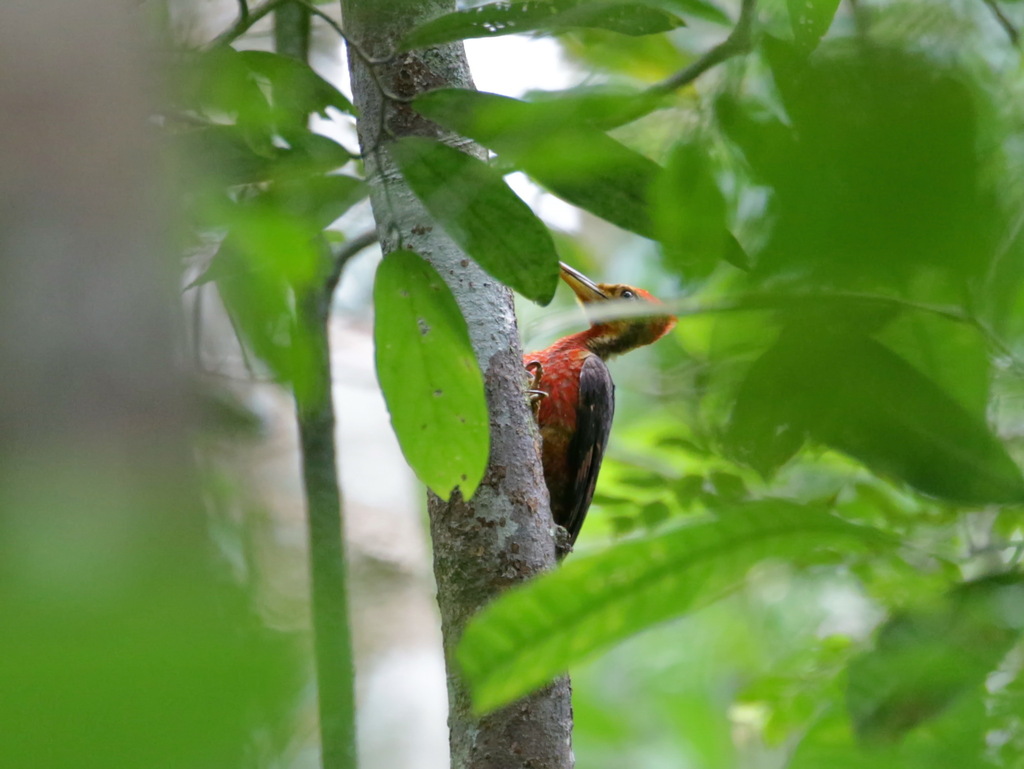
Pito Dorsinaranja
Photo © Ian Dugdale
Photo © Ian Dugdale — CC BY 4.0 — Source: iNaturalist #303659495The orange-backed woodpecker (Chrysocolaptes validus) is a bird in the woodpecker family Picidae, found in southern Thailand, Malaya, Sarawak and Sabah in Malaysia, Brunei, Sumatra, and Java. It is a forest specialist that is found primarily in the canopy. == Taxonomy == The orange-backed woodpecker was described and illustrated in 1825 by Dutch zoologist Coenraad Jacob Temminck in his Nouveau recueil de planches coloriées d'oiseaux from specimens that had been collected on the Indonesian island of Java. He coined the binomial name Pic validus. This species was previously placed in its own genus Reinwardtipicus. It is now one of ten species placed in the genus Chrysocolaptes that was introduced in 1843 by the English zoologist Edward Blyth. Two subspecies are recognised: C. v. xanthopygius (Finsch, 1905) – the Malay Peninsula, Sumatra, and Borneo C. v. validus (Temminck, 1825) – Java == Gallery ==
Taman Negara National Park
Kampong Samas, Malasia
150+ aves+17 mamíferos
Where ancient rainforest meets limestone peaks, one of Southeast Asia’s oldest protected wilderness preserves sprawls across 4,343 square kilometers of […]
VER PARQUE NACIONALTaman Negara Bukit Lambir National Park
Miri, Malasia
+137 aves+15 mamíferos
Rainforest cascades down sandstone ridges where crystal streams carve through ancient geology, creating a landscape of profound biological richness in […]
VER PARQUE NACIONALGunung Mulu National Park
Long Seridan, Malasia
+128 aves+29 mamíferos
Where granite monoliths pierce the rainforest canopy of Sarawak, an ancient limestone karst landscape reveals one of Southeast Asia’s most […]
VER PARQUE NACIONALWay Kambas National Park
Lampung Timur, Indonesia
+148 aves+28 mamíferos
Across the low swamplands of eastern Lampung, where freshwater wetlands merge into tidal mangrove forests along the Sunda Strait, sprawls […]
VER PARQUE NACIONALAún no hay fotos de la comunidad. Inicia sesión para añadir la primera.
Aún no hay observaciones de la comunidad de esta especie.