Golondrina del Pacífico
Photo © Roger Rittmaster
Photo © Roger Rittmaster — CC BY 4.0 — Source: iNaturalist #37276208Identification
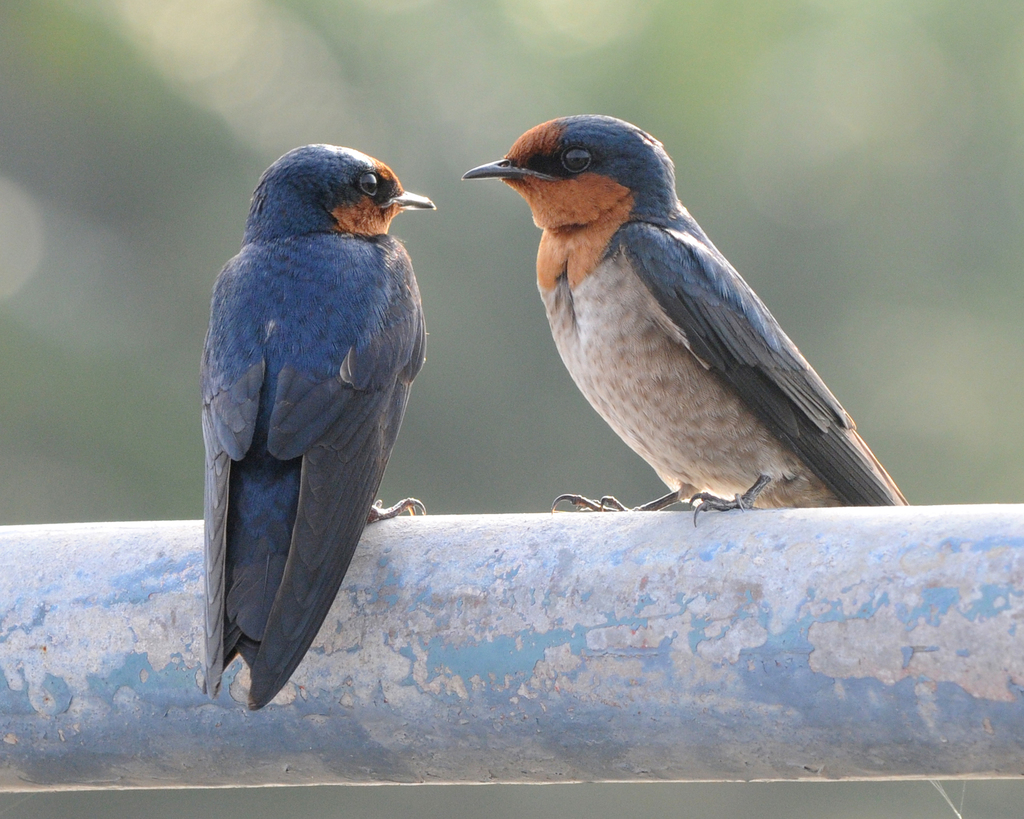
The Pacific swallow is a small passerine measuring just 13 cm in length, making it a compact member of the swallow family. It is easily distinguished by its striking plumage: a blue-black back and crown contrast sharply with browner wings and tail, while its most distinctive feature is a bright red face and throat set against dusky underparts. Compared to the similar barn swallow and welcome swallow, the Pacific swallow can be reliably identified by its notably shorter and less forked tail, a useful distinction when observing birds in flight or at rest.
Range & Habitat
The Pacific swallow breeds throughout tropical southern Asia and across the islands of the south Pacific, with its range extending from south Myanmar and the Andaman Islands eastward through Vietnam, the Philippines, and Indonesia's Moluccas and Sunda Islands, and southeastward to New Guinea, the Bismarck Archipelago, Solomon Islands, Vanuatu, Fiji, and Tonga. The species is resident throughout most of its range, though some local seasonal movements occur. Traditionally associated with coastal regions, the Pacific swallow has shown a remarkable tendency in recent years to expand its range into forested upland areas, allowing travellers to encounter this species in increasingly diverse environments.
Behaviour & Diet
The Pacific swallow is a skilled aerial insectivore, spending much of its day on the wing hunting insects—particularly flies—in swift, agile flight. It shares behavioural similarities with other aerial hunters such as swifts, though it is unrelated to them. During breeding season, pairs construct distinctive cup-shaped nests made from mud pellets carefully collected in the beak. These nests are typically positioned under cliff ledges or, increasingly, on man-made structures including buildings, bridges, and tunnels, demonstrating the species' adaptability to human landscapes. The nest interior is lined with softer materials, and pairs raise clutches of two to three eggs.
Best Time & Places to See It
The Pacific swallow's year-round residence throughout its range makes it accessible to travellers at any season, though local movements may influence availability in specific areas. Coastal regions remain prime viewing locations, particularly near suitable nesting sites on cliffs and buildings. However, the species' expanding range into forested uplands means birders and wildlife enthusiasts should also scan higher-elevation habitats. The extensive geographic range—spanning from Southeast Asia across the Indonesian archipelago to the Pacific island nations—offers numerous opportunities to encounter this species across multiple destinations.
Photography Tips
Photographing the Pacific swallow presents both challenges and rewards. The bird's small size and rapid, acrobatic flight demand a fast shutter speed and tracking ability. Look for perched birds near nesting sites on buildings, bridges, or cliff faces, where you can capture the striking red face and throat colouration against the blue-black crown. The contrast between darker upperparts and dusky underparts is best rendered in clear, natural light. Early morning often provides optimal lighting and increased activity around nest sites, offering the best opportunities for both flight shots and detailed portraits of this elegant swallow.
Mu Ko Ang Thong National Park
Tailandia
+105 aves+18 mamíferos
Limestone karsts pierce an emerald sea, their weathered peaks rising abruptly from turquoise waters where mangrove forests cling to tidal […]
VER PARQUE NACIONALHat Noppharat Thara-Mu Ko Phi Phi National Park
Ao Nang, Tailandia
+127 aves+21 mamíferos
Limestone cliffs plunge into emerald waters where mangrove forests crown the shoreline and coral gardens flourish beneath transparent shallows. This […]
VER PARQUE NACIONALMu Ko Similan National Park
Tailandia
+30 aves+5 mamíferos
Where granite monoliths thrust from turquoise waters, an archipelago of nine pristine islands creates one of Southeast Asia’s most dramatic […]
VER PARQUE NACIONALBako National Park
Kuching, Malasia
+112 aves+18 mamíferos
Weathered sandstone cliffs rise dramatically from the South China Sea, their ochre faces sculpted by millennia of wind and tide […]
VER PARQUE NACIONALKuching Wetlands National Park
Kuching, Malasia
+135 aves+21 mamíferos
Where brackish waters meet mangrove stilts and freshwater swamps blend into coastal mudflats, one of Southeast Asia’s most dynamic wetland […]
VER PARQUE NACIONALTaman Negara National Park
Kampong Samas, Malasia
150+ aves+17 mamíferos
Where ancient rainforest meets limestone peaks, one of Southeast Asia’s oldest protected wilderness preserves sprawls across 4,343 square kilometers of […]
VER PARQUE NACIONALPenang National Park
Balik Pulau, Malasia
+125 aves+30 mamíferos
Granite peaks rise abruptly from the Andaman Sea where tropical rainforest clings to steep slopes in one of Malaysia’s oldest […]
VER PARQUE NACIONALTaman Negara Bukit Lambir National Park
Miri, Malasia
+137 aves+15 mamíferos
Rainforest cascades down sandstone ridges where crystal streams carve through ancient geology, creating a landscape of profound biological richness in […]
VER PARQUE NACIONALGunung Mulu National Park
Long Seridan, Malasia
+128 aves+29 mamíferos
Where granite monoliths pierce the rainforest canopy of Sarawak, an ancient limestone karst landscape reveals one of Southeast Asia’s most […]
VER PARQUE NACIONALTaman Nasional Baluran
Situbondo, Indonesia
+86 aves+13 mamíferos
Where savanna grasslands sweep toward volcanic slopes and mangrove-lined coastlines converge, East Java’s most biodiverse protected landscape unfolds across nearly […]
VER PARQUE NACIONALTaman Nasional Meru Betiri
Jember, Indonesia
+60 aves+4 mamíferos
Where rainforest plunges into volcanic slopes and pristine beaches curve along Java’s southeastern edge, one of Indonesia’s most biodiverse sanctuaries […]
VER PARQUE NACIONALWest Bali National Park
Gerokgak, Indonesia
+142 aves+12 mamíferos
Where limestone cliffs plunge into crystalline waters and monsoon forests cling to volcanic slopes, Indonesia’s northwestern frontier reveals one of […]
VER PARQUE NACIONALAketajawe Lolobata National Park
Halmahera Timur, Indonesia
+109 aves+7 mamíferos
Where rugged volcanic plateaus rise above the Halmahera seascape, one of Indonesia’s most biodiverse reserves sprawls across nearly 14,000 square […]
VER PARQUE NACIONALManusela National Park
Maluku Tengah, Indonesia
+81 aves+6 mamíferos
Where granite peaks pierce the equatorial haze above Seram Island, a vast wilderness of primary rainforest unfolds across 4,175 square […]
VER PARQUE NACIONALBogani Nani Wartabone National Park
Bolaang Mongondow, Indonesia
+96 aves+6 mamíferos
Where limestone peaks rise abruptly from dense rainforest and crystalline rivers carve through pristine valleys, one of Sulawesi’s most biodiverse […]
VER PARQUE NACIONALGunung Ciremai National Park
Majalengka, Indonesia
+115 aves+10 mamíferos
Where volcanic slopes rise dramatically from the Javanese lowlands, a 382-square-kilometre sanctuary of montane forest clings to the dormant peak […]
VER PARQUE NACIONALGunung Merbabu National Park
Magelang, Indonesia
+104 aves+1 mamíferos
Where volcanic slopes rise sharply from Java’s central plateau, a 197-square-kilometre sanctuary of montane forest unfolds in perpetual mist. Gunung […]
VER PARQUE NACIONALMount Merapi National Park
Hargobinangun, Indonesia
+93 aves+3 mamíferos
Where volcanic slopes rise through bands of montane forest and alpine meadow, one of Indonesia’s most dynamic ecosystems reveals itself […]
VER PARQUE NACIONALLore Lindu National Park
Indonesia
+101 aves
Where limestone karst formations pierce a landscape of pristine rainforest, Central Sulawesi’s 4,856-square-kilometre conservation heartland rises from sea level to […]
VER PARQUE NACIONALBatang Gadis National Park
Mandailing Natal, Indonesia
+36 aves
Where granite gorges slice through emerald rainforest and white-water rivers thunder across moss-draped boulders, one of Sumatra’s most pristine wilderness […]
VER PARQUE NACIONALKerinci Seblat National Park
Kerinci, Indonesia
+60 aves+30 mamíferos
Where rainforest canopies surge across volcanic highlands and misty valleys plunge between soaring peaks, one of Southeast Asia’s most biodiverse […]
VER PARQUE NACIONALSembilang National Park
Banyuasin, Indonesia
+48 aves+3 mamíferos
Mangrove forests stretch endlessly across South Sumatra’s coastal lowlands, their gnarled root systems anchoring a labyrinth of tidal channels and […]
VER PARQUE NACIONALBerbak National Park
Tanjung Jabung Timur, Indonesia
+65 aves+1 mamíferos
Vast peatland swamps sprawl across Sumatra’s eastern coast, where waterlogged forests rise from tea-coloured waters and sago palms tower above […]
VER PARQUE NACIONALGunung Palung National Park
Kayong Utara, Indonesia
+42 aves+2 mamíferos
Where rainforest sprawls across West Kalimantan’s interior, an extraordinary wilderness unfolds across nearly 2,300 square kilometers of pristine habitat. Dramatic […]
VER PARQUE NACIONALWay Kambas National Park
Lampung Timur, Indonesia
+148 aves+28 mamíferos
Swamps and dipterocarp forests interweave across Sumatra’s southeastern lowlands, creating a mosaic of habitats that few conservation areas in Southeast […]
VER PARQUE NACIONALKomodo National Park
Komodo, Indonesia
+69 aves+14 mamíferos
Where volcanic peaks rise dramatically from turquoise waters, a primordial landscape unfolds across three main islands and countless smaller ones […]
VER PARQUE NACIONALAún no hay fotos de la comunidad. Inicia sesión para añadir la primera.
Aún no hay observaciones de la comunidad de esta especie.