Ganga India
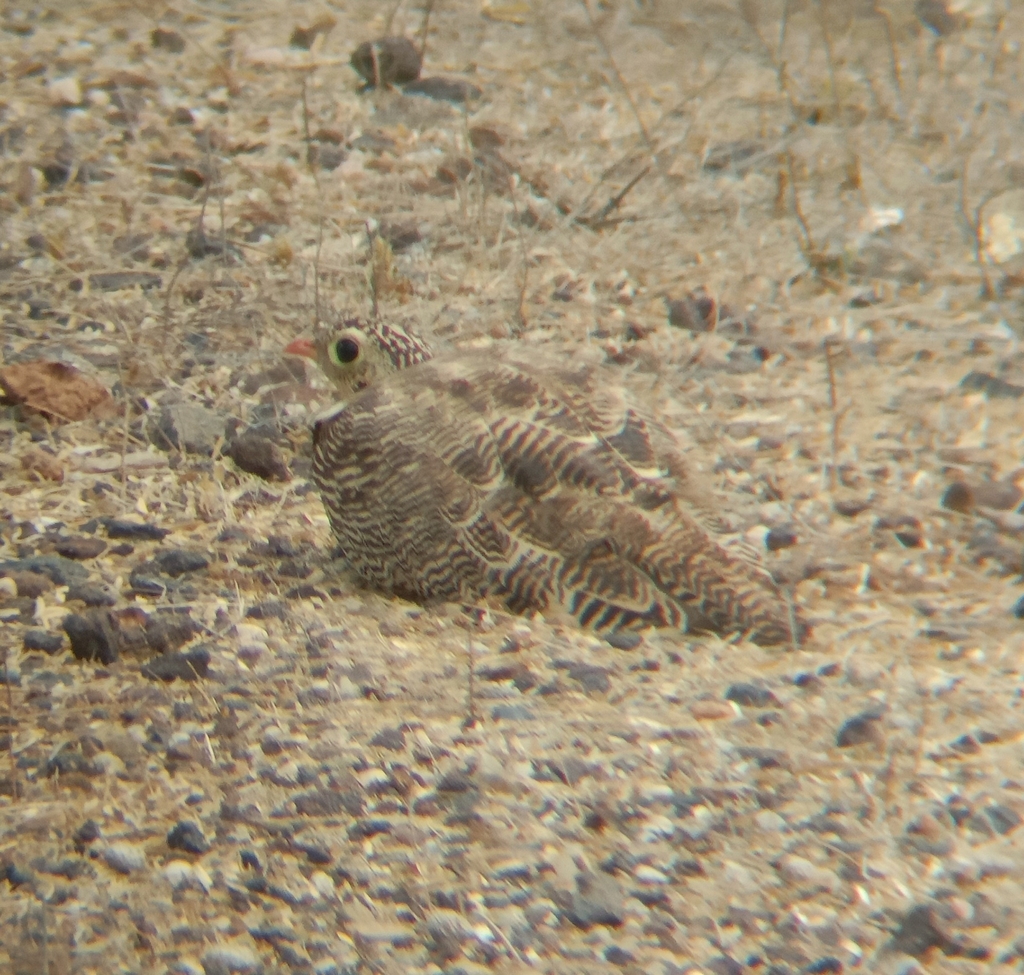
Photo © Malaika Mathew Chawla
Photo © Malaika Mathew Chawla — CC BY 4.0 — Source: iNaturalist #162248922Identification
The painted sandgrouse is a plump, ground-dwelling bird with a distinctive appearance that differs notably between sexes. Males are particularly striking, featuring an orange bill, a bold black bar across the white forehead, and fine black longitudinal lines on the nape. A white patch of bare skin surrounds the eye, and a broad black and white band encircles the chest. The breast and belly are uniform pinkish-brown, while the back, wings, and tail display brown plumage boldly marked with black and white transverse bars. Females are considerably duller, appearing greyish-brown overall with barring and speckling in darker brown and white tones. The species has the characteristic sandgrouse body plan: small head, short legs, and a compact, robust form.
Range & Habitat
The painted sandgrouse is found across India and Pakistan, inhabiting dry regions with rough grassland, rocky areas, and scrub. This is a bird adapted to arid environments where water is scarce and vegetation sparse. The species' preference for dry, open terrain makes it well-suited to the semi-arid landscapes of the Indian subcontinent.
Behaviour & Diet
The painted sandgrouse is primarily a seed-eater, foraging for seeds in its dry habitat. The species is highly gregarious, forming groups that exhibit distinctive congregating behaviour, particularly at waterholes. These gatherings at water sources are a key behavioural feature, as water is essential in the arid environments where the bird lives. This tendency to gather predictably at waterholes makes the species' daily routines relatively predictable for observers.
Best Time & Places to See It
Locating painted sandgrouse requires access to suitable dry, open habitats within India and Pakistan. The most reliable opportunities to observe this species come during visits to waterholes, particularly during dawn and dusk when birds congregate to drink. Visiting arid regions with rough grassland, rocky scrub, and accessible water sources will offer the best chances of encounter. The gregarious nature of the species means that when found, multiple individuals are often present.
Photography Tips
Waterhole sites present excellent opportunities for photography, as predictable gathering behaviour allows for patient positioning and preparation. The males' striking plumage—particularly the contrasting black and white markings on the head and chest, combined with pinkish-brown underparts—provides compelling photographic subjects. Capture the bold patterns and rich coloration of males to best showcase this species' beauty. Early morning or late afternoon light will enhance the colours and details of the plumage. Position yourself carefully to avoid disturbing the birds while they drink, as they can be wary; a hide or patient, distant approach will yield better results than direct approach.
Ranthambhore National Park
Sawai Madhopur, India
+126 aves+25 mamíferos
Where granite fortresses rise from the Aravalli Hills, a sprawling mosaic of dry deciduous forest, grassland, and ten interconnected lakes […]
VER PARQUE NACIONALPanna National Park
Badgadi Kalan, India
+136 aves+27 mamíferos
Where granite gorges slice through central India’s Vindhyan plateau, a landscape of stark beauty unfolds across nearly six hundred square […]
VER PARQUE NACIONALGir National Park
Asundrali, India
150+ aves+12 mamíferos
Dry deciduous forests cloak the rolling hills of western Gujarat where the Gir landscape rises as a final sanctuary for […]
VER PARQUE NACIONALAún no hay fotos de la comunidad. Inicia sesión para añadir la primera.
Aún no hay observaciones de la comunidad de esta especie.