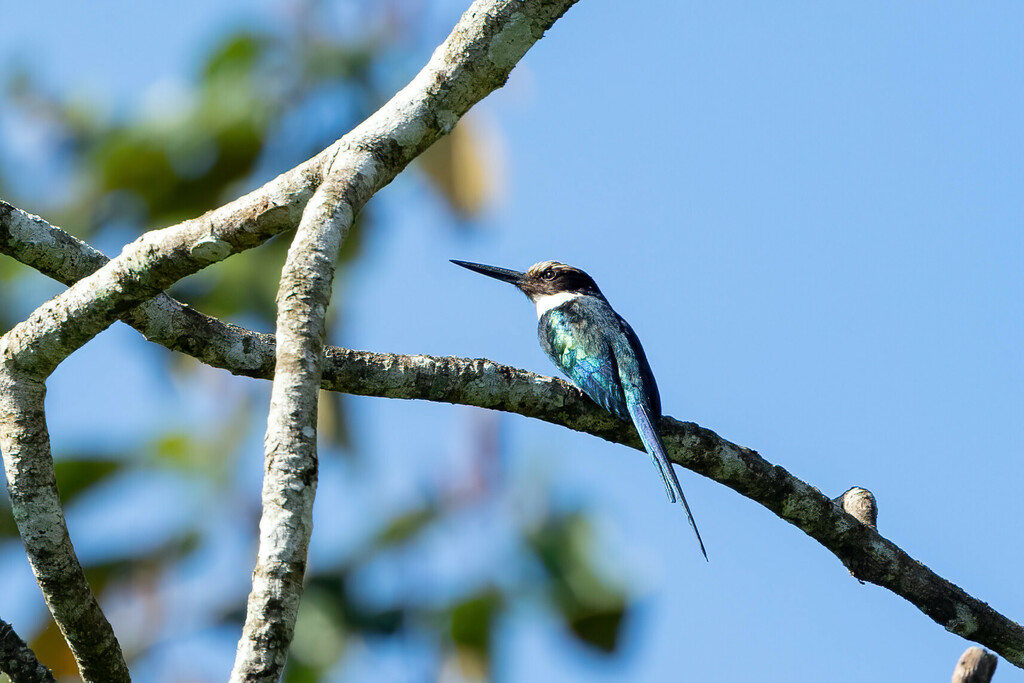
Jacamará colilargo
Photo © Thibaud Aronson
Photo © Thibaud Aronson — CC BY-SA 4.0 — Source: iNaturalist photo #214122472Identification
The paradise jacamar is a striking small bird, measuring 25.5 to 34 cm long and weighing just 25 to 32.5 grams. The nominate subspecies displays a distinctive plumage pattern: a dark brown crown contrasts with glossy black upper parts, while the throat and upper breast are clean white, with the remaining underparts blackish. Other subspecies show subtle variations—some feature a lighter crown and more extensive white throat, while one subspecies displays a bronzy greenish sheen across the upper parts. This species belongs to the jacamar family, birds specialized for catching flying insects with precision.
Range & Habitat
The paradise jacamar inhabits much of the Amazon Basin, with four recognized subspecies distributed across Venezuela, the Guianas, Brazil, Bolivia, Colombia, Ecuador, and Peru. The bird favors terra firme, várzea, and savanna forests—both primary and secondary growth—as well as dry forest and gallery forest. Unusually for jacamars, it is primarily a canopy dweller rather than occupying the mid-story level, preferring edges and open areas such as clearings and treefalls over dense forest interior. Most records come from below 500 meters elevation, though it occasionally reaches up to 1,100 meters in suitable habitat.
Behaviour & Diet
The paradise jacamar is an aerial insectivore, primarily hunting butterflies and moths, dragonflies, flies, and wasps. Like other jacamars, it hunts by perching on exposed branches—either alone, in pairs, or in small groups—and sallying out to snatch prey from the air with characteristic precision. It sometimes participates in mixed-species foraging flocks moving through the canopy, increasing foraging efficiency. The species vocalizes with a distinctive descending series of "peep" notes that accelerate and weaken toward the end, along with shorter calls described as "pip," "peeap," or "glewweh."
Best Time & Places to See It
The paradise jacamar varies from rare to common throughout its Amazonian range and has been recorded in numerous protected areas across the region. Travelers should look for the species in canopy-level habitat, particularly along forest edges, in clearings, and around treefalls where it hunts most actively. Its preference for open perches and exposed branches makes it more detectable than many forest birds, though patience and good binoculars are essential for spotting this small species against a leafy background.
Photography Tips
Photographers should focus on capturing the species in its preferred canopy habitat, where early morning light best reveals the glossy black plumage and the striking white throat and breast contrast. The bird's habit of perching openly on exposed branches provides excellent photographic opportunities, though the canopy height can be challenging. Look for hunting perches along forest edges and clearings, and watch for the characteristic sallying behavior when the bird launches after flying insects. The species' small size demands telephoto lenses and patience, but the elegant posture and bold plumage patterns reward careful observation.
Amazônia National Park
Brasil
+74 aves+8 mamíferos
Dawn breaks over a realm where the Rio Tapajós cuts through the heart of the Brazilian Amazon, its dark waters […]
VER PARQUE NACIONALMapinguari National Park
Brasil
+120 aves+30 mamíferos
Where the Amazon’s southwestern frontier meets the Xingu Basin, vast tracts of pristine tropical forest rise and fall across nearly […]
VER PARQUE NACIONALAnavilhanas National Park
Brasil
+132 aves+30 mamíferos
Where the Rio Negro braids into a labyrinth of islands and waterways, one of the Amazon’s most pristine archipelagos unfolds […]
VER PARQUE NACIONALCampos Amazónicos National Park
Amazonas, Brasil
+88 aves+21 mamíferos
Where open grasslands merge unexpectedly with dense Amazon rainforest, an ecological mosaic of rare brilliance unfolds across this 27,263-square-kilometre sanctuary […]
VER PARQUE NACIONALSerra do Divisor National Park
Brasil
+132 aves+30 mamíferos
Where the Ucayali River carves its ancient path through northwestern Brazil, rainforest canopy rises in unbroken waves across nearly 27,000 […]
VER PARQUE NACIONALAún no hay fotos de la comunidad. Inicia sesión para añadir la primera.
Aún no hay observaciones de la comunidad de esta especie.