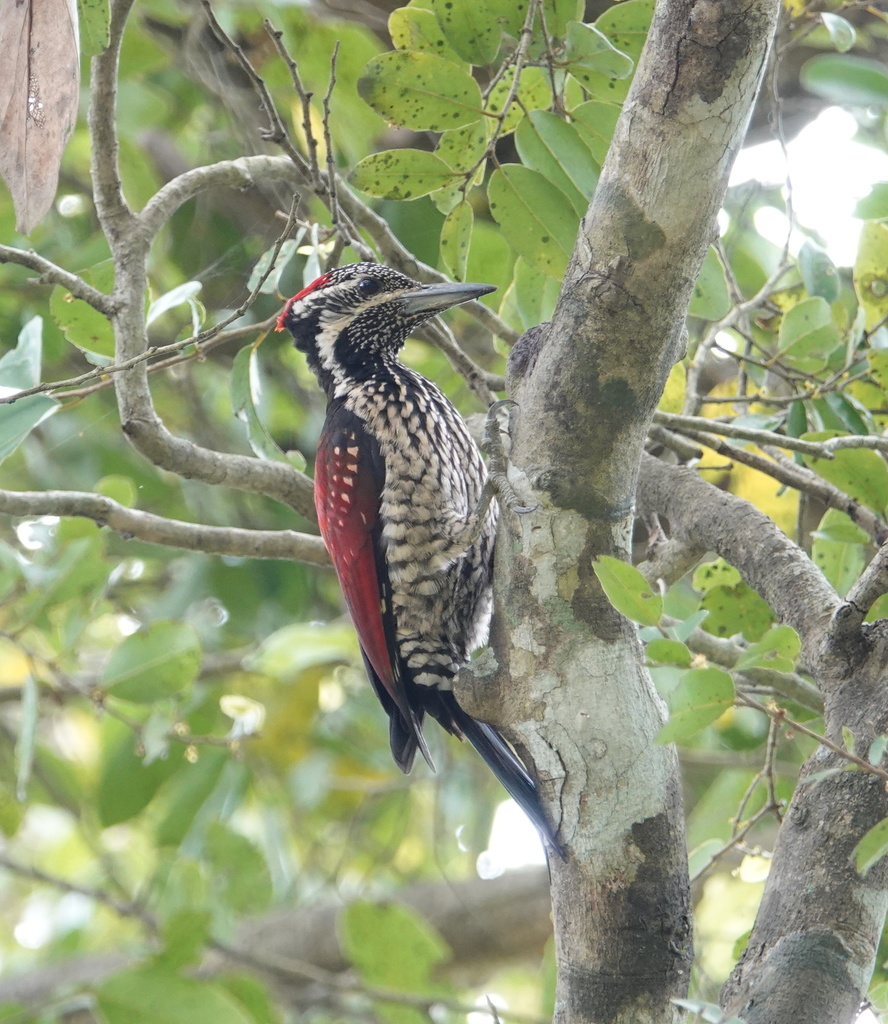
Pito Dorsirrojo
Photo © Matthew Blissett
Photo © Matthew Blissett — CC BY 4.0 — Source: iNaturalist #20733740Identification
The Red-backed flameback is a striking woodpecker about 28 centimetres in length, predominantly crimson in plumage with distinctive black trailing edges to the wings. Its underparts are white with messy black markings, while the breast and neck are black adorned with white spots on the throat and white streaks on the breast. A bold black eyestripe stretches from the eye to the back of the neck, diffusing into the nape and upper back, with contrasting white streaks between the eye and neck. Males sport a red crown, while females have a forecrown and forehead that are black speckled with white. The bird possesses a fairly sized grey bill that forms a blunt point. Juveniles are duller with less pronounced markings; males show white spots on the crown while females have few or no spots. As the only red-coloured Dinopium species, it stands out distinctly among Sri Lanka's woodpeckers.
Range & Habitat
The Red-backed flameback is endemic to Sri Lanka, occurring throughout the island except in the far north. It inhabits subtropical and tropical dry forests, subtropical and tropical moist lowland forests, and mangrove forests, as well as man-made environments such as home gardens. Though mostly found in the dry zone, it shows a preference for humid environments and can be spotted at elevations up to 1,500 metres. The species is the most common woodpecker in Sri Lanka, classified as common to locally common throughout its range.
Behaviour & Diet
The Red-backed flameback's diet consists primarily of ants, with a particular preference for carpenter ants, ants of the genus Meranoplus, and the pupae and larvae of Asian weaver ants. It supplements its diet with other invertebrates including spiders, caterpillars, weevils, and beetles, and occasionally feeds on fruit for dietary fibre and nutrients. The bird is an acrobatic forager, using its tail as support while climbing trees and employing a flap-and-glide bounding flight pattern. It breaks into weaver ant leaf nests in trees but descends to the ground to access ground-dwelling ant colonies.
This species produces a sharp, unmusical whinny call—more screeching than related species—typically rendered as rhythmic "woik-woik-wik-wi-ti-ti-t-t t-t-trrrrrr!" or repeated "woik-tri-tri-tri" sequences lasting about three seconds, accompanied by a dull drumroll lasting 0.8 to 1.5 seconds. Red-backed flamebacks forage alone, in pairs, or as family groups, and readily join multi-species foraging flocks.
Best Time & Places to See It
The Red-backed flameback breeds from December to September, with peak breeding activity from August-September and February-June, making these periods excellent for observation. As Sri Lanka's most common woodpecker and one of the island's common endemic species, it can be encountered throughout the country south of the north, particularly in forested areas, mangroves, and home gardens. Its abundance and lack of range restrictions make it a reliable species for birdwatchers and photographers across most of Sri Lanka.
Photography Tips
Look for this species in woodland and forest edges where it forages in pairs or small groups, often joining mixed-species flocks that move through the canopy. The Red-backed flameback's vibrant crimson plumage contrasts beautifully against green foliage, particularly when backlit. Position yourself to capture the distinctive black eyestripe and white throat markings that characterize the species. Early morning activity during breeding season (August-September and February-June) offers the best opportunities for photography, as birds are more vocal and active. Watch for characteristic bounding flight patterns and listen for the distinctive sharp calls to locate individuals in dense vegetation.
Lunugamvehera National Park
Sri Lanka
+129 aves+30 mamíferos
Where scrubland meets open water beneath the dry zone sky, one of Sri Lanka’s most underrated wilderness sanctuaries reveals itself […]
VER PARQUE NACIONALMinneriya National Park
Sri Lanka
+123 aves+30 mamíferos
Dawn breaks over a sprawling tapestry of dry deciduous woodland and freshwater marshland where ancient granite outcrops punctuate the landscape […]
VER PARQUE NACIONALWasgamuwa National Park
Sri Lanka
+122 aves+30 mamíferos
Dawn breaks over a landscape where ancient riverine forests meet sprawling grasslands, carved through by the Mahaweli River’s serpentine passage […]
VER PARQUE NACIONALAngamedilla National Park
Polonnaruwa, Sri Lanka
+122 aves+30 mamíferos
Where granite outcrops rise dramatically from dry deciduous forest, Sri Lanka’s central highlands reveal one of the island’s most rugged […]
VER PARQUE NACIONALMaduru Oya National Park
Sri Lanka
+123 aves+30 mamíferos
Granite monoliths rise abruptly from dense dry lowland forest in Sri Lanka’s eastern interior, creating a mosaic of rocky outcrops, […]
VER PARQUE NACIONALAún no hay fotos de la comunidad. Inicia sesión para añadir la primera.
Aún no hay observaciones de la comunidad de esta especie.