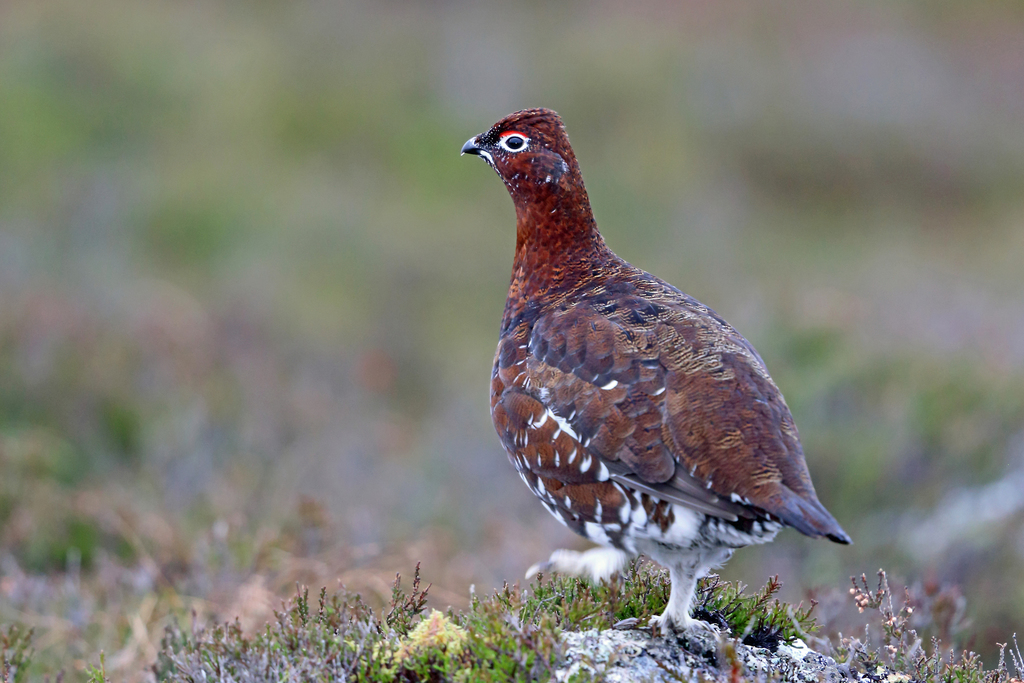
Lagópodo Escocés
Photo © Nigel Voaden
Photo © Nigel Voaden — CC BY 4.0 — Source: iNaturalist photo #2873381Identification
The red grouse is a medium-sized moorland bird distinguished by its reddish-brown plumage, which remains consistent year-round—unlike related species that develop white winter plumage. Males are more intensely coloured than females, with prominent red crests above their eyes; females are duller and less richly toned. The bird's black tail contrasts with white legs, and white stripes are visible on the underwings. Juveniles lack the characteristic red crests and appear generally duller. Red grouse populations in Ireland are sometimes slightly paler than their British counterparts, with females displaying yellower plumage and finely barred underparts—likely an adaptation to moorlands with more grass and sedge growth.
Audially, red grouse are distinctive and relatively easy to identify. Their most common call is a sharp, repeated 'chut!chut!chut!chut!chut!chuttt....' or alternatively a 'Goback, goback, goback' vocalisation. When flushed from a resting place, the bird produces a characteristic whirring sound with its wings—a useful clue for observers in the field.
Range & Habitat
The red grouse is endemic to Britain and Ireland, having evolved in isolation from other willow grouse subspecies found across northern Eurasia and North America. In Scotland, the species is widespread across most regions, including Orkney, Shetland, and the Outer Hebrides, though absent from urban areas and coastal lowlands. Welsh populations are now largely restricted to Snowdonia, the Brecon Beacons, and the Cambrian Mountains, having undergone significant range contraction. In England, red grouse are mainly northern birds, found in Northumberland, County Durham, the Lake District, Yorkshire, the Pennines, and the Peak District. In Ireland, they are most common in County Mayo (where populations are increasing) and on the County Antrim plateau, with other strongholds in the Slieve Bloom and Knockmealdown Mountains.
Red grouse are birds of upland heather moorland in treeless terrain, though they also inhabit some low-lying bogs. The British population is estimated at 250,000 pairs, with 1–5,000 pairs in Ireland. Recent decades have seen a marked population decline, with birds now absent from many areas where they were formerly common, primarily due to heather loss from overgrazing, conifer plantation establishment, and reduced upland gamekeeper numbers.
Behaviour & Diet
Red grouse are herbivores, feeding predominantly on heather shoots, seeds, and flowers. They supplement their diet with berries, cereal crops, and occasional insects. During harsh winter weather, birds sometimes visit farmland and will eat hawthorn berries from hedgerows.
Pair formation begins in autumn, with males becoming increasingly territorial as winter progresses. Nesting occurs in shallow scrapes lined with vegetation, measuring up to 20 centimetres wide. Females typically lay six to nine pale yellow, shiny eggs with dark brown spots during April and May. Incubation lasts 19 to 25 days, and chicks are capable of flight within 12 to 13 days, reaching full size after 30 to 35 days. Grouse populations exhibit periodic population cycles, with numbers peaking at very high densities before crashing and recovering—a pattern linked to the parasitic nematode worm Trichostrongylus tenuis, though the relationship between parasites, food availability, and social factors remains debated among researchers.
Best Time & Places to See It
Scottish uplands offer the most reliable opportunities for observing red grouse, with populations present across most regions except urban areas. Northern English moorlands—particularly the Pennines, Peak District, and Lake District—provide good viewing opportunities. In Wales, Snowdonia and the Brecon Beacons are prime locations. Irish travellers should focus on County Mayo, the County Antrim plateau, and the Slieve Bloom Mountains. Small populations persist on Dartmoor in southern England. Spring and early summer are optimal seasons for observation, when birds are more visible during breeding season and territorial males are vocal. Early morning visits to moorland habitat increase chances of encountering these birds before they retreat into heather.
Photography Tips
Red grouse are masters of camouflage on heather moorland, so patience and careful scanning are essential. Early morning or late afternoon light often yields the best photography opportunities. The bird's reddish-brown plumage photographs well against green and purple moorland vegetation, with males' red crests particularly striking in good light. Listen for their distinctive calls to locate birds; the repeated 'chut-chut-chut' vocalisations can guide you to nearby individuals. When flushed, birds produce that characteristic whirring wing sound, giving you a brief window to capture them in flight. Wide-angle landscape shots showcasing the bird in its moorland habitat can be as compelling as close-ups of plumage detail.
Lake District National Park
Westmorland and Furness, Gran Bretaña
+124 aves+25 mamíferos
Glacial valleys plunge between fell-sided mountains where slate-grey waters mirror some of England’s most dramatic upland terrain. This landscape of […]
VER PARQUE NACIONALYorkshire Dales National Park
North Yorkshire, Gran Bretaña
+104 aves+22 mamíferos
Where limestone escarpments rise above verdant valleys, a patchwork of moorland, grassland, and woodland creates one of England’s most ecologically […]
VER PARQUE NACIONALNorth York Moors National Park
North Yorkshire, Gran Bretaña
+128 aves+21 mamíferos
Heather moorlands roll across 554 square miles of the Yorkshire uplands, where rolling hills give way to deep valleys carved […]
VER PARQUE NACIONALNorthumberland National Park
Northumberland, Gran Bretaña
+71 aves+12 mamíferos
Where the Cheviot Hills rise like ancient sentinels above the Scottish borderlands, a landscape of moorland, forestry, and river valleys […]
VER PARQUE NACIONALDartmoor National Park
West Devon, Gran Bretaña
+103 aves+19 mamíferos
Where weathered granite tors pierce the horizon and wind-sculpted moorland sprawls across 368 square miles of southwestern England, a landscape […]
VER PARQUE NACIONALCairngorms National Park
Muir, Gran Bretaña
+124 aves+27 mamíferos
Where ancient granite massifs rise above the Scottish Highlands, a subarctic wilderness unfolds across 1,748 square kilometres of raw, elemental […]
VER PARQUE NACIONALAún no hay fotos de la comunidad. Inicia sesión para añadir la primera.
Aún no hay observaciones de la comunidad de esta especie.