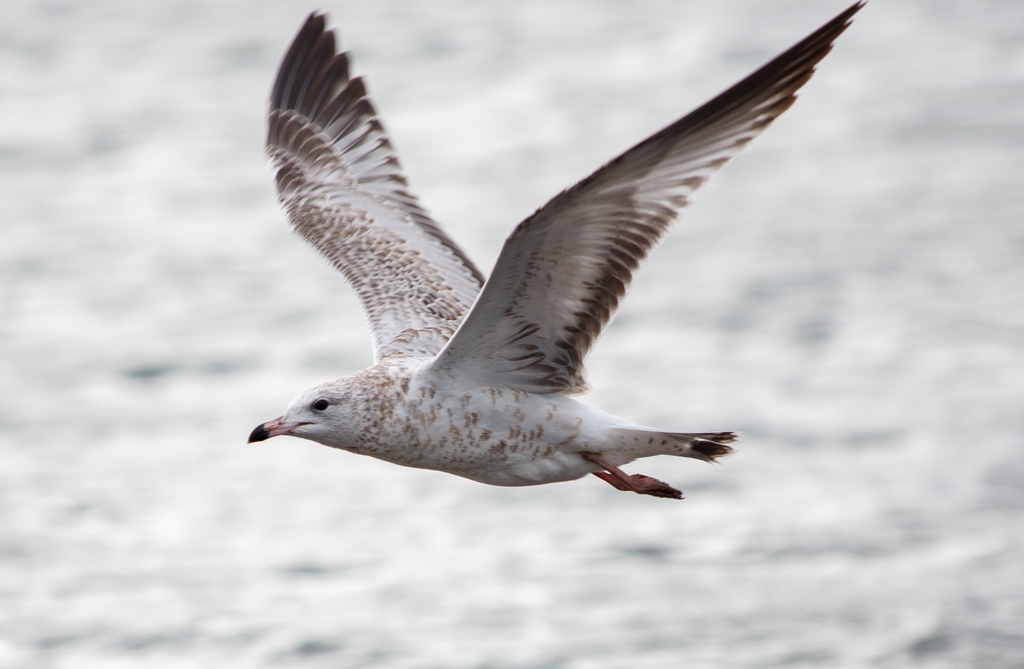
Gaviota de Delaware
Photo © Bailey Duncan
Photo © Bailey Duncan — CC BY-SA 4.0 — Source: iNaturalist photo #574109390Identification
The ring-billed gull is a medium-sized gull averaging 43 to 54 centimetres in length, with a wingspan ranging from 105 to 117 centimetres. Adults are distinctive: white head, neck and underparts contrast with silver-grey backs and wings, which feature black wingtips marked with white 'mirrors'. The relatively short, yellow bill is immediately recognizable by its black ring—the feature that gives the species its name. Bright yellow legs and yellow eyes with red rims complete the adult plumage. Adults weigh between 300 and 700 grams.
Identifying immatures requires patience, as ring-billed gulls take three years to acquire their breeding plumage, beginning in largely brown juvenile dress and changing appearance with each fall moult. Adults show impressive longevity, with an average lifespan of 10.9 years for those reaching adulthood, and the oldest recorded individual observed in Cleveland in 2021 was still alive at 28 years old.
Range & Habitat
Native to North America, ring-billed gulls breed across Canada and the northern United States, nesting colonially near lakes, rivers, and coastal areas. Traditionally ground-nesters on islands, they have increasingly adapted to nesting on flat factory roofs. These birds show strong fidelity to nesting sites year after year, though they may change mates. They are highly migratory, with most populations moving south in winter to the Gulf of Mexico and Atlantic and Pacific coasts of the United States and northern Mexico, though some winter in the mildest Canadian areas, including the Pacific coast of southwest British Columbia and the Atlantic coast of Nova Scotia.
Ring-billed gulls are a ubiquitous presence in North American parking lots and urban spaces, where they congregate in large numbers. They are a familiar sight at beaches, marinas, docks and parks. Notably, they regularly wander to western Europe and are no longer classified as a rarity in Ireland and Great Britain, though their frequency there has declined since 2010.
Behaviour & Diet
These opportunistic omnivores forage in flight, while swimming, walking, or wading, readily stealing food from other birds and scavenging wherever possible. Their diet is remarkably varied, including insects, fish, grain, eggs, earthworms, and rodents. Ring-billed gulls have adapted exceptionally well to human-modified environments, exploiting discarded and unattended food in human spaces, which has earned them a reputation as pests at crowded beaches. They readily congregate where people hand-feed them, demonstrating their comfort around humans.
Despite their success in modern landscapes, ring-billed gulls face natural predators including rats, foxes, dogs, cats, raccoons, coyotes, eagles, hawks, and owls. Interestingly, they have been observed in pairs actively chasing hawks, suggesting some cooperative defence behaviour.
Best Time & Places to See It
Ring-billed gulls are the most common gull in eastern North America and are reliably found year-round across their range, making them accessible to most North American nature travellers. Urban and suburban parks, beaches, marinas, and docks offer excellent viewing opportunities, particularly where people congregate. Winter is an ideal season for observing them in southern US coastal regions and northern Mexico, where they concentrate in large numbers.
For those willing to travel further afield, ring-billed gulls have become regular winter visitors to western Europe, particularly Ireland and Great Britain, though sightings there have become less frequent in recent years.
Photography Tips
The ring-billed gull's bold yellow bill with its distinctive black ring is the key identification feature to capture. Photograph adults in strong light to emphasize the contrast between their white underparts and silver-grey backs, and ensure the black wingtips and white mirrors are visible. The bright yellow legs and eye-ring also make striking details at close range.
Urban settings offer abundant opportunities to photograph these birds, though backgrounds of parking lots and rubbish can detract from images. Seek cleaner backdrops at beaches, lakes, and coastal areas. Patience with immatures will reward you with documentation of their three-year progression to breeding plumage, a worthwhile photographic project for dedicated observers.
Picos de Europa National Park
Posada de Valdeón, España
+120 aves+17 mamíferos
Where limestone peaks pierce the Asturian sky at nearly 2,700 metres, three colossal massifs create a fortress of vertical rock […]
VER PARQUE NACIONALGulf Islands National Park Reserve
Southern Gulf Islands Electoral Area, Canadá
+130 aves+24 mamíferos
Where the Pacific Northwest’s temperate rainforest meets the Salish Sea, an archipelago of over 15 islands and numerous islets creates […]
VER PARQUE NACIONALGlacier National Park
Glacier, Canadá
+123 aves+30 mamíferos
Where the Columbia Mountains rise in British Columbia’s interior, temperate rainforest gives way to alpine meadows scattered with late-lying snow. […]
VER PARQUE NACIONALCape Breton Highlands National Park
Cape Breton Highlands National Park, Canadá
+115 aves+23 mamíferos
Where the Cabot Trail winds through Nova Scotia’s northern reaches, weathered plateaus rise dramatically above the Atlantic, their cliff faces […]
VER PARQUE NACIONALTeide Natural Monument
La Orotava, España
+126 aves+9 mamíferos
Where the Atlantic swells meet volcanic stone, Spain’s highest peak rises 3,718 metres into crystalline air, its slopes a masterclass […]
VER RESERVA NATURALTimanfaya National Park
Tinajo, España
+132 aves+5 mamíferos
Where volcanic stone dominates the horizon in shades of rust and charcoal, Lanzarote’s most dramatic wilderness unfolds across 13,600 hectares […]
VER PARQUE NACIONALFrontenac National Park
Sainte-Praxède, Canadá
+126 aves+26 mamíferos
Granite cliffs rise abruptly from crystalline lakes, their weathered faces painted in rust and lichen, while boreal forest sweeps across […]
VER PARQUE NACIONALBanff National Park
Improvement District No. 9, Canadá
+121 aves+30 mamíferos
Where turquoise glacial lakes mirror jagged peaks and coniferous forests sweep across vast alpine plateaus, one of North America’s most […]
VER PARQUE NACIONALL’Île-Bonaventure-Et-Du-Rocher-Percé National Park
Le Rocher-Percé, Canadá
+146 aves+3 mamíferos
Where the St. Lawrence River crashes against Quebec’s Gaspésie Peninsula, a pierced limestone monolith rises 88 metres from churning Atlantic […]
VER PARQUE NACIONALMont-Saint-Bruno National Park
Saint-Bruno-de-Montarville, Canadá
+121 aves+30 mamíferos
Where the Saint Lawrence lowlands rise into unexpected prominence, a modest but ecologically rich mountain dome commands attention across Quebec’s […]
VER PARQUE NACIONALPointe-Taillon National Park
Lac-Saint-Jean-Est, Canadá
+135 aves+24 mamíferos
Where the St. Lawrence River widens into the Gulf, a slender peninsula of boreal forest and wetland emerges from the […]
VER PARQUE NACIONALMauricie National Park
Shawinigan, Canadá
+120 aves+30 mamíferos
Where granite ridges rise above boreal forest and pristine waterways carve through the Canadian Shield, a wilderness of rare ecological […]
VER PARQUE NACIONALVoyageurs National Park
Northwest Saint Louis, Estados Unidos
+12 aves+16 mamíferos
Where granite bedrock meets crystalline waters along Minnesota’s Canadian border, an archipelago of pristine lakes fragments the boreal landscape into […]
VER PARQUE NACIONALIndiana Dunes National Park
Porter, Estados Unidos
+12 aves+29 mamíferos
Where Lake Michigan’s shoreline surrenders to towering sand formations, a landscape of extraordinary contrasts emerges across nearly 920 square kilometres […]
VER PARQUE NACIONALLassen Volcanic National Park
Shasta County, Estados Unidos
+114 aves+25 mamíferos
Steaming vents pierce a landscape sculpted by volcanic fury, where obsidian flows meet alpine meadows across nearly 550 square kilometers […]
VER PARQUE NACIONALGreat Sand Dunes National Park
Saguache County, Estados Unidos
+91 aves
Where the Rocky Mountain front meets the San Luis Valley, towering walls of sand rise improbably from the Colorado high […]
VER PARQUE NACIONALGrand Teton National Park
Teton County, Estados Unidos
+123 aves+30 mamíferos
Where granite peaks pierce the Wyoming sky, a landscape of raw geological drama unfolds across 2,550 square kilometers of pristine […]
VER PARQUE NACIONALYellowstone National Park
Park County, Estados Unidos
+120 aves+31 mamíferos
Geothermal plumes rise from an alien landscape where boiling springs feed crystalline pools and geysers erupt with clockwork precision across […]
VER PARQUE NACIONALMount Rainier National Park
Pierce County, Estados Unidos
+105 aves+27 mamíferos
Where volcanic slopes rise dramatically from temperate rainforest to alpine tundra, a landscape of raw geological power unfolds across 1,322 […]
VER PARQUE NACIONALRedwood National Park
Humboldt County, Estados Unidos
+126 aves+29 mamíferos
Where ancient titans pierce the California fog, the tallest trees on Earth create a primordial landscape unlike anywhere else. Spanning […]
VER PARQUE NACIONALDeath Valley National Park
Inyo County, Estados Unidos
+130 aves+29 mamíferos
Where scorched salt flats stretch beneath some of Earth’s most punishing skies, a landscape of extremes unfolds across 30,012 square […]
VER PARQUE NACIONALMonts-Valin National Park
Mont-Valin, Canadá
+27 aves+6 mamíferos
Where granite peaks thrust through boreal forest in Quebec’s Laurentian region, dramatic canyons and crystalline lakes define a landscape of […]
VER PARQUE NACIONALWaterton Lakes National Park
Improvement District No. 04, Canadá
+127 aves+30 mamíferos
Where the Rocky Mountains plunge dramatically into the turquoise waters of two pristine glacial lakes, one of North America’s most […]
VER PARQUE NACIONALWood Buffalo National Park
Improvement District No. 24, Canadá
+27 aves+12 mamíferos
Where boreal forest dissolves into muskeg and pristine waterways carve through an otherwise untamed wilderness, Canada’s largest national park sprawls […]
VER PARQUE NACIONALLac-Témiscouata National Park
Témiscouata, Canadá
+55 aves+10 mamíferos
Where the Appalachian highlands meet the boreal forest, a pristine wilderness of over 500 square kilometres unfolds across eastern Quebec. […]
VER PARQUE NACIONALFundy National Park of Canada
Alma Parish, Canadá
+131 aves+27 mamíferos
Where the Bay of Fundy’s tidal rhythms sculpt the Maritime landscape, a compact wilderness of 345 square kilometres unfolds across […]
VER PARQUE NACIONALMont-Tremblant National Park
Lac-des-Dix-Milles, Canadá
+110 aves+23 mamíferos
Where granite ridges rise above boreal forest and crystalline lakes mirror the Quebec sky, one of eastern Canada’s most dynamic […]
VER PARQUE NACIONALÎles-De-Boucherville National Park
Boucherville, Canadá
+104 aves+10 mamíferos
Dawn breaks over a labyrinth of forested islands rising from the St. Lawrence River, where 18 square kilometres of protected […]
VER PARQUE NACIONALGros Morne National Park
Canadá
+128 aves+19 mamíferos
Where granite peaks rise dramatically above fjord-carved valleys, one of Canada’s most geologically spectacular wilderness areas commands nearly 4,000 square […]
VER PARQUE NACIONALBic National Park
Rimouski, Canadá
+119 aves+17 mamíferos
Granite cliffs plunge toward the churning Saint Lawrence River, where salt marshes and boreal forest converge in an explosive collision […]
VER PARQUE NACIONALKouchibouguac National Park of Canada
Carleton Parish, Canadá
+114 aves+16 mamíferos
Salt marshes melting into Acadian forest meet the Bay of Fundy’s restless tides along New Brunswick’s hidden gem. This 591-square-kilometre […]
VER PARQUE NACIONALForillon National Park
Gaspé, Canadá
+131 aves+11 mamíferos
Where the Gaspé Peninsula meets the Gulf of Saint Lawrence, rugged cliffs plunge into churning Atlantic waters, sculpting a dramatic […]
VER PARQUE NACIONALPoint Pelee National Park
Leamington, Canadá
+125 aves+28 mamíferos
Where Lake Erie’s waters meet a sandy finger of Ontario’s shoreline, one of North America’s most vital migratory corridors pulses […]
VER PARQUE NACIONALKampinos National Park
Gurba, Polonia
+123 aves+30 mamíferos
Vast wetlands and ancient pine forests sprawl across the sandy plains just northwest of Warsaw, where Poland’s largest national park […]
VER PARQUE NACIONALEl Vizcaíno
Laguna San Ignacio, México
+101 aves+15 mamíferos
Where the Baja California peninsula thins into a tapestry of salt lagoons and coastal desert, one of Mexico’s most biodiverse […]
VER RESERVA DE LA BIOSFERAParque Nacional Isla Isabel
Santiago Ixcuintla, México
+49 aves+4 mamíferos
Where the Pacific swells meet volcanic stone, three dormant cinder cones rise from the Sea of Cortez like sentinels guarding […]
VER PARQUE NACIONALAún no hay fotos de la comunidad. Inicia sesión para añadir la primera.
Aún no hay observaciones de la comunidad de esta especie.