Avetigre Colorada
Photo © Leonel Roget
Photo © Leonel Roget — CC BY 4.0 — Source: iNaturalist photo #365001851Identification
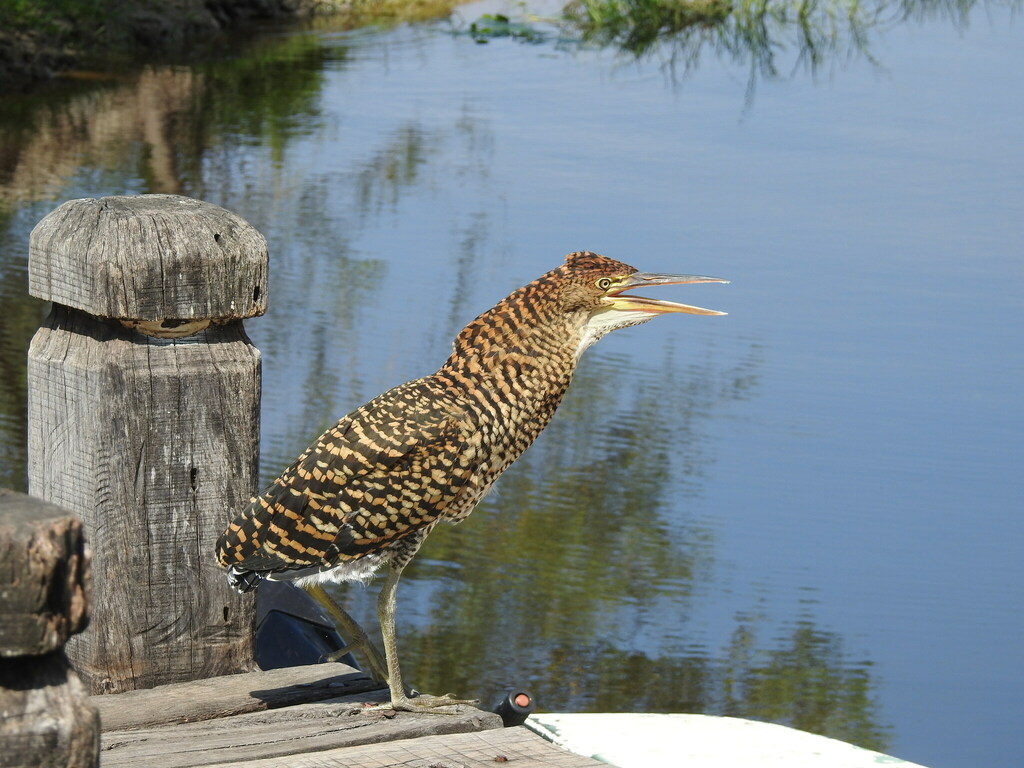
The rufescent tiger heron is a medium-sized heron measuring 26–30 inches (66–76 cm) in length. Adults are distinctive for their dark rufous head, neck, and chest, accented by a white stripe running down the center of the foreneck. The upperparts are brownish with fine black vermiculations, while the belly and vent are buffy-brown, and the flanks display bold black and white barring. The tail is black, narrowly barred with white. The bill is stout and yellowish to dusky, the legs are dull green, and the bright yellow irides, loral skin, and orbital ring create a striking facial expression. Juveniles are quite different, appearing rusty-buff overall and coarsely barred with black, with especially pronounced buff and black banding on the wings; they retain white on the throat, central chest, and belly, and take approximately five years to acquire full adult plumage. Adult rufescent tiger herons are relatively easy to distinguish from other tiger heron species by their rufous coloring on the head and neck, though juvenile birds are considerably more challenging to identify.
Range & Habitat
The rufescent tiger heron is found in wetlands throughout Central America and much of South America. The species generally occurs below 500 meters (1,600 feet) in elevation, though it has been recorded at higher altitudes, reaching up to 1,600 meters (5,200 feet) in Colombia. Two subspecies are recognized: the northern subspecies ranges from Honduras south to northeast Bolivia and Amazonian Brazil, while the southern subspecies occurs from southeast Bolivia to south Brazil and northern Argentina.
Behaviour & Diet
The rufescent tiger heron is largely crepuscular and characteristically solitary, spending much of its time hunting alone in wetland environments. Its diet is predominantly aquatic, comprising fish, crustaceans, water beetles, and dragonfly larvae, supplemented by adult dragonflies and grasshoppers. The bird employs a patient hunting strategy, standing hunched in shallow pools or wet forest areas while waiting for prey to approach within striking distance.
Vocally, this species is most notable for its low-pitched paired hooting calls, which are often delivered at night. It also produces a distinctive fast series of sharp wok notes that decrease in volume and speed, as well as a prolonged hoot transcribed as "ooooooo-ooh," which rises markedly at the end.
Best Time & Places to See It
The rufescent tiger heron's crepuscular nature means that early morning and evening hours offer the best opportunities for observation. Visitors should focus on wetland habitats throughout the species' range in Central and South America, particularly in lowland areas below 500 meters. The bird's solitary and patient hunting behavior makes it relatively predictable once located, as it tends to remain in one area for extended periods while hunting.
Photography Tips
Photographing this heron requires patience and attention to lighting conditions, given its preference for crepuscular activity. Early dawn and dusk light, while challenging, can beautifully illuminate the rufous tones of the adult's head and neck plumage. Position yourself with a clear view of shallow water or forest pools where the bird hunts, and maintain a respectful distance to avoid disturbing its hunting routine. The bright yellow facial markings and contrasting plumage patterns offer excellent photographic opportunities when light permits, while the dynamic hunting posture of the hunched bird poised over shallow water provides compelling behavioral shots.
Emas National Park
Brasil
+128 aves+29 mamíferos
Vast grasslands ripple across the central Brazilian plateau, where fire has sculpted the landscape for millennia. Parque Nacional das Emas […]
VER PARQUE NACIONALTortuguero National Park
Roxana, Costa Rica
+124 aves+30 mamíferos
Where emerald waterways thread through impenetrable rainforest and pristine Caribbean beaches merge with lagoons, one of Costa Rica’s most biodiverse […]
VER PARQUE NACIONALYasuní National Park
Aguarico, Ecuador
+132 aves+30 mamíferos
Where the Napo and Curaray rivers carve through Ecuador’s vast Amazonian lowlands, one of Earth’s most biodiverse terrestrial ecosystems sprawls […]
VER PARQUE NACIONALNatural Sierra de Chiribiquete National Park
Solano, Colombia
+130 aves+23 mamíferos
Where tabletop mountains rise abruptly from the Colombian Amazon, a landscape of almost alien majesty unfolds across nearly 87,000 square […]
VER PARQUE NACIONALNatural el Cocuy National Park
Güicán, Colombia
+139 aves+13 mamíferos
Where snow-capped peaks pierce the Colombian highlands at over 5,000 metres, a landscape of stark geological drama unfolds across nearly […]
VER PARQUE NACIONALAmacayacu National Park
Leticia, Colombia
+133 aves+29 mamíferos
Where the Amazon’s dark waters merge with flooded forest and terra firme upland, five thousand square kilometres of pristine wilderness […]
VER PARQUE NACIONALViruá National Park
Brasil
+103 aves+14 mamíferos
Where granite inselbergs rise dramatically from the Amazon’s northern fringe, a 3,651-square-kilometre wilderness unfolds across Roraima State. This Category II […]
VER PARQUE NACIONALIguaçu National Park
Brasil
+133 aves+29 mamíferos
Where the Paraná Plateau drops away in a thunderous cascade, one of Earth’s most spectacular waterfall systems tears through subtropical […]
VER PARQUE NACIONALPantanal Matogrossense National Park
Brasil
+139 aves+21 mamíferos
Where water and grassland merge in the heart of Brazil’s Mato Grosso do Sul, one of South America’s most biodiverse […]
VER PARQUE NACIONALChapada Diamantina National Park
Brasil
+100 aves+5 mamíferos
Where granite plateaus rise dramatically from the Atlantic Forest’s green embrace, a landscape of profound geological drama unfolds across the […]
VER PARQUE NACIONALManu National Park
Manu, Perú
+131 aves+30 mamíferos
Where the Andes plunge into the Amazon basin, a wilderness of uncompromising scale unfolds across 1.5 million hectares. Spanning three […]
VER PARQUE NACIONALBahuaja Sonene National Park
San Pedro de Putina Punco, Perú
+132 aves+30 mamíferos
Where granite ridges rise above the confluence of Peru’s Río Heath and Río Tambopata, one of the Amazon’s most pristine […]
VER PARQUE NACIONALSoberanía National Park
Cristóbal, Panamá
+132 aves+30 mamíferos
Where the Chagres River cuts through lowland tropical forest mere kilometres from Panama City’s skyline, one of Central America’s most […]
VER PARQUE NACIONALDarién National Park
Tucutí, Panamá
+132 aves+30 mamíferos
Where rainforest swallows the horizon and rivers carve through primordial wilderness, one of Central America’s last great untamed frontiers unfolds […]
VER PARQUE NACIONALEl Palmar National Park
Distrito Sexto, Argentina
+132 aves+21 mamíferos
Where the Paraná River winds through northern Argentina, vast groves of yatay palms rise from rolling grassland like a botanical […]
VER PARQUE NACIONALRío Pilcomayo National Park
Argentina
150+ aves+10 mamíferos
Where wetlands sprawl across the Argentine Chaco, the Pilcomayo River carves a vital ribbon of life through one of South […]
VER PARQUE NACIONALEl Rey National Park
Municipio de Las Lajitas, Argentina
+59 aves+8 mamíferos
Where subtropical mountain forests merge with humid lowland savannas, northwestern Argentina guards one of South America’s most biodiverse yet underexplored […]
VER PARQUE NACIONALChaco National Park
Municipio de Presidencia de la Plaza, Argentina
+142 aves+20 mamíferos
Where the Gran Chaco’s thornforests meet wetland mosaics, a landscape of profound ecological contrast unfolds across northwestern Argentina. This 151-square-kilometre […]
VER PARQUE NACIONALAún no hay fotos de la comunidad. Inicia sesión para añadir la primera.
Aún no hay observaciones de la comunidad de esta especie.