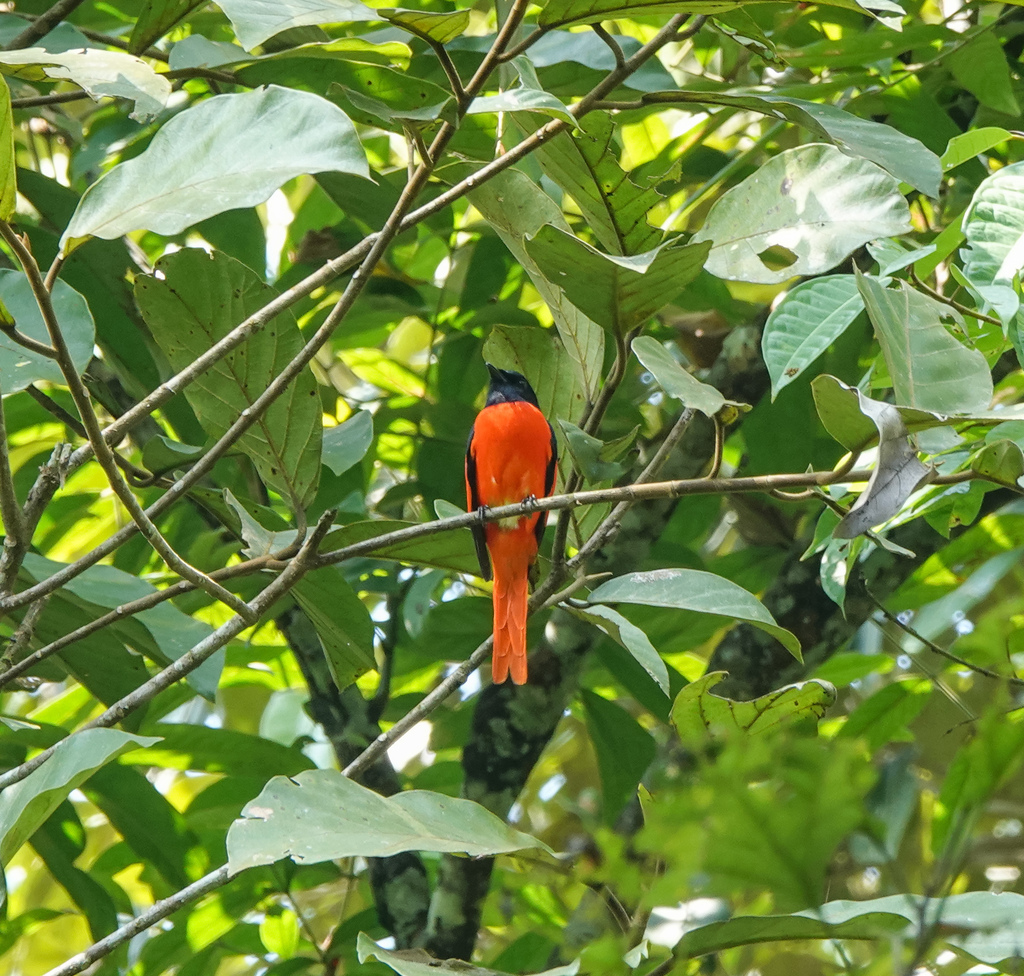
Minivet Escarlata
Photo © Rejoice Gassah
Photo © Rejoice Gassah — CC BY 4.0 — Source: iNaturalist #124689073Identification
The scarlet minivet is a compact passerine measuring 20–22 cm long, with a strong dark beak and notably long wings. Sexual dimorphism is striking: males display glossy black upperparts and head contrasting brilliantly with scarlet underparts, rump, tail edges, and wing patches. Females are more subdued, with grey upperparts and bright yellow underparts including the face, rump, tail edges, and wing patches. The shade and pattern of orange-red in males varies considerably across populations, making regional subspecies distinguishable to experienced observers.
Range & Habitat
This species occupies tropical southern Asia from Northeast India through southern China, Indonesia, and the Philippines, with considerable geographic variation across its range. As many as nineteen subspecies have been described, distributed from Himalayan foothills to remote island populations in Borneo, Java, and the Philippines. The scarlet minivet is a common resident breeding bird in forests and well-wooded habitats, including gardens, with a marked preference for hilly country. These birds favour dense canopy environments where they can forage among the treetops.
Behaviour & Diet
Scarlet minivets are insectivorous specialists, capturing prey through flycatching or while perched. They employ a distinctive foraging technique, beating their wings vigorously to flush insects from foliage. These gregarious birds typically form small flocks and frequently join mixed-species foraging groups, usually working high in the forest canopy. Males produce a pleasant whistling song. Nesting occurs high in the treetops in cup-like structures ingeniously woven from small twigs and spider webs—the silk providing crucial structural reinforcement. Females lay two or three spotted pale green eggs, with incubation primarily performed by the female, though both parents participate in raising young.
Best Time & Places to See It
The scarlet minivet's status as a common resident means it can be encountered year-round throughout its range. Look for them in hilly forested regions from Northeast India eastward, with particular opportunities in Myanmar, Thailand, southern China, and the Philippine islands. Their preference for high canopy foraging means scanning upper branches and watching for mixed-species feeding flocks, which offer the best chance of locating them. Gardens in well-wooded areas also provide opportunities for closer observation.
Photography Tips
Photographing scarlet minivets presents the classic challenge of canopy-dwelling birds: they remain high and often distant. Fast shutter speeds (1/1000th or faster) are essential to freeze wing-beating during their active foraging. Males' vibrant plumage rewards photography but demands careful exposure metering to avoid blown highlights on red underparts. Position yourself where backlighting through leaves creates separation and accentuates their brilliant colours. Patient observation of mixed-species flocks increases encounter frequency. Early morning offers the best light and activity levels in their preferred high-canopy habitat.
Langtang National Park
Helambu, Nepal
+135 aves+18 mamíferos
Where the Himalayas rise in a tumultuous embrace of rock and forest, pristine valleys carved by glacial melt create one […]
VER PARQUE NACIONALValmiki National Park
Ramnagar, India
+128 aves+30 mamíferos
Where the Himalayan foothills soften into the Ganges plains, dense sal forests rise above meandering rivers and grassland mosaics that […]
VER PARQUE NACIONALKhangchendzonga National Park
Sakkyong, India
+132 aves+30 mamíferos
Where the Eastern Himalayas rise in their most dramatic splendour, alpine meadows give way to ancient temperate forests cloaked in […]
VER PARQUE NACIONALKhao Yai National Park
Prachantakham District, Tailandia
+132 aves+30 mamíferos
Dawn breaks over a mosaic of evergreen forest, bamboo thickets, and grassland valleys where the Thai landscape rises and falls […]
VER PARQUE NACIONALKhao Laem National Park
Sangkhla Buri District, Tailandia
+137 aves+25 mamíferos
Where limestone peaks rise dramatically above a shimmering reservoir, Thailand’s most compelling freshwater ecosystem unfolds across the Thai-Cambodian borderlands. Khao […]
VER PARQUE NACIONALMount Nanling Forest Park
Ruyang Forest Farm, China
+83 aves+4 mamíferos
Granite peaks thrust through a verdant canopy where the Nanling range divides tropical and subtropical China, creating a mosaic of […]
VER PARQUE NACIONALKanha Tiger Reserve
Kanha Kisli F.V., India
+126 aves+29 mamíferos
Where sal forests give way to emerald meadows and crystalline streams carve through ancient valleys, one of India’s finest wilderness […]
VER PARQUE NACIONALKaziranga National Park
Kohora, India
+129 aves+30 mamíferos
Dawn breaks over the floodplains of the Brahmaputra, where tall grasslands stretch endlessly beneath monsoon-heavy skies. This sprawling wilderness of […]
VER PARQUE NACIONALBako National Park
Kuching, Malasia
+112 aves+18 mamíferos
Weathered sandstone cliffs rise dramatically from the South China Sea, their ochre faces sculpted by millennia of wind and tide […]
VER PARQUE NACIONALTaman Negara National Park
Kampong Samas, Malasia
150+ aves+17 mamíferos
Where ancient rainforest meets limestone peaks, one of Southeast Asia’s oldest protected wilderness preserves sprawls across 4,343 square kilometers of […]
VER PARQUE NACIONALTaman Negara Bukit Lambir National Park
Miri, Malasia
+137 aves+15 mamíferos
Rainforest cascades down sandstone ridges where crystal streams carve through ancient geology, creating a landscape of profound biological richness in […]
VER PARQUE NACIONALTaman Nasional Baluran
Situbondo, Indonesia
+86 aves+13 mamíferos
Where savanna grasslands sweep toward volcanic slopes and mangrove-lined coastlines converge, East Java’s most biodiverse protected landscape unfolds across nearly […]
VER PARQUE NACIONALTaman Nasional Meru Betiri
Jember, Indonesia
+60 aves+4 mamíferos
Where rainforest plunges into volcanic slopes and pristine beaches curve along Java’s southeastern edge, one of Indonesia’s most biodiverse sanctuaries […]
VER PARQUE NACIONALWest Bali National Park
Gerokgak, Indonesia
+142 aves+12 mamíferos
Where limestone cliffs plunge into crystalline waters and monsoon forests cling to volcanic slopes, Indonesia’s northwestern frontier reveals one of […]
VER PARQUE NACIONALGunung Ciremai National Park
Majalengka, Indonesia
+115 aves+10 mamíferos
Where volcanic slopes rise dramatically from the Javanese lowlands, a 382-square-kilometre sanctuary of montane forest clings to the dormant peak […]
VER PARQUE NACIONALGunung Merbabu National Park
Magelang, Indonesia
+104 aves+1 mamíferos
Where volcanic slopes rise sharply from Java’s central plateau, a 197-square-kilometre sanctuary of montane forest unfolds in perpetual mist. Gunung […]
VER PARQUE NACIONALMount Merapi National Park
Hargobinangun, Indonesia
+93 aves+3 mamíferos
Where volcanic slopes rise through bands of montane forest and alpine meadow, one of Indonesia’s most dynamic ecosystems reveals itself […]
VER PARQUE NACIONALWay Kambas National Park
Lampung Timur, Indonesia
+148 aves+28 mamíferos
Swamps and dipterocarp forests interweave across Sumatra’s southeastern lowlands, creating a mosaic of habitats that few conservation areas in Southeast […]
VER PARQUE NACIONALAún no hay fotos de la comunidad. Inicia sesión para añadir la primera.
Aún no hay observaciones de la comunidad de esta especie.