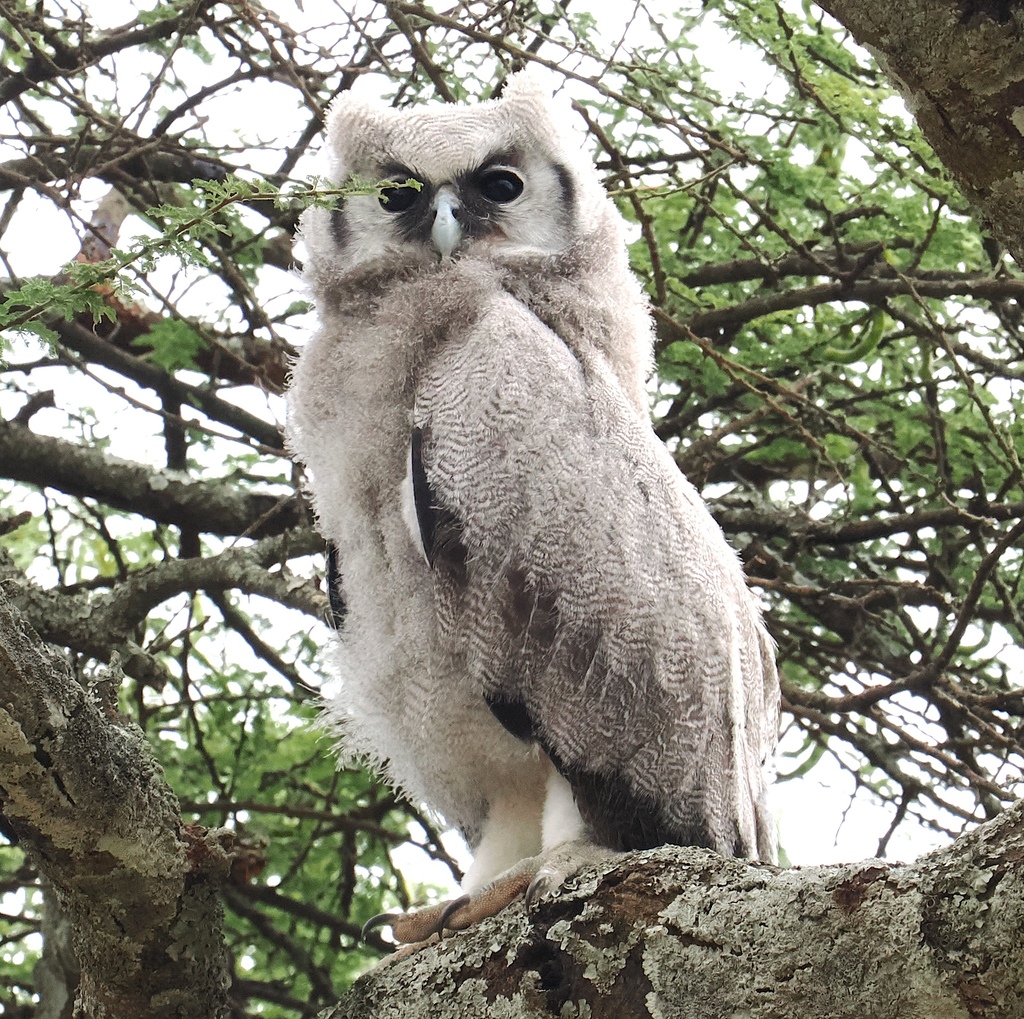
Búho lechoso
Photo © desertnaturalist
Photo © desertnaturalist — CC BY 4.0 — Source: iNaturalist #246187824Identification
Verreaux's eagle-owl is the largest owl in Africa and the world's largest owl found in the tropics, measuring 58–66 cm in total length. This massive, powerful raptor is primarily grey in colour and possesses a distinctive feature unique among all owl species: bright pink eyelids. These striking eyelids make identification straightforward once glimpsed. The species exhibits remarkable sexual dimorphism, with females averaging up to 35% heavier than males—among the most pronounced size differences of any living owl species. Wingspans typically reach around 140 cm, though larger females may span nearly 164 cm.
Range & Habitat
Widely distributed across sub-Saharan Africa, Verreaux's eagle-owl is a resident species showing little variation in appearance throughout its considerable range. It is primarily a bird of dry, wooded savanna, and has demonstrated some adaptability to human-modified landscapes, though it occurs at fairly low densities across its range. Some regional population declines have been documented, but the species maintains a stable conservation status overall.
Behaviour & Diet
Verreaux's eagle-owl is a highly opportunistic predator armed with powerful talons that enable it to tackle a diverse range of prey. While mammals comprise just over half of its known diet, the species takes equal numbers of birds and insects locally, plus any other appropriately sized prey encountered. This dietary flexibility has proven advantageous: when primary prey species decline in a region, the eagle-owl readily adapts to alternative food sources. Despite its large size and highly territorial nature, the species hunts alone, commanding exclusive territories across the savanna.
Best Time & Places to See It
Verreaux's eagle-owl is a resident species, meaning populations remain year-round throughout sub-Saharan Africa, so timing is flexible for travellers. Seek this magnificent raptor in dry, wooded savanna habitats across the continent. Their low population density means patience and local knowledge are essential. Early morning and dusk periods offer the best viewing opportunities, when owls are most active.
Photography Tips
The brilliant pink eyelids are Verreaux's eagle-owl's most distinctive and photogenic feature—prioritise capturing these in good light. The species' large size and powerful build offer striking silhouettes against dawn or dusk skies. Work with local guides familiar with territorial birds in your region, as individuals may return to favoured perches. Avoid disturbance of this territorial species, and remember that low population densities make encounters genuinely special rather than routine.
Serengeti National Park
Tanzania
+131 aves+30 mamíferos
Dawn breaks over an endless golden savanna where acacia-studded plains stretch to distant volcanic highlands, their slopes cloaked in montane […]
VER PARQUE NACIONALChobe National Park
Botsuana
+122 aves+30 mamíferos
Where the Zambezi River cuts through northern Botswana, one of Africa’s greatest concentrations of large mammals gathers across flood plains, […]
VER PARQUE NACIONALVirunga National Park
Uganda
+132 aves+30 mamíferos
Where the Rwenzori Mountains pierce the equatorial sky and volcanic slopes descend toward the Congo Basin, one of Africa’s most […]
VER PARQUE NACIONALLake Mburo National Park
Uganda
+124 aves+30 mamíferos
Dawn breaks across a mosaic of acacia woodland, papyrus swamps, and open grassland where Uganda’s southwestern savanna meets the edge […]
VER PARQUE NACIONALTsavo East National Park
Athi ward, Kenya
+132 aves+30 mamíferos
Dawn breaks over one of Africa’s most expansive wilderness areas, where volcanic outcrops pierce the savanna and the Galana River […]
VER PARQUE NACIONALTsavo West National Park
Mwatate, Kenya
+132 aves+30 mamíferos
Where volcanic rock formations pierce the savanna and sulfurous springs bubble beneath rust-coloured earth, Kenya’s southwestern wilderness reveals itself in […]
VER PARQUE NACIONALTarangire National Park
Tanzania
+124 aves+30 mamíferos
Where acacia woodlands meet vast plains and the Tarangire River cuts a lifeline through Tanzania’s heartland, one of Africa’s most […]
VER PARQUE NACIONALQueen Elizabeth National Park
Uganda
+129 aves+30 mamíferos
Where the Albertine Rift’s dramatic escarpments plunge toward sprawling savanna, one of Africa’s most ecologically diverse landscapes unfolds across southwestern […]
VER PARQUE NACIONALKruger National Park
Ba-Phalaborwa Local Municipality, Sudáfrica
+132 aves+30 mamíferos
Where the Limpopo River forms a natural frontier, vast savannas sweep across nearly 20,000 square kilometers of pristine African wilderness. […]
VER PARQUE NACIONALZiwa Rhino and Wildlife Ranch
Nakasongola, Uganda
+131 aves+17 mamíferos
Where papyrus wetlands merge into sprawling savanna, Uganda’s central landscape opens into one of East Africa’s most vital rhino recovery […]
VER SANTUARIO DE VIDA SILVESTREAbijata-Shalla Lakes National Park
Etiopía
+135 aves+22 mamíferos
Where two soda lakes mirror the Ethiopian highlands, a landscape of stark volcanic beauty unfolds across the Rift Valley floor. […]
VER PARQUE NACIONALAún no hay fotos de la comunidad. Inicia sesión para añadir la primera.
Aún no hay observaciones de la comunidad de esta especie.