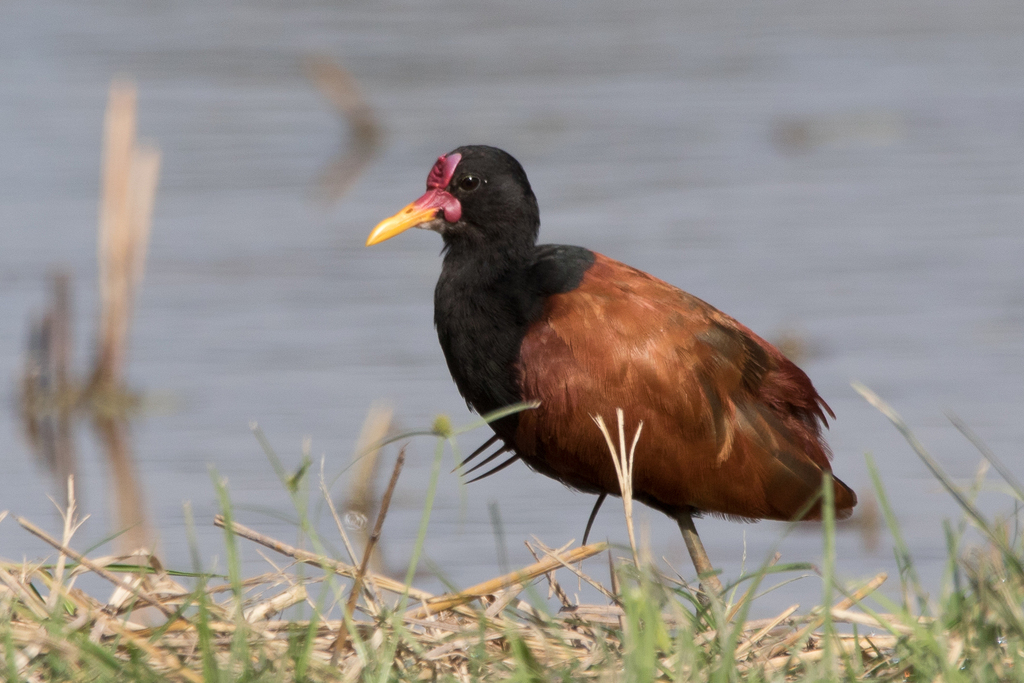
Jacana Sudamericana
Photo © Frank Thomas Sautter
Photo © Frank Thomas Sautter — CC0 1.0 — Source: iNaturalist photo #476719491Identification
The wattled jacana is a strikingly distinctive wader, unmistakable in its appearance. Adults are 17–23 cm long, with females noticeably larger than males. They display a rich chestnut back and wing coverts contrasting with a mainly black body, while their greenish-yellow flight feathers are conspicuous in flight. The species' most remarkable features are its bright yellow bill, which extends upward into a red coot-like head shield and reddish wattle, plus yellow bony spurs on the leading edge of the wings that serve as weapons for defense. The legs and exceptionally long toes are dull blue-grey. Young birds are always identifiable by the presence of white in their plumage, particularly on the underparts.
Six subspecies exist across the species' range, with subtle variations. The nominate jacana is most widespread, while J. j. hypomelaena of western Panama and northern Colombia replaces all chestnut plumage with black. J. j. scapularis of western Ecuador shows black feathers on the chestnut shoulders and white outer primary feathers.
Range & Habitat
The wattled jacana is found throughout much of South America east of the Andes, as well as in western Panama and Trinidad, making it the only Jacanidae species with such extensive distribution. It inhabits wetland environments where aquatic vegetation thrives, relying on its characteristically long toes and claws to walk across floating plants without sinking.
Behaviour & Diet
Wattled jacanas exhibit unusual breeding systems: females are polyandrous, forming harems of up to four or five males. Females are not only larger but also more heavily ornamented with facial crests and larger wings, and possess longer wing spurs for defense than males. These roles reverse at breeding time—males assume responsibility for incubating the four black-marked brown eggs in floating nests, holding two eggs between each wing and the breast, while females help defend the nests of multiple mates. The species is highly vocal, producing a range of noisy rattling calls, earning its name from the Tupi word ñaha'nã, meaning "very loud bird."
The wattled jacana forages across water and floating vegetation for a diverse diet including insects such as beetles, grasshoppers, and crickets, plus other invertebrates like ticks and mollusks. It also takes small fish, roots, and seeds picked from the water's surface or vegetation.
Best Time & Places to See It
This conspicuous bird is found across a vast range from Trinidad south through the Guianas, Venezuela, Colombia, Ecuador, Peru, and Brazil to eastern Bolivia, northern Argentina, and Uruguay. Look for wattled jacanas in freshwater wetlands with abundant floating vegetation—marshes, lagoons, and pond edges provide ideal habitat. Their loud, rattling calls often announce their presence before they're seen.
Photography Tips
The wattled jacana's striking coloration and bold markings make it a rewarding photographic subject. Position yourself near floating vegetation where they forage, and use the bird's vocalizations to locate individuals. The bright yellow bill, red head shield, and distinctive body pattern are best captured in good light. Photograph young birds to capture their characteristic white plumage, and watch for wing-spur displays during territorial or defensive behavior—these dramatic moments showcase the species' unique weaponry.
Tijuca National Park
Brasil
+127 aves+30 mamíferos
Where Atlantic rainforest clings to steep granite slopes mere kilometres from Rio de Janeiro’s urban sprawl, one of Brazil’s most […]
VER PARQUE NACIONALEmas National Park
Brasil
+128 aves+29 mamíferos
Vast grasslands ripple across the central Brazilian plateau, where fire has sculpted the landscape for millennia. Parque Nacional das Emas […]
VER PARQUE NACIONALYasuní National Park
Aguarico, Ecuador
+132 aves+30 mamíferos
Where the Napo and Curaray rivers carve through Ecuador’s vast Amazonian lowlands, one of Earth’s most biodiverse terrestrial ecosystems sprawls […]
VER PARQUE NACIONALCerros de Amotape National Park
District of San Jacinto, Ecuador
+117 aves+6 mamíferos
Where granite peaks pierce the tropical sky above northwestern Ecuador, a landscape of extraordinary ecological complexity unfolds across nearly 4,800 […]
VER PARQUE NACIONALNatural Utría National Park
Alto Baudó (Pie de Pató), Colombia
+144 aves+15 mamíferos
Where the Chocó rainforest plunges headlong into the Pacific, a pristine coastal wilderness unfolds across 1,287 square kilometers of Colombia’s […]
VER PARQUE NACIONALNatural el Cocuy National Park
Güicán, Colombia
+139 aves+13 mamíferos
Where snow-capped peaks pierce the Colombian highlands at over 5,000 metres, a landscape of stark geological drama unfolds across nearly […]
VER PARQUE NACIONALMorrocoy National Park
Municipio Silva
+91 aves+4 mamíferos
Where crystalline Caribbean waters meet Venezuela’s northern coast, a mosaic of coral reefs, white-sand beaches, and mangrove forests creates one […]
VER PARQUE NACIONALAmacayacu National Park
Leticia, Colombia
+133 aves+29 mamíferos
Where the Amazon’s dark waters merge with flooded forest and terra firme upland, five thousand square kilometres of pristine wilderness […]
VER PARQUE NACIONALPeixe National Park Lagoon
Brasil
150+ aves+5 mamíferos
Coastal lagoons and barrier-island ecosystems unfold across southern Brazil’s Rio Grande do Sul, where freshwater meets Atlantic salt in an […]
VER PARQUE NACIONALViruá National Park
Brasil
+103 aves+14 mamíferos
Where granite inselbergs rise dramatically from the Amazon’s northern fringe, a 3,651-square-kilometre wilderness unfolds across Roraima State. This Category II […]
VER PARQUE NACIONALPantanal Matogrossense National Park
Brasil
+139 aves+21 mamíferos
Where water and grassland merge in the heart of Brazil’s Mato Grosso do Sul, one of South America’s most biodiverse […]
VER PARQUE NACIONALLençóis Maranhenses National Park
Brasil
+60 aves+3 mamíferos
Across 3,670 square kilometres of northeastern Brazil, an improbable landscape unfolds: a vast mosaic of freshwater lagoons, palm-studded dunes, and […]
VER PARQUE NACIONALChapada Diamantina National Park
Brasil
+100 aves+5 mamíferos
Where granite plateaus rise dramatically from the Atlantic Forest’s green embrace, a landscape of profound geological drama unfolds across the […]
VER PARQUE NACIONALAnavilhanas National Park
Brasil
+132 aves+30 mamíferos
Where the Rio Negro braids into a labyrinth of islands and waterways, one of the Amazon’s most pristine archipelagos unfolds […]
VER PARQUE NACIONALManu National Park
Manu, Perú
+131 aves+30 mamíferos
Where the Andes plunge into the Amazon basin, a wilderness of uncompromising scale unfolds across 1.5 million hectares. Spanning three […]
VER PARQUE NACIONALBahuaja Sonene National Park
San Pedro de Putina Punco, Perú
+132 aves+30 mamíferos
Where granite ridges rise above the confluence of Peru’s Río Heath and Río Tambopata, one of the Amazon’s most pristine […]
VER PARQUE NACIONALSarigua National Park
Parita, Panamá
+69 aves+3 mamíferos
Where the Pacific’s tidal rhythms sculpt Panama’s coastline, a mosaic of mangrove forests, deciduous woodlands, and seasonally flooded wetlands creates […]
VER PARQUE NACIONALSoberanía National Park
Cristóbal, Panamá
+132 aves+30 mamíferos
Where the Chagres River cuts through lowland tropical forest mere kilometres from Panama City’s skyline, one of Central America’s most […]
VER PARQUE NACIONALChagres National Park
Caimitillo, Panamá
+131 aves+30 mamíferos
Where rainforest canopy meets mountain spine, the Chagres River carves through some of Central America’s most pristine tropical wilderness. Spanning […]
VER PARQUE NACIONALDarién National Park
Tucutí, Panamá
+132 aves+30 mamíferos
Where rainforest swallows the horizon and rivers carve through primordial wilderness, one of Central America’s last great untamed frontiers unfolds […]
VER PARQUE NACIONALPortobelo National Park
Portobelo, Panamá
+115 aves+16 mamíferos
Where Caribbean waters dissolve into rainforest, a protected realm of pristine coastal wilderness unfolds across 570 square kilometers of northern […]
VER PARQUE NACIONALEl Palmar National Park
Distrito Sexto, Argentina
+132 aves+21 mamíferos
Where the Paraná River winds through northern Argentina, vast groves of yatay palms rise from rolling grassland like a botanical […]
VER PARQUE NACIONALRío Pilcomayo National Park
Argentina
150+ aves+10 mamíferos
Where wetlands sprawl across the Argentine Chaco, the Pilcomayo River carves a vital ribbon of life through one of South […]
VER PARQUE NACIONALEl Rey National Park
Municipio de Las Lajitas, Argentina
+59 aves+8 mamíferos
Where subtropical mountain forests merge with humid lowland savannas, northwestern Argentina guards one of South America’s most biodiverse yet underexplored […]
VER PARQUE NACIONALChaco National Park
Municipio de Presidencia de la Plaza, Argentina
+142 aves+20 mamíferos
Where the Gran Chaco’s thornforests meet wetland mosaics, a landscape of profound ecological contrast unfolds across northwestern Argentina. This 151-square-kilometre […]
VER PARQUE NACIONALAún no hay fotos de la comunidad. Inicia sesión para añadir la primera.
Aún no hay observaciones de la comunidad de esta especie.