Achichilique común
Photo © Dan Vickers
Photo © Dan Vickers — CC BY 4.0 — Source: iNaturalist #262026337Identification
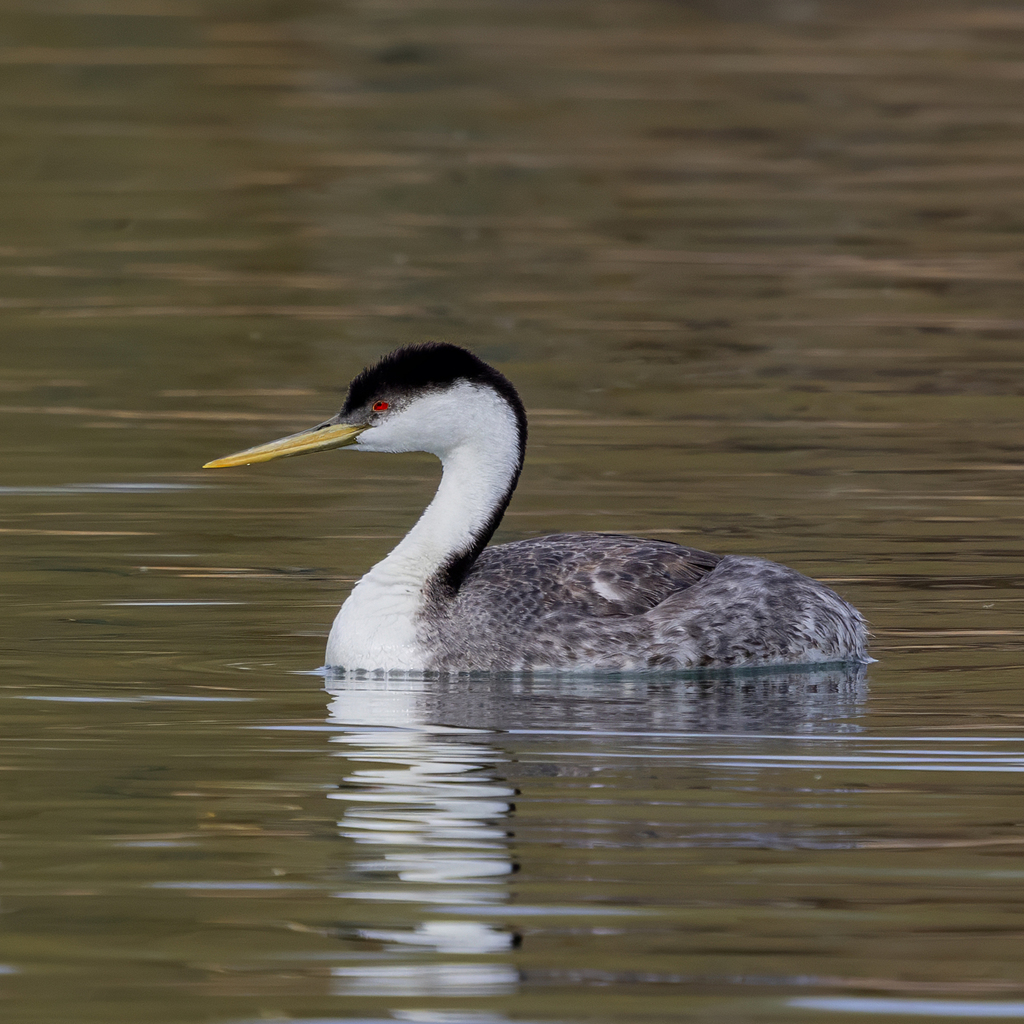
The western grebe is the largest North American grebe, measuring 55–75 cm long with a wingspan of 79–102 cm and weighing 795–2,000 g. Its most striking features are its black-and-white plumage, long slender swan-like neck, and distinctive red eyes. The bird has a straight greenish-yellow bill and black markings around the eyes. It can be easily confused with Clark's grebe, which shares similar size, behavior, and habitat, though the two species are known to interbreed. Key differences include Clark's grebe having whiter flanks, a paler gray back, white (rather than black) eye patches, and an upturned bright yellow bill. The downy young of western grebes are grey, while Clark's young are white.
Range & Habitat
The western grebe is widespread throughout western North America, with no single area of particular abundance. This species is found across a broad geographic range extending from western Canada and the United States (including California and Utah) south to Mexico. Northern populations migrate west to coastal ocean waters in winter, while birds in the southwest and Mexico may remain as permanent residents year-round.
Western grebes nest in colonies of hundreds on large inland lakes, sometimes using coastal marshes. They prefer bodies of water that combine marsh vegetation with open water. Nests are constructed from plant debris and sodden materials, built by both sexes beginning roughly from late April through June and continuing throughout laying and incubation.
Behaviour & Diet
Western grebes are renowned for their elaborate and synchronized courtship displays, among the most complex in waterbird species. The Rushing Ceremony—also called a water dance—is the most frequent display for forming pair-bonds. In this spectacular behavior, two birds rear up and patter across the water's surface with stiff, lifted wings and curved necks. This display occurs in same-sex pairs or between males and females; competing males may perform Rushing together to attract female attention, with the winner continuing with his chosen mate.
Following pair formation, birds perform the Weed Ceremony, where mates bob their heads in water, dive in place, and resurface while holding weed in their beaks. This precedes mating and nest-building activities. The Greeting Ceremony involves dip-shaking (dipping the head while rapidly waggling the bill side to side with conspicuous water splash) and bob-shaking. After breeding, male western grebes feed their mates as part of mate-feeding behavior.
Best Time & Places to See It
The breeding season, from roughly late April through June, is the ideal time to observe western grebes, particularly if you wish to witness their famous courtship displays. Large inland lakes in western North America offer the best viewing opportunities, especially those with mixed marsh vegetation and open water. Coastal ocean areas are particularly good for observing northern populations during winter months.
Photography Tips
Photographing western grebes during their breeding season courtship displays offers spectacular opportunities. The Rushing Ceremony, with birds pattering across water in an upright posture with wings lifted and necks curved, provides dynamic action shots. Early morning light on lakes is ideal for capturing the contrast between their black-and-white plumage and for highlighting their distinctive red eyes. Their large size and gregarious nesting behavior in colonies of hundreds means you can often find multiple subjects within a single frame.
Glacier National Park
Glacier, Canadá
+123 aves+30 mamíferos
Where the Columbia Mountains rise in British Columbia’s interior, temperate rainforest gives way to alpine meadows scattered with late-lying snow. […]
VER PARQUE NACIONALBanff National Park
Improvement District No. 9, Canadá
+121 aves+30 mamíferos
Where turquoise glacial lakes mirror jagged peaks and coniferous forests sweep across vast alpine plateaus, one of North America’s most […]
VER PARQUE NACIONALJasper National Park
Improvement District No. 12, Canadá
+127 aves+32 mamíferos
Where the Canadian Rockies erupt into a wilderness of turquoise glacial lakes and precipitous valleys, nearly 11,000 square kilometres of […]
VER PARQUE NACIONALLassen Volcanic National Park
Shasta County, Estados Unidos
+114 aves+25 mamíferos
Steaming vents pierce a landscape sculpted by volcanic fury, where obsidian flows meet alpine meadows across nearly 550 square kilometers […]
VER PARQUE NACIONALGrand Teton National Park
Teton County, Estados Unidos
+123 aves+30 mamíferos
Where granite peaks pierce the Wyoming sky, a landscape of raw geological drama unfolds across 2,550 square kilometers of pristine […]
VER PARQUE NACIONALYellowstone National Park
Park County, Estados Unidos
+120 aves+31 mamíferos
Geothermal plumes rise from an alien landscape where boiling springs feed crystalline pools and geysers erupt with clockwork precision across […]
VER PARQUE NACIONALBlack Canyon of the Gunnison National Park
Montrose County, Estados Unidos
+103 aves+23 mamíferos
Where granite walls plunge nearly 2,000 feet to meet the Gunnison River’s relentless current, some of North America’s steepest and […]
VER PARQUE NACIONALRedwood National Park
Humboldt County, Estados Unidos
+126 aves+29 mamíferos
Where ancient titans pierce the California fog, the tallest trees on Earth create a primordial landscape unlike anywhere else. Spanning […]
VER PARQUE NACIONALEl Vizcaíno
Laguna San Ignacio, México
+101 aves+15 mamíferos
Where the Baja California peninsula thins into a tapestry of salt lagoons and coastal desert, one of Mexico’s most biodiverse […]
VER RESERVA DE LA BIOSFERAAún no hay fotos de la comunidad. Inicia sesión para añadir la primera.
Aún no hay observaciones de la comunidad de esta especie.