Abejaruco Frentiblanco
Photo © Darren Obbard
Photo © Darren Obbard — CC BY 4.0 — Source: iNaturalist #188818412Identification
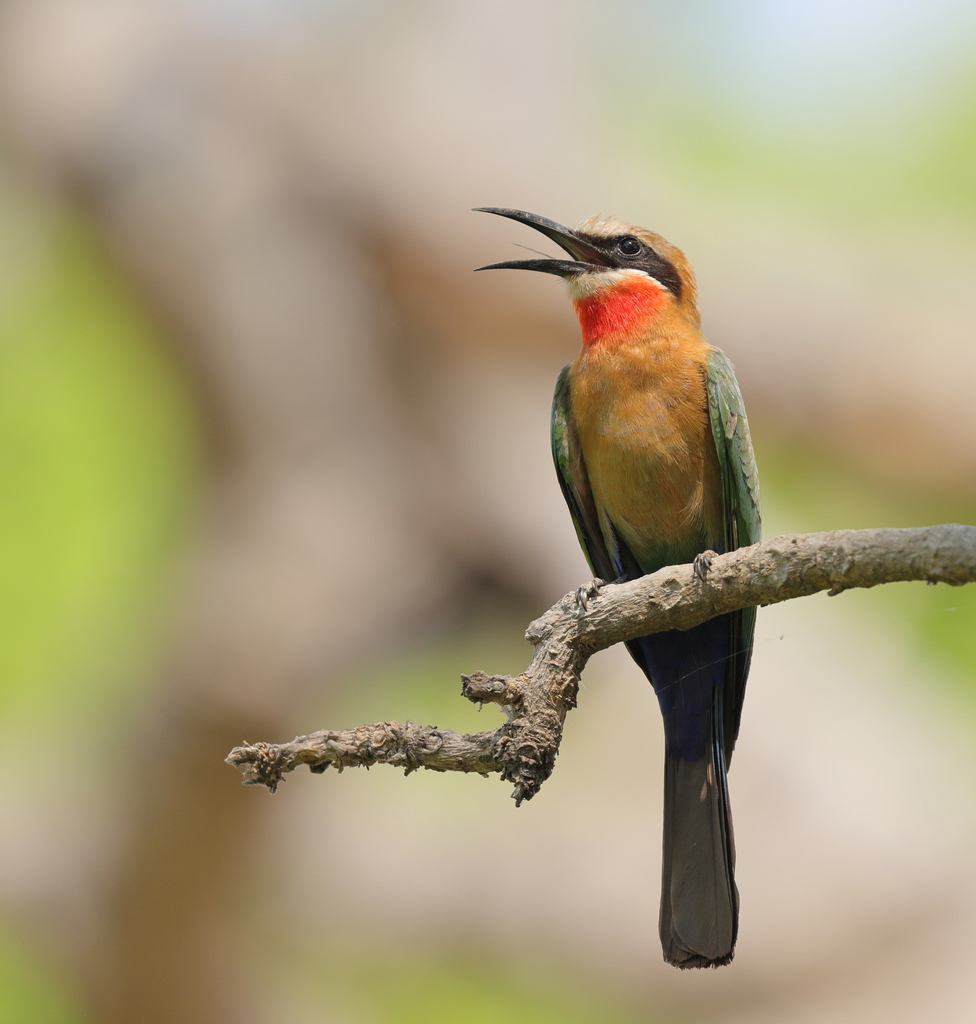
The white-fronted bee-eater is a richly coloured, slender bird measuring 23 cm (9 inches) in length. Its most distinctive features are a bright white forehead, a striking black mask, and a brilliant red throat patch. The upperparts are green while the underparts display warm cinnamon tones, and the tail is notably square-shaped. Like all bee-eaters, it is an elegant and colourful species, and its deep squeaking call is distinctive and often heard before the bird is seen.
Range & Habitat
The white-fronted bee-eater is widely distributed across the vast savannah regions of sub-equatorial Africa. These birds favour open country, particularly areas near gullies where their primary prey—bees—are abundant. A population of white-fronted bee-eaters may range across many square kilometres of savannah, yet individuals consistently return to the same colony sites for roosting, socializing, and breeding.
Behaviour & Diet
This species exhibits one of the most complex family-based social systems found in birds. White-fronted bee-eaters nest in colonies averaging 200 individuals, digging roosting and nesting holes in cliffs or earthen banks. The colonies comprise socially monogamous, extended family groups known as "clans," which practice cooperative breeding. Remarkably, non-breeding individuals become helpers to their relatives, assisting in approximately half of all nesting attempts. These helpers contribute to all aspects of reproduction, from chamber excavation to feeding young, significantly increasing breeding success. Helper behaviour is strongly influenced by kinship, with individuals preferentially assisting their closest relatives.
White-fronted bee-eaters hunt primarily on bees, supplemented by other flying insects according to seasonal availability. They employ two distinct hunting methods: making quick hawking flights from lower branches of shrubs and trees, or gliding slowly downward from a perch to hover briefly before capturing prey.
Best Time & Places to See It
Look for white-fronted bee-eaters in open savannah habitat, particularly near gullies and water courses where bees congregate. They can usually be seen in low trees, where they wait between hunting sorties. Their colonies return to traditional roosting and breeding sites, making these locations reliable viewing points.
Photography Tips
The white forehead, black mask, and red throat make this species visually striking and rewarding to photograph. Position yourself near known colony sites and watch from low vantage points where the birds hunt. Early morning and late afternoon light will enhance the brilliant colours of the plumage. Patience is essential, as capturing the bird in its characteristic hawking flight or hovering manoeuvre requires anticipation and quick reflexes. The bird's frequent calls can help locate individuals in vegetation.
Arusha National Park
Tanzania
+132 aves+30 mamíferos
Where the volcanic slopes of Mount Meru rise dramatically from Tanzania’s northern highlands, a landscape of extraordinary ecological diversity unfolds […]
VER PARQUE NACIONALMapungubwe National Park
Musina Local Municipality, Botsuana
+132 aves+30 mamíferos
Where the Limpopo River carves a boundary between nations, ancient sandstone cliffs rise in sculptured isolation above riverine woodland and […]
VER PARQUE NACIONALChobe National Park
Botsuana
+122 aves+30 mamíferos
Where the Zambezi River cuts through northern Botswana, one of Africa’s greatest concentrations of large mammals gathers across flood plains, […]
VER PARQUE NACIONALPilanesberg National Park
Moses Kotane Local Municipality, Sudáfrica
+130 aves+30 mamíferos
Where ancient volcanic calderas rise above the surrounding lowveld, a 734-square-kilometre sanctuary unfolds across the North West Province of South […]
VER PARQUE NACIONALKruger National Park
Ba-Phalaborwa Local Municipality, Sudáfrica
+132 aves+30 mamíferos
Where the Limpopo River forms a natural frontier, vast savannas sweep across nearly 20,000 square kilometers of pristine African wilderness. […]
VER PARQUE NACIONALMarakele National Park
Modimolle Local Municipality, Sudáfrica
+122 aves+30 mamíferos
Where granite gorges slice through the bushveld and ancient mountains rise in weathered majesty, southern Africa’s most underrated wilderness unfolds […]
VER PARQUE NACIONALNkasa Rupara National Park
Namibia
+106 aves+28 mamíferos
Where the Okavango Delta’s papyrus-choked waterways spill into northern Namibia’s borderlands, a landscape of startling contrasts emerges. Sprawling across 518 […]
VER PARQUE NACIONALBwabwata National Park
Namibia
150+ aves+23 mamíferos
Where the Kavango and Zambezi rivers converge across northeastern Namibia, a vast wilderness of 14,249 square kilometres unfolds in layers […]
VER PARQUE NACIONALAún no hay fotos de la comunidad. Inicia sesión para añadir la primera.
Aún no hay observaciones de la comunidad de esta especie.