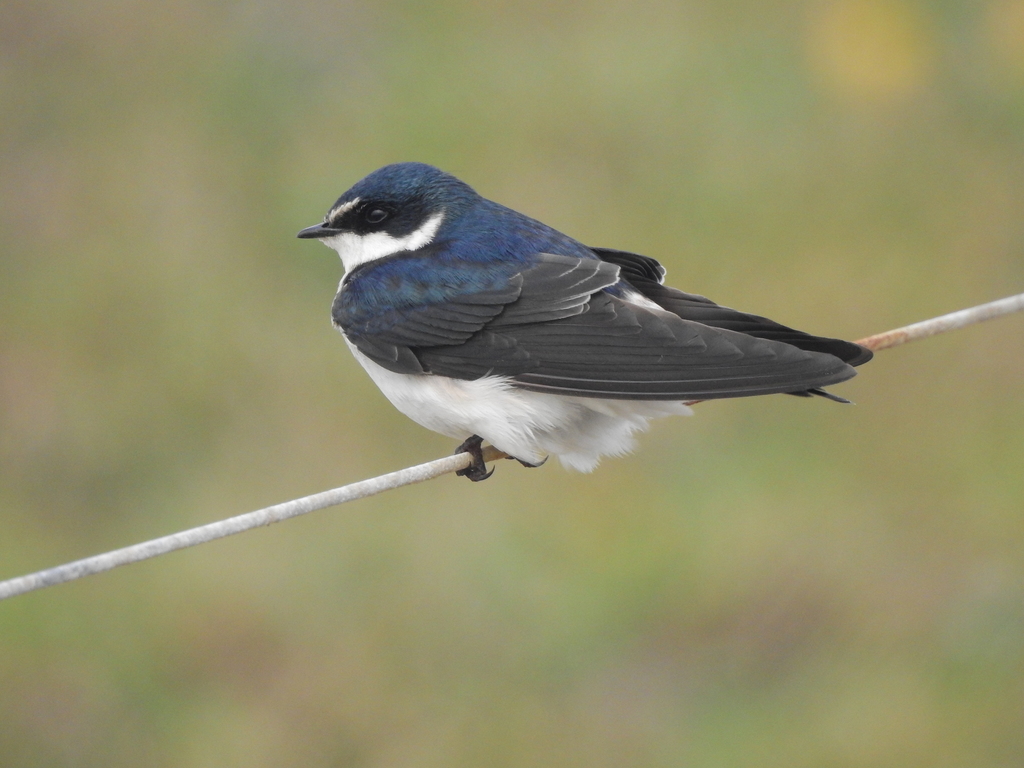
Golondrina Cejiblanca
Photo © Diana Fuentes
Photo © Diana Fuentes — CC BY-SA 4.0 — Source: iNaturalist photo #28096412The white-rumped swallow (Tachycineta leucorrhoa) is a species of bird in the family Hirundinidae. First described and given its binomial name by French ornithologist Louis Pierre Vieillot in 1817, it was for many years considered a subspecies of the Chilean swallow. The species is monotypic with no known population variations. It has a white supraloral streak, or streak above its lores (the region between a bird's eye and nostrils), which can be used to differentiate it from the Chilean swallow. The lores, ear coverts, tail, and wings are black, with white tips on the inner secondaries, tertials, and greater coverts of the wings. The rest of the upperparts are a glossy blue. Its underparts and underwing-coverts are white, in addition to the rump, as the name suggests. The sexes are similar, and the juvenile is duller and browner with a dusky breast. This species usually builds its nest in holes in trees or dead snags or under or in artificial structures like fence posts and the eaves of buildings. The white-rumped swallow is solitary and nests in distributed pairs during the breeding season. The breeding season is from October to December in Brazil and from October to February in neighboring…
Emas National Park
Brasil
+128 aves+29 mamíferos
Vast grasslands ripple across the central Brazilian plateau, where fire has sculpted the landscape for millennia. Parque Nacional das Emas […]
VER PARQUE NACIONALPeixe National Park Lagoon
Brasil
150+ aves+5 mamíferos
Coastal lagoons and barrier-island ecosystems unfold across southern Brazil’s Rio Grande do Sul, where freshwater meets Atlantic salt in an […]
VER PARQUE NACIONALSerra Geral National Park
Brasil
+124 aves+14 mamíferos
Where granite escarpments rise abruptly from the Atlantic Forest canopy, a landscape of dramatic canyons and windswept plateaus defines one […]
VER PARQUE NACIONALAún no hay fotos de la comunidad. Inicia sesión para añadir la primera.
Aún no hay observaciones de la comunidad de esta especie.