Zenaida Aliblanca
Photo © MarvalPhotography19
Photo © MarvalPhotography19 — CC BY 4.0 — Source: iNaturalist photo #315034537Identification
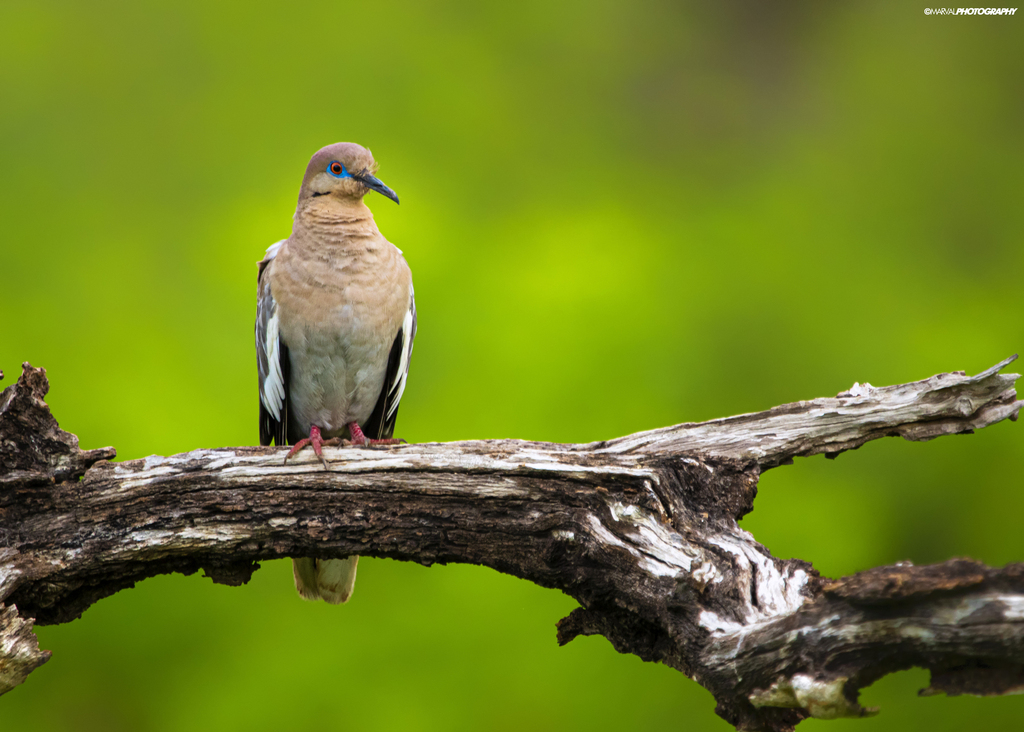
The white-winged dove is a large dove, measuring 29 cm from tip to tail with a wingspan of 48–58 cm. Its most distinctive feature is the bold white wing patch that appears as a brilliant white crescent in flight and is visible even at rest—a characteristic that sets it apart from similar species like the mourning dove. Adults display brownish-gray plumage above and gray below, with a striking blue ring of featherless skin around each eye and bright crimson eyes. A long, dark mark on the lower face and bright pink or red legs further distinguish this species. Males show slightly more iridescent purple tones on the crown, neck, and nape, though sexing in the field is difficult. Juveniles are duller and grayer, with brown eyes rather than the adult's crimson, and typically show juvenile plumage between March and October.
Range & Habitat
The white-winged dove's native range extends from the Southwestern United States through Mexico, Central America, and the Caribbean. Three subspecies are recognized, with geographical variation in size and coloration: eastern birds tend to be paler and grayer, while southern birds are browner and darker. These doves inhabit a variety of environments including desert, scrub, and urban areas. Historically, their range closely mirrored that of the saguaro cactus, their favored food source. However, human expansion and agriculture have dramatically altered their distribution, greatly expanding their range by providing reliable grain sources and leading some modern populations to become migratory.
Behaviour & Diet
White-winged doves are highly adaptable birds whose diet consists mostly of grains, though they also consume pollen and nectar, particularly from the saguaro cactus—a vital source of water for these desert-dwelling birds. Their distinctive call is likened to the English phrase "who cooks for you." Historically, these doves nested in enormous colonies, though most have been lost to human activities and climate change, resulting in nesting now occurring largely in isolation rather than in massive aggregations. Despite significant habitat loss and being the second most shot game bird in the United States, this species has proved remarkably adaptable to human environments.
Best Time & Places to See It
White-winged doves are found throughout the Southwestern United States, Mexico, Central America, and the Caribbean. Their presence in agricultural areas and urban environments makes them accessible to travellers in these regions. Some populations are migratory, so timing may vary by location. The International Union for Conservation of Nature classifies this species as least-concern, ensuring stable populations across much of its range.
Photography Tips
The white-winged dove's distinctive white wing patch is best captured in flight, where it appears as a brilliant white crescent against the bird's brownish-gray plumage. When photographing perched birds, focus on the striking blue eye-ring and crimson eyes, along with the dark facial mark. The bird's plump, medium-sized frame and relatively bold behaviour in urban and agricultural settings make it approachable for photographers. Light conditions that emphasize the contrast between the white wings and darker body plumage will produce the most striking images.
Manuel Antonio National Park
Quepos, Costa Rica
+125 aves+30 mamíferos
White sand beaches curve between steep jungle walls where the Pacific laps against Costa Rica’s most biodiverse coastal sanctuary. Rainforest […]
VER PARQUE NACIONALArenal Volcano National Park
Peñas Blancas, Costa Rica
+131 aves+30 mamíferos
Where a perfect cone of dark basalt rises 1,633 metres above rainforest canopy, Costa Rica’s most iconic volcano commands a […]
VER PARQUE NACIONALChirripó National Park
Rivas, Costa Rica
+132 aves+30 mamíferos
Where the Central American spine rises above the clouds, granite peaks puncture a realm of perpetual mist and montane forest. […]
VER PARQUE NACIONALBraulio Carrillo National Park
Las Horquetas, Costa Rica
+132 aves+30 mamíferos
Steep volcanic slopes plunge into misty valleys where primary tropical rainforest cloaks the landscape in unrelenting green. Rising from 2,000 […]
VER PARQUE NACIONALSanta Rosa National Park
Santa Elena, Costa Rica
+129 aves+30 mamíferos
Dawn breaks over a mosaic of dry forest and humid woodland where Costa Rica’s northwestern peninsula juts into the Pacific. […]
VER PARQUE NACIONALGuanacaste National Park
Santa Elena, Costa Rica
+132 aves+30 mamíferos
Where Pacific dry forest meets cloud-shrouded volcanic peaks, one of Costa Rica’s most biodiverse conservation areas unfolds across northwestern Guanacaste […]
VER PARQUE NACIONALVolcán Poás National Park
Toro Amarillo, Costa Rica
+132 aves+30 mamíferos
Where volcanic peaks pierce the Costa Rican highlands, a landscape of primordial drama unfolds. The Poás volcano dominates this 6,506-hectare […]
VER PARQUE NACIONALBig Bend National Park
Brewster County, Estados Unidos
+121 aves+29 mamíferos
Where the Rio Grande carves a serpentine boundary between Texas and Mexico, the Chisos Mountains rise abruptly from desert scrubland […]
VER PARQUE NACIONALSaguaro National Park
Tucson, Estados Unidos
+126 aves+28 mamíferos
Towering sentinels of the Sonoran Desert rise across nearly two thousand square kilometers of Arizona’s most iconic terrain. These magnificent […]
VER PARQUE NACIONALJoshua Tree National Park
Riverside County, Estados Unidos
+123 aves+29 mamíferos
Where two vast deserts collide, twisted rock formations pierce a sky of startling clarity. Spanning over 5,600 square kilometres of […]
VER PARQUE NACIONALCarlsbad Caverns National Park
Eddy County, Estados Unidos
+131 aves+27 mamíferos
Where limestone towers pierce the New Mexico desert, an underground realm rivals the grandeur of any above-ground landscape. Spanning 518 […]
VER PARQUE NACIONALSaguaro National Park – Tucson Mountain District
Pima County, Estados Unidos
+134 aves+26 mamíferos
Granite peaks rise abruptly from the Sonoran Desert floor, their bajadas cloaked in a forest of colossal saguaro cacti that […]
VER PARQUE NACIONALSaguaro National Park – Rincon Mountain District
Pima County, Estados Unidos
+131 aves+28 mamíferos
Dawn breaks over slopes where towering saguaro cacti puncture the Sonoran Desert sky like sentinels guarding an ancient realm. This […]
VER PARQUE NACIONALDeath Valley National Park
Inyo County, Estados Unidos
+130 aves+29 mamíferos
Where scorched salt flats stretch beneath some of Earth’s most punishing skies, a landscape of extremes unfolds across 30,012 square […]
VER PARQUE NACIONALSarigua National Park
Parita, Panamá
+69 aves+3 mamíferos
Where the Pacific’s tidal rhythms sculpt Panama’s coastline, a mosaic of mangrove forests, deciduous woodlands, and seasonally flooded wetlands creates […]
VER PARQUE NACIONALDzibilchantún National Park
Barcelona, México
+97 aves+5 mamíferos
Cenotes puncture the limestone plateau of Mexico’s Yucatan Peninsula like sapphire eyes, and this compact 8-square-kilometre park shelters some of […]
VER PARQUE NACIONALLagunas de Montebello National Park
Laguna de Montebello, México
+126 aves+3 mamíferos
Crystalline waters pierce through limestone plateaus in the borderlands of Chiapas, where over fifty interconnected lakes create a landscape of […]
VER PARQUE NACIONALArrecifes de Cozumel National Park
San Miguel de Cozumel, México
+134 aves+21 mamíferos
Crystalline waters lap against the world’s second-longest coral barrier reef, where vibrant walls of living limestone plunge into the abyss. […]
VER PARQUE NACIONALSian Ka’an
Chunyaxché, México
+115 aves
Where mangrove labyrinths dissolve into turquoise shallows and jungle canopy meets pristine Caribbean shoreline, one of Mexico’s most biodiverse reserves […]
VER RESERVA DE LA BIOSFERASierra de Tamaulipas
El Porvenir, México
+91 aves+20 mamíferos
Where limestone peaks thrust skyward through dense subtropical forest, Mexico’s northeastern frontier reveals one of the continent’s most biodiverse mountain […]
VER RESERVA NATURALParque Nacional Cerro de la Estrella
México
+123 aves+30 mamíferos
Volcanic ridges rise abruptly from the valley floor south of Mexico City, their slopes clothed in a mosaic of pine-oak […]
VER PARQUE NACIONALParque Nacional Benito Juárez
San Andrés Huayápam, México
+129 aves+30 mamíferos
Towering pine and fir forests blanket the high plateaus of Oaxaca’s Sierra Madre Oriental, where elevation exceeds 3,600 meters and […]
VER PARQUE NACIONALParque Nacional Grutas de Cacahuamilpa
Pilcaya, México
+141 aves+19 mamíferos
Where limestone cliffs plunge into shadowed canyons, the Río Río Grande carves its ancient passage through one of Mexico’s most […]
VER PARQUE NACIONALAún no hay fotos de la comunidad. Inicia sesión para añadir la primera.
Aún no hay observaciones de la comunidad de esta especie.