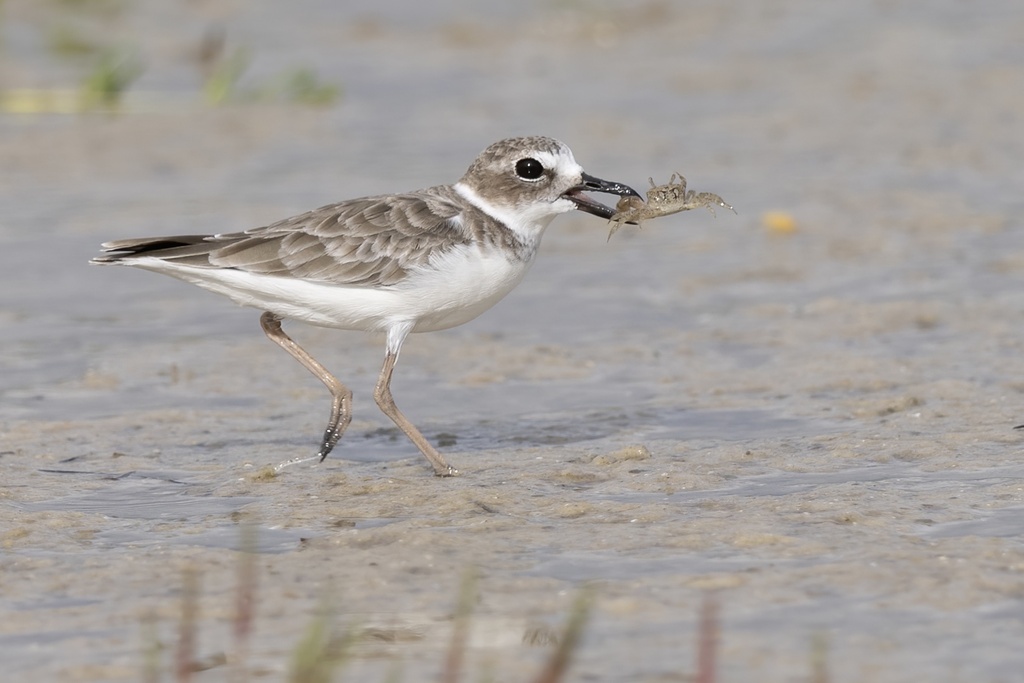
Chorlitejo Piquigrueso
Photo © Matt Felperin
Photo © Matt Felperin — CC BY 4.0 — Source: iNaturalist photo #333628462Wilson's plover (Anarhynchus wilsonia) is a small bird of the family Charadriidae. It was named after the Scottish-American ornithologist Alexander Wilson by his friend George Ord in 1814. Wilson's plover is a coastal wader which breeds on both coasts of the Americas from the equator northwards. Its range extends north to include much of the U.S. eastern seaboard, and the Pacific coast of Mexico on the west. == Range and habitat == It is a partial migrant. Birds leave the United States, except Florida, to winter south in Brazil. Some Mexican birds leave in winter for Peru. Furthermore, a small resident population is known from Brazil, it being named as a new subspecies, brasiliensis, in 2008. In 2012 it was established that this is a junior synonym, and the correct name for the subspecies is crassirostris. This also means that one of the subspecies of the greater sand plover had to be renamed. This strictly coastal plover nests on a bare scrape on sandy beaches or sandbars. == Description == The breeding male has a black breast band, lores and forecrown, and a rufous mask. Females and non-breeding males have a similar plumage, but the black of the breeding male…
Morrocoy National Park
Municipio Silva
+91 aves+4 mamíferos
Where crystalline Caribbean waters meet Venezuela’s northern coast, a mosaic of coral reefs, white-sand beaches, and mangrove forests creates one […]
VER PARQUE NACIONALSarigua National Park
Parita, Panamá
+69 aves+3 mamíferos
Where the Pacific’s tidal rhythms sculpt Panama’s coastline, a mosaic of mangrove forests, deciduous woodlands, and seasonally flooded wetlands creates […]
VER PARQUE NACIONALArrecifes de Cozumel National Park
San Miguel de Cozumel, México
+134 aves+21 mamíferos
Crystalline waters lap against the world’s second-longest coral barrier reef, where vibrant walls of living limestone plunge into the abyss. […]
VER PARQUE NACIONALAún no hay fotos de la comunidad. Inicia sesión para añadir la primera.
Aún no hay observaciones de la comunidad de esta especie.