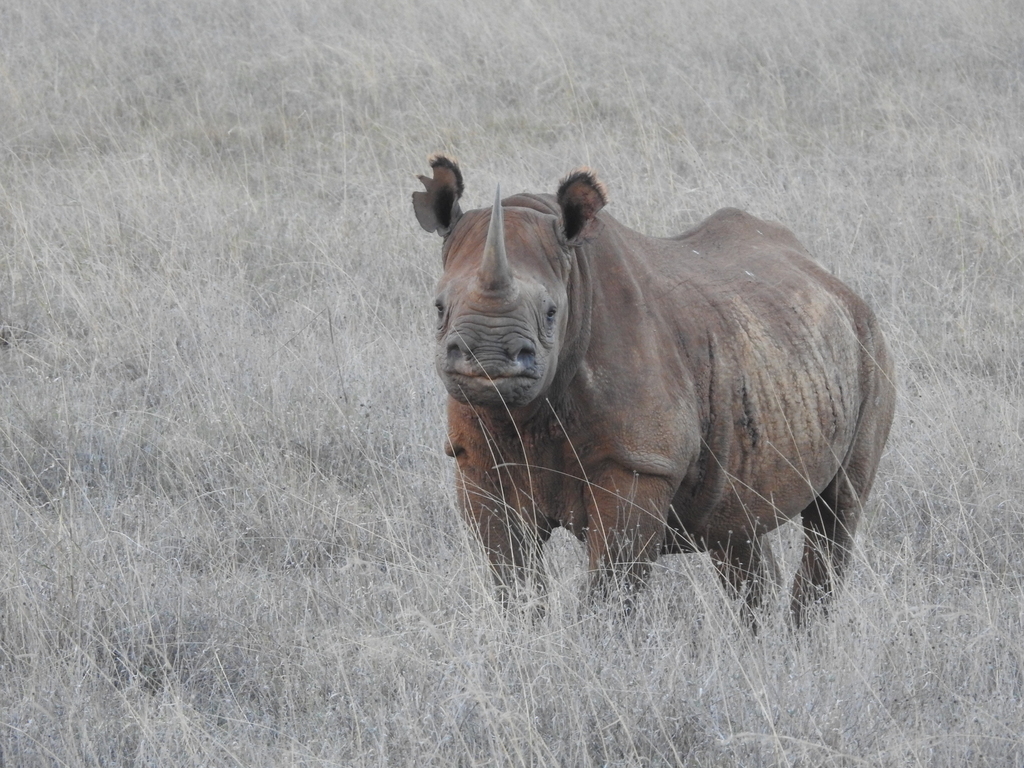
rinoceronte Negro
Photo © Ashwin Viswanathan
Photo © Ashwin Viswanathan — CC BY 4.0 — Source: iNaturalist #190595946Identification
The black rhinoceros is often confused with Africa's other native rhino species, the white rhinoceros, but they are distinguished by their lip shape. The black rhino has a distinctive pointed or hooked upper lip, earning it the alternative name "hook-lipped rhinoceros," while the white rhino has a square upper lip. Despite its name, the black rhinoceros's colour varies from brown to grey rather than being uniformly black. Like all rhinos, it is a massive, thick-skinned animal with two horns, and it is the only extant species in the genus Diceros.
Range & Habitat
The black rhinoceros is native to East and Southern Africa, with its range spanning Angola, Botswana, Eswatini, Kenya, Lesotho, Malawi, Mozambique, Namibia, South Africa, Tanzania, Zambia, and Zimbabwe. However, its distribution is highly fragmented today. Different subspecies occupy different regions: the Eastern black rhinoceros is found primarily in Kenya, Rwanda, and Tanzania (with a population in South Africa's Addo Elephant National Park); the South-central black rhinoceros, the most widely distributed subspecies, survives in reserves across much of its former range from northeastern South Africa to northeastern Tanzania; and the South-western black rhinoceros, adapted to desert and semi-desert conditions, is restricted to wildlife reserves in Namibia with occasional sightings in Angola.
Behaviour & Diet
Limited specific behavioural and dietary information is provided in available sources for this profile. Visitors seeking detailed ethological insights are encouraged to consult specialised field guides and wildlife reserves, where expert guides can provide in-depth observations of black rhino behaviour in their natural habitats.
Best Time & Places to See It
The black rhinoceros is critically endangered, with only an estimated 3,142 mature individuals remaining in the wild, making sightings rare and precious. The most reliable locations for viewing include national parks and wildlife reserves in Kenya, Tanzania, Namibia, and South Africa, particularly those managing the Eastern and South-central subspecies. Addo Elephant National Park in South Africa is one confirmed site. The South-western population in Namibian reserves offers another opportunity, though sightings remain unpredictable given the species' scarcity.
Photography Tips
Photographing black rhinos requires patience, as encounters are uncommon and the species is shy and elusive. Work with experienced guides at accredited reserves who understand animal behaviour and can position you safely for optimal viewing. Early morning and late afternoon often provide the best light and activity levels. Given the animal's size and the typically open savanna habitats where it may be spotted, a telephoto lens (at least 200–400mm) is essential to maintain safe distance while capturing detailed images of the distinctive hooked lip and horns.
Mount-Kenya National Park
Abothuguchi west ward, Kenya
+132 aves+30 mamíferos
Where the slopes of Kenya’s second-highest mountain rise steeply from the Meru County foothills, a landscape of profound ecological richness […]
VER PARQUE NACIONALNgorongoro Conservation Area
Tanzania
+123 aves+30 mamíferos
Volcanic calderas and open grassland dominate this high plateau in northern Tanzania, where the landscape rises above 2,000 metres and […]
VER ÁREA DE GESTIóN DE VIDA SILVESTREPilanesberg National Park
Moses Kotane Local Municipality, Sudáfrica
+130 aves+30 mamíferos
Granite peaks and volcanic ridges rise unexpectedly from the savanna floor across this 734-square-kilometre expanse in the North West province, […]
VER PARQUE NACIONALIthala Game Reserve
uPhongolo Local Municipality, Sudáfrica
+133 aves+29 mamíferos
Rolling thornbush savanna and acacia woodland dominate the landscape of this 494-square-kilometre national park in KwaZulu-Natal’s uPhongolo Local Municipality, where […]
VER PARQUE NACIONALEtosha National Park
Namibia
+62 aves+30 mamíferos
Across northern Namibia’s stark semi-arid plateau, a vast shallow depression transforms seasonally into one of Africa’s most dramatic wildlife theaters. […]
VER PARQUE NACIONALAún no hay fotos de la comunidad. Inicia sesión para añadir la primera.
Aún no hay observaciones de la comunidad de esta especie.