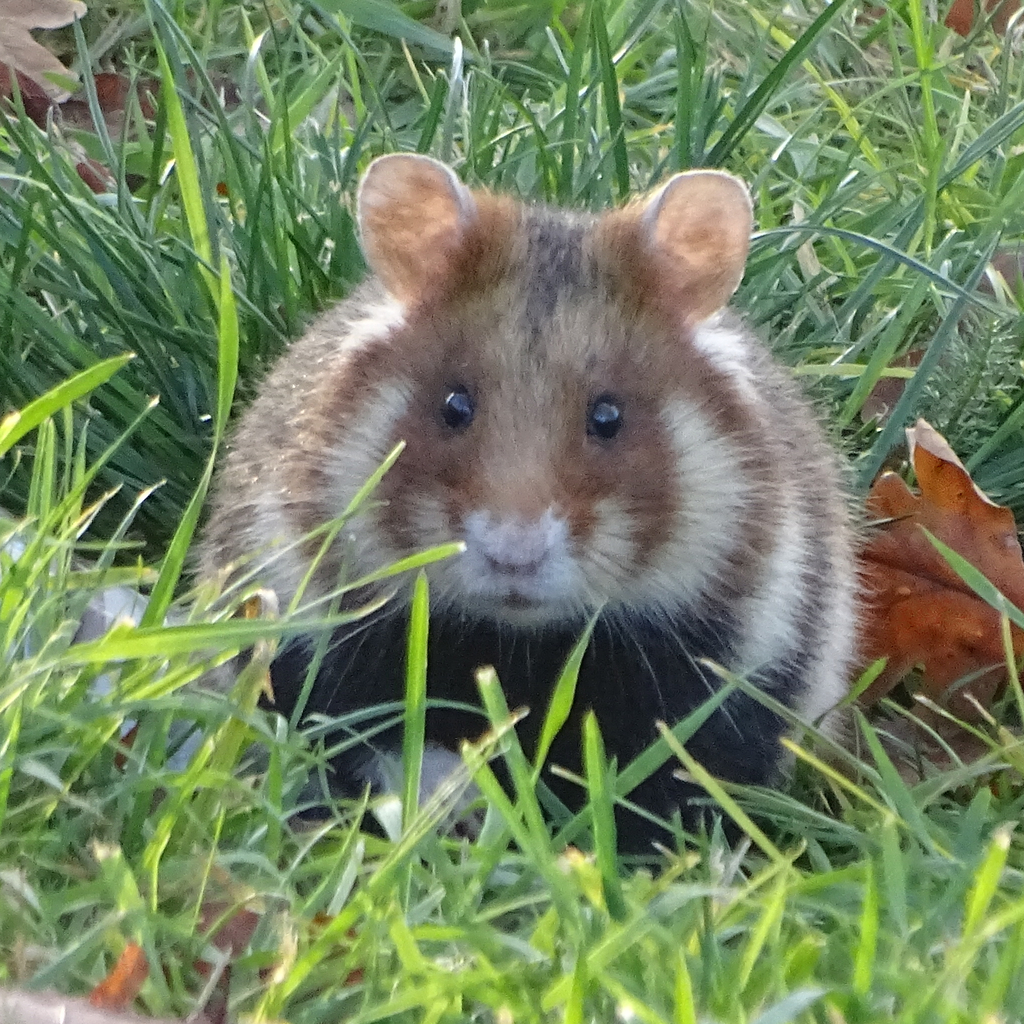
Hámster europeo
Photo © Patrick Hacker
Photo © Patrick Hacker — CC BY 4.0 — Source: iNaturalist #100269871The European hamster (Cricetus cricetus), also known as the Eurasian hamster, black-bellied hamster or common hamster, is the only living species of hamster in the genus Cricetus. It is native to grassland and similar habitats in a large part of Eurasia, extending from Belgium to Xinjiang in China. Historically, it was considered a farmland pest and had been trapped for its fur. Its population has declined drastically in recent years and is now considered critically endangered. The main threats to the species are thought to be intensive agriculture, habitat destruction, and persecution by farmers. == Description == The European hamster is the largest living hamster, reaching up to 20 to 30 centimetres (7.9 to 11.8 in) in length, with a relatively short tail around 4–6 cm (1.6–2.4 in) long, with a body mass typically around 200 to 650 grams (7.1 to 22.9 oz), though exceptionally body masses of over 1 kg (2.2 lb) have been recorded. Males are generally somewhat larger and heavier than females. The colour of the body fur varies from being black on the belly, brown on the back, as well as white and cream on the nose, paws, cheeks, neck, and behind the forelimbs, with some…
Hortobágy National Park
Hortobágy, Hungría
+132 aves+19 mamíferos
Where the Great Hungarian Plain stretches endlessly toward the horizon, vast wetlands and grasslands create one of Europe’s most dynamic […]
VER PARQUE NACIONALFertő–hanság National Park
Fertőszéplak, Hungría
+12 aves+27 mamíferos
Where shallow waters meet vast reed beds beneath wide Hungarian skies, one of Central Europe’s most dynamic wetland complexes unfolds […]
VER PARQUE NACIONALNizhnyaya Kama National Park
Yelabuzhsky District, Rusia
+118 aves+9 mamíferos
Where the middle Volga River carves through the ancient steppes of Tatarstan, a sprawling 1,100-square-kilometre sanctuary unfolds across meadows, wetlands, […]
VER PARQUE NACIONALAún no hay fotos de la comunidad. Inicia sesión para añadir la primera.
Aún no hay observaciones de la comunidad de esta especie.