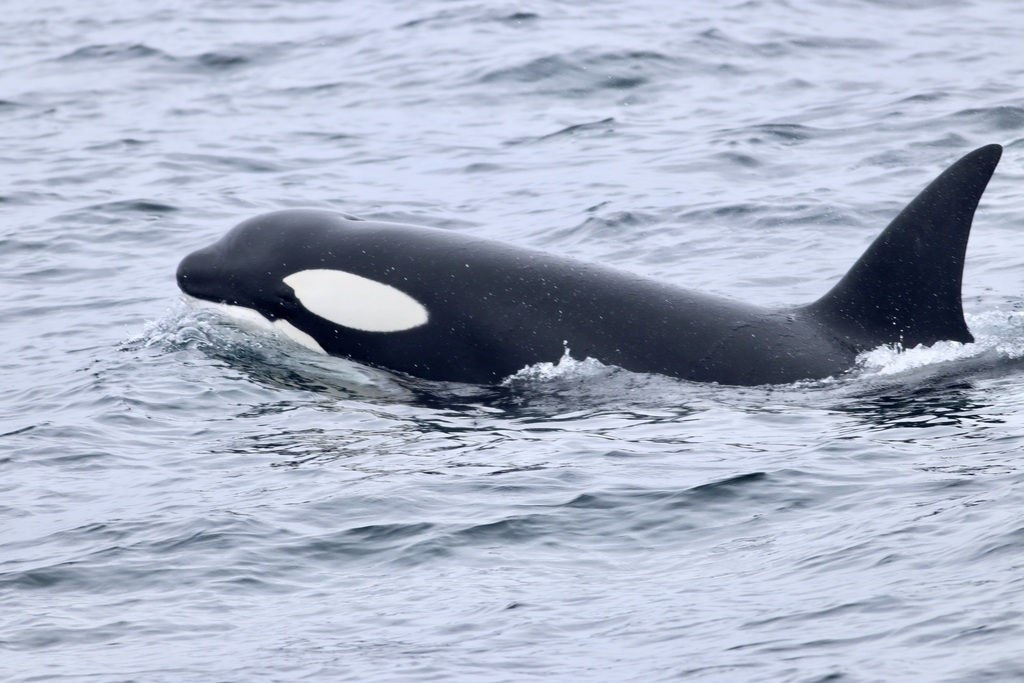
Orca
Photo © Vsevolod Rudyi
Photo © Vsevolod Rudyi — CC BY 4.0 — Source: iNaturalist photo #214912458Identification
The orca is instantly recognizable as the largest member of the oceanic dolphin family, distinguished by its striking pigmentation: predominantly black on the upper body with white undersides and distinctive white eye patches. These dramatic markings make the orca one of the most visually distinctive cetaceans, easily identifiable even from a distance. The stark contrast between dark and light coloration is consistent across individuals, though scientists have proposed dividing the global population into different races, subspecies, or possibly even separate species, suggesting some variation exists among populations.
Range & Habitat
Orcas are cosmopolitan cetaceans found across the world's oceans, inhabiting marine environments from Arctic and Antarctic regions to tropical seas. However, they are more commonly documented in temperate and cooler coastal waters, where they tend to be more concentrated. This wide distribution makes them potential subjects for wildlife travellers in diverse locations, though your chances of encountering them are heightened in cooler oceanic regions.
Behaviour & Diet
As apex predators, orcas maintain a remarkably diverse diet that varies by population. Different groups specialize in particular prey types, including bony fish, sharks, rays, and marine mammals such as seals, dolphins, and whales. This dietary specialization is just one aspect of their sophisticated social structure. Orcas are highly social animals, with some populations forming stable matrilineal family groups known as pods. Their complex hunting techniques and distinctive vocal behaviours—often unique to specific groups and transmitted across generations—are considered manifestations of animal culture, rivalling the cultural complexity observed in primates.
Best Time & Places to See It
The most studied orca populations occur off the west coast of North America, where three distinct types have been identified: fish-eating "residents," mammal-eating "transients," and "offshores." These well-documented populations offer the most reliable opportunities for observation. However, orcas inhabit coastal waters worldwide, making sightings possible in numerous temperate and polar regions. Other populations remain less well-studied but are known to exist across the global ocean.
Photography Tips
The orca's bold black-and-white pattern provides exceptional contrast for photography, particularly in clear water conditions. Their distinctive white eye patches and dorsal fins create striking compositional elements. Look for the dramatic moment when orcas surface to breathe or when pods move through coastal waters, as these provide dynamic photo opportunities. The high contrast of their colouration means they photograph well even in variable lighting, making orcas among the most photogenic of all cetaceans.
Glacier Bay National Park
Unorganized Borough, Estados Unidos
+12 aves+19 mamíferos
Tidewater glaciers calve thunderous bergs into pristine fjords where the Alaskan wilderness reaches its most dramatic expression. Spanning 26,400 square […]
VER PARQUE NACIONALSea Lion Island
Sealion Island Settlement, Islas Falkland
+23 aves+3 mamíferos
Windswept tussock grasslands roll across volcanic terrain where Southern Ocean swells crash against rocky shores, creating one of the Falkland […]
VER ISLA Y ARCHIPIéLAGOVaranger National Park
Båtsfjord, Noruega
+70 aves+13 mamíferos
Where the Arctic tundra meets the Barents Sea, vast plateaus of birch woodland and dwarf shrub heath roll across northeastern […]
VER PARQUE NACIONALEstrecho Nature Park
Pedro Valiente, España
+135 aves+23 mamíferos
Where Mediterranean pine forests meet wind-sculpted coastal cliffs, one of Europe’s most dynamic ecological crossroads unfolds across the Strait of […]
VER PARQUE NATURALDeception Island
Gabriel de Castilla Base, Antártida
+16 aves+6 mamíferos
Steaming geothermal vents pierce a landscape of blackened volcanic sand and ice, where the earth’s raw power still trembles beneath […]
VER ISLA Y ARCHIPIéLAGOCuverville Island
Cuverville Island, Antártida
+14 aves+7 mamíferos
Where black volcanic peaks jut from the Gerlache Strait, penguin colonies blanket the rocky shores in a cacophony of sound […]
VER ISLA Y ARCHIPIéLAGONeko Harbour
Neko Harbour, Antártida
+17 aves+10 mamíferos
Towering peaks of fractured ice rise abruptly from gunmetal waters, their faces scarred by millennia of glacial advance and retreat. […]
VER PAISAJE PROTEGIDOParadise Bay
Brown Station, Antártida
+14 aves+5 mamíferos
Where granite peaks plunge into the Bismarck Strait, a sheltered cove reveals one of Antarctica’s most dramatic ecosystems. Paradise Bay’s […]
VER PAISAJE PROTEGIDOBrown Bluff
Brown Bluff, Antártida
+18 aves+3 mamíferos
Where rust-colored volcanic peaks pierce the Antarctic Peninsula’s icy realm, a geologist’s dreamscape unfolds beneath towering cliffs of iron oxide […]
VER PAISAJE PROTEGIDOPort Lockroy
Port Lockroy, Antártida
+14 aves+6 mamíferos
Towering peaks of black rock pierce through Antarctic pack ice on the Gerlache Strait, where one of the continent’s most […]
VER PAISAJE PROTEGIDOPetermann Island
Petermann Island, Antártida
+14 aves+7 mamíferos
Icebound cliffs rise dramatically from the Bellingshausen Sea, their weathered faces sculpted by millennia of Antarctic wind and tide. This […]
VER ISLA Y ARCHIPIéLAGOPaulet Island
Paulet Island, Antártida
+16 aves+3 mamíferos
Windswept ice and weathered rock converge at this remote Antarctic outcrop, where jagged peaks pierce through perpetual pack ice and […]
VER ISLA Y ARCHIPIéLAGOWilhelmina Bay
Wilhelmina Bay, Antártida
+17 aves+10 mamíferos
Sheer cliffs of black volcanic rock plunge into waters so pristine they reflect the Antarctic sky like polished obsidian. This […]
VER PAISAJE PROTEGIDOLemaire Channel
Orne Harbour, Antártida
+17 aves+10 mamíferos
Where granite peaks plunge into steel-grey waters, the Lemaire Channel carves one of Antarctica’s most dramatic passages. This narrow strait, […]
VER PAISAJE PROTEGIDOSt. Andrews Bay
South Georgia, Islas Georgias del Sur y Sandwich del Sur
+28 aves+11 mamíferos
Where windswept tundra dissolves into obsidian beaches, one of the planet’s most extraordinary wildlife theaters unfolds across St. Andrews Bay. […]
VER PAISAJE PROTEGIDOFortuna Bay
Stromness, Islas Georgias del Sur y Sandwich del Sur
+26 aves+9 mamíferos
Where tussock grasslands sweep down to black-sand beaches and elephant seals haul out in thunderous colonies, the raw sub-Antarctic landscape […]
VER PAISAJE PROTEGIDOCooper Bay
Cooper Bay, Islas Georgias del Sur y Sandwich del Sur
+27 aves+9 mamíferos
Where black-sand beaches meet towering cliffs striped with cascading meltwater, one of the Southern Ocean’s most dramatic amphitheaters reveals itself. […]
VER PAISAJE PROTEGIDOElsehul Bay
Bird Island Station, Islas Georgias del Sur y Sandwich del Sur
+29 aves+4 mamíferos
Granite peaks rise sheer from the Southern Ocean, their weathered faces streaked with cascading meltwater and cloaked in tussock grass […]
VER PAISAJE PROTEGIDOAún no hay fotos de la comunidad. Inicia sesión para añadir la primera.
Aún no hay observaciones de la comunidad de esta especie.