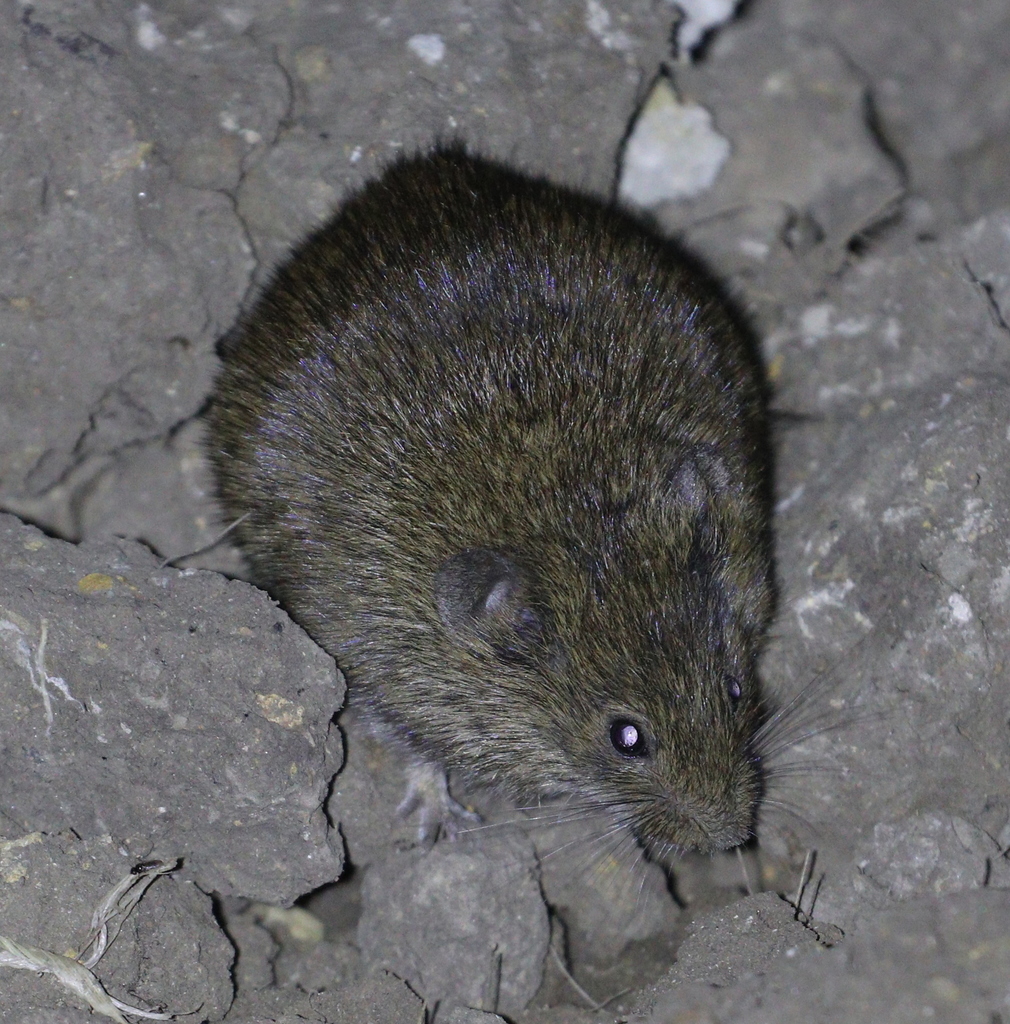
Topillo Campesino
Photo © Jan Ebr & Ivana Ebrová
Photo © Jan Ebr & Ivana Ebrová — CC BY 4.0 — Source: iNaturalist #91828311Identification
The common vole is a small European rodent belonging to the genus Microtus. Adults are compact creatures, with males reaching up to 51 g in weight and non-pregnant females up to 42 g. Their small size and rodent features make them easily confused with related species, particularly the field vole in Britain and Ireland, where the common vole does not occur. Juveniles are born tiny, weighing between 1.0 and 3.1 g, and grow rapidly during their first weeks of life.
Range & Habitat
The common vole is widely distributed across large areas of Eurasia, though it is notably absent from Britain, Ireland, and the Orkney Islands, where the related field vole takes its place instead. The species shows remarkable habitat flexibility, thriving in diverse environments ranging from open meadows and heathlands to fallow land. It avoids only the densest forests.
Primary habitats include natural grasslands and open country, but the common vole has successfully adapted to human-modified landscapes. It particularly favours agricultural fields, especially those with shallow-sloped areas. In these secondary habitats, the availability of cultivated crops supports faster reproduction rates than in primary habitats, making farmland particularly attractive to populations during the growing season.
Behaviour & Diet
Common voles are ground-dwelling creatures with naturally poor climbing ability. They create extensive networks of aboveground runways that branch through their home range like a railway system, using these highways for faster, safer movement and easier navigation. They rarely venture outside these established routes. Underground, they excavate nests 30–40 cm deep, which serve multiple purposes: food storage, raising young, and shelter for rest and sleep.
The natural diet consists primarily of grass, though in agricultural areas they readily consume cultivated crops. Socially, females are territorial and maintain separate home ranges of 300–400 m², sometimes sharing nests with up to five related females and their juveniles. Males, by contrast, are non-territorial "floaters" moving between female territories to mate; their larger home ranges of 1200–1500 m² reflect this polygynous system. Reproduction is intense, with females capable of producing three reproductive cycles annually from March through October, after pregnancies lasting 16–24 days.
Best Time & Places to See It
The reproductive season from March to October offers the best opportunity for observation, when population activity and visibility are highest. However, common voles are naturally secretive, spending much of their time within their runway systems or underground nests. Population densities fluctuate considerably in three- to five-year cycles, ranging from 100 to over 2000 individuals per hectare depending on the year and conditions. This means sighting opportunities vary significantly year to year. Agricultural regions across Eurasia, particularly meadows and cultivated fields, offer the most reliable locations for encountering this species, though patience and careful observation are essential.
Photography Tips
Photographing common voles presents considerable challenges due to their cryptic nature and preference for remaining within runway systems. Success requires patience and fieldcraft. Early morning or dusk may offer better opportunities when voles are most active. Setting up quietly near known runway systems or field edges and waiting for natural activity to resume can yield results. The runway networks themselves are conspicuous features that betray vole presence, making them useful guides for photographers seeking to locate these elusive rodents.
Cañón del Río Lobos Nature Park
Santa María de las Hoyas, España
+126 aves+25 mamíferos
Where limestone cliffs rise abruptly from a serpentine river valley, the Río Lobos carves one of Spain’s most dramatic natural […]
VER PARQUE NATURALLower Saxon Wadden Sea National Park
Dunum, Alemania
+124 aves+28 mamíferos
Tidal mud flats stretch to the horizon where the North Sea exhales and inhales twice daily, sculpting one of Europe’s […]
VER PARQUE NACIONALHamburgisches Wattenmeer National Park
Hamburg, Alemania
+134 aves+21 mamíferos
Where the Elbe River surrenders to the North Sea, a vast tapestry of mud flats, salt marshes, and shallow tidal […]
VER PARQUE NACIONALSaxon Switzerland National Park
Sebnitz, Alemania
+120 aves+30 mamíferos
Where sandstone cliffs soar vertically above the Elbe River, a landscape of extraordinary geological drama unfolds across the German-Czech borderlands. […]
VER PARQUE NACIONALŠumava National Park
Alemania
+120 aves+29 mamíferos
Where ancient spruce forests rise and peat bogs stretch beneath mist-laden skies, the Bavarian borderlands hold one of Central Europe’s […]
VER PARQUE NACIONALOrdesa y Monte Perdido National Park
Sobrarbe, España
+121 aves+29 mamíferos
Where limestone cliffs rise nearly a thousand metres in sheer vertical walls, the Pyrenees reveal their most dramatic visage. Ordesa […]
VER PARQUE NACIONALL’Empordà Nature Park Marshes
Empuriabrava, España
+127 aves+26 mamíferos
Where the Pyrenean foothills flatten into the Mediterranean, freshwater marshes, reed beds, and lagoons create one of Spain’s most vital […]
VER PARQUE NATURALCévennes (Cœur) National Park
Vebron, Francia
+120 aves+32 mamíferos
Where granite ridges plunge into serpentine river valleys, a wilderness of schist and limestone unfolds across the Massif Central. Ancient […]
VER PARQUE NACIONALMercantour (Cœur) National Park
Isola, Francia
+120 aves+29 mamíferos
Where alpine meadows surrender to vertiginous limestone cliffs, the Mercantour’s beating heart pulses with Mediterranean and Alpine rhythms. This 4,221-square-kilometre […]
VER PARQUE NACIONALVanoise National Park
Val-Cenis, Francia
+105 aves+21 mamíferos
Where granite peaks fracture the Alpine sky above 4,000 meters, Vanoise’s 1,716 square kilometers unfold as France’s oldest national park […]
VER PARQUE NACIONALŐrség National Park
Kondorfa, Hungría
+65 aves+20 mamíferos
Where the Alps fade into the Carpathian foothills, a gentle mosaic of ancient forests and rolling hills defines one of […]
VER PARQUE NACIONALHortobágy National Park
Hortobágy, Hungría
+132 aves+19 mamíferos
Where the Great Hungarian Plain stretches endlessly toward the horizon, vast wetlands and grasslands create one of Europe’s most dynamic […]
VER PARQUE NACIONALDuna-Ipoly National Park
Dömös, Hungría
+121 aves+30 mamíferos
Where the Danube carves its sinuous path through northern Hungary, limestone ridges rise abruptly from the river valley, their pale […]
VER PARQUE NACIONALFertő–hanság National Park
Fertőszéplak, Hungría
+12 aves+27 mamíferos
Where shallow waters meet vast reed beds beneath wide Hungarian skies, one of Central Europe’s most dynamic wetland complexes unfolds […]
VER PARQUE NACIONALTrialeti Planned National Park
Tbisi, Georgia
+130 aves+21 mamíferos
Where limestone plateaus rise above the Caucasian foothills, a mosaic of oak forests, alpine meadows, and beech woodlands creates one […]
VER PARQUE NACIONALDirigida Laguna de Gallocanta Nature Reserve
Las Cuerlas, España
+136 aves+21 mamíferos
Where continental steppe meets the vast mirror of inland water, Spain’s largest natural lagoon reveals a landscape of haunting beauty. […]
VER RESERVA NATURALLosiny Ostrov National Park
Balashikhinsky District, Rusia
+120 aves+30 mamíferos
Ancient pine and birch forests sweep across undulating terrain where the Moskva River winds through Moscow’s northeastern reaches, creating a […]
VER PARQUE NACIONALMagura National Park
Kotań, Polonia
+76 aves+11 mamíferos
Where beech and spruce forests rise across the Pieniny Mountains, a landscape of dramatic limestone gorges and verdant plateaux unfolds […]
VER PARQUE NACIONALWolin National Park
Kamień County, Polonia
+96 aves+17 mamíferos
Where the Baltic coastline fragments into a mosaic of pine forests, freshwater lakes, and windswept dunes, northwestern Poland harbors one […]
VER PARQUE NACIONALBiałowieża National Park
Bialowieza, Polonia
+105 aves+29 mamíferos
Ancient woodland sprawls across the Polish-Belarusian border where primordial forests have escaped the axe for centuries. This 198-square-kilometre sanctuary harbours […]
VER PARQUE NACIONALKerkini Lake National Park
Serres, Grecia
+132 aves+25 mamíferos
Where the Strymon River winds through northeastern Greece, a sprawling freshwater lake mirrors the dramatic Belasitsa Mountains, creating one of […]
VER PARQUE NACIONALAún no hay fotos de la comunidad. Inicia sesión para añadir la primera.
Aún no hay observaciones de la comunidad de esta especie.