Murciélago Hortelano
Photo © Yves Bas
Photo © Yves Bas — CC BY 4.0 — Source: iNaturalist photo #113802159Identification
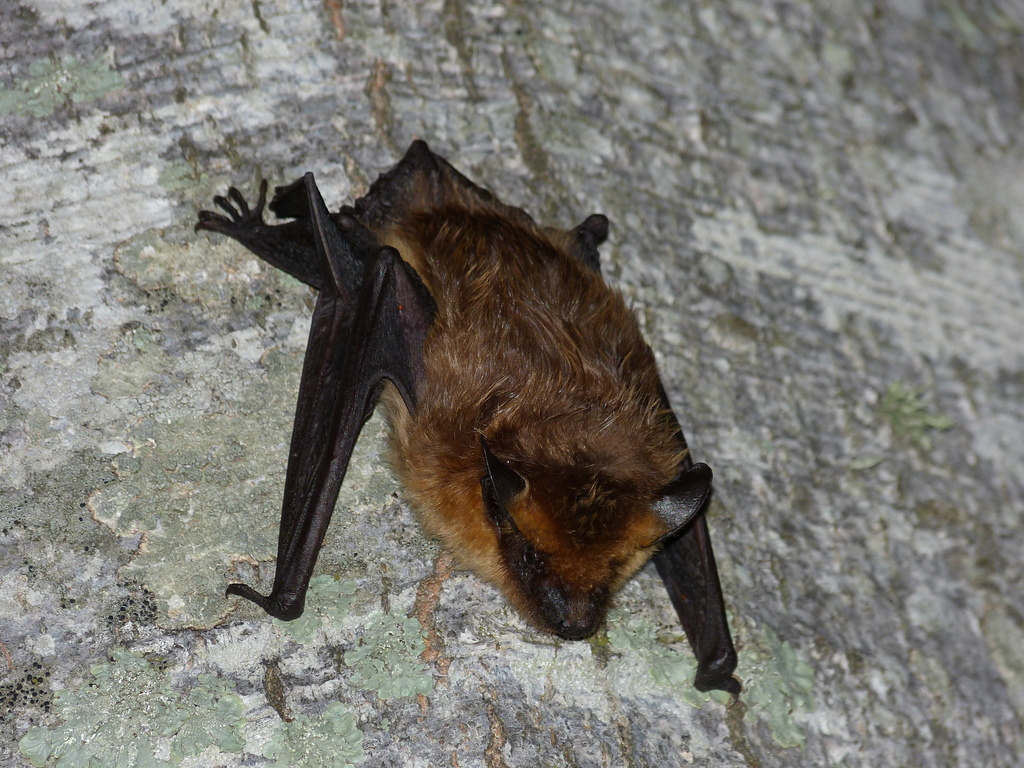
The Eurasian Serotine is a considerably large bat, easily recognised by its distinctive appearance and flight style. It has long, smoky-brown fur on the back, with paler yellowish-brown underparts. The nose and triangular-shaped ears are black, while the wing membranes are dark black or brown. Juveniles are noticeably darker than adults. With a wingspan of around 37 cm (15 inches), this species is unmistakable in flight: its broad wings combined with slow, highly manoeuvrable flapping interspersed with brief glides create a distinctive silhouette that sets it apart from other bat species. The tragus has a relatively thin and pointed shape, unlike the kidney-shaped tragus found in Nyctalus bats.
Range & Habitat
The Eurasian Serotine has a wide Palaearctic distribution spanning from southern Great Britain and Spain in the west to the Himalayas, northeastern India, the Tian Shan mountains, southern Mongolia and northern China in the east. The species occurs between approximately 58 and 30 degrees latitude, with records extending south to Turkey and Iran. It has occasionally been recorded as a vagrant in the Canary Islands.
This adaptable species utilises a remarkable variety of habitats including temperate and subtropical dry forests, maquis, agricultural land, semi-desert and suburban areas. Notably, it has become highly oriented towards using buildings for summer roosts, particularly older structures with high gables and cavity walls such as churches, rather than relying on natural tree roosts as ancestral populations likely did.
Behaviour & Diet
Serotine bats are primarily aerial hawkers, hunting mainly flying insects such as butterflies and moths. Foraging activity peaks at dusk, with a secondary period of activity around dawn. These bats are highly mobile, commuting an average of 6.5 km to and from feeding areas per night and utilising up to five distinct feeding areas in a single night. They typically forage low, between 0–5 metres above the ground, employing three main feeding strategies: short flights, ground feeding and aerial hawking. Echolocation calls range from 25–55 kHz with most energy at 31 kHz.
During the breeding season in Europe, females establish maternity colonies from late May onwards, usually giving birth to a single pup in early July. Young bats make their first flights at around three weeks old and become independent foragers at six weeks. Breeding colonies typically disperse by early September. Male bats remain mostly solitary or in small groups, with mating occurring in autumn. Both sexes reach sexual maturity at one year old.
Best Time & Places to See It
The best time to observe Eurasian Serotines is from late May through early September when maternity colonies are active and foraging activity is most intense. Dusk is the optimal time for sightings, as this is when foraging activity peaks. Look for them in agricultural landscapes, woodland edges, and suburban areas across their range from southern Britain and Spain eastward through Europe to Asia.
Buildings—especially older churches and structures with high gables and cavity walls—are key locations to search. These bats are highly dependent on building roosts and are hardly ever found in trees. Early morning observations around dawn may also yield sightings during the secondary period of activity.
Photography Tips
Photographing Eurasian Serotines in flight is challenging but rewarding. Their distinctive broad-winged silhouette and slow, manoeuvrable flight make them identifiable even at a distance. Dusk is the ideal shooting time when foraging activity is strongest. Position yourself near known feeding areas—typically within 6.5 km of roost sites in agricultural or woodland margins—to maximise encounter opportunities.
Fast shutter speeds and high-speed sync flash are essential to freeze their flight and reveal fine details of the wing membranes and ear structure. Backlighting can effectively silhouette their characteristic broad wings and slow flapping flight pattern. Patience near known roost sites such as older buildings with gables may also yield photographs of bats emerging at dusk or returning at dawn.
L’Albufera Nature Park
València, España
+130 aves+22 mamíferos
Dawn breaks over a vast lagoon where freshwater meets saltmarsh, creating one of Spain’s most biodiverse wetland mosaics. This protected […]
VER PARQUE NATURALLower Saxon Wadden Sea National Park
Dunum, Alemania
+124 aves+28 mamíferos
Tidal mud flats stretch to the horizon where the North Sea exhales and inhales twice daily, sculpting one of Europe’s […]
VER PARQUE NACIONALLower Oder Valley National Park
Schwedt/Oder, Alemania
+124 aves+30 mamíferos
Where two nations’ borders converge along the Oder River, a landscape of wetlands, floodplain forests and oxbow lakes unfolds across […]
VER PARQUE NACIONALJasmund National Park
Sassnitz, Alemania
+126 aves+26 mamíferos
Soaring white limestone cliffs plunge dramatically toward the Baltic Sea, their chalk faces sculpted by millennia of wind and wave […]
VER PARQUE NACIONALSerra de Montsant Nature Park
La Morera de Montsant, España
+129 aves+27 mamíferos
Where limestone ridges thrust skyward above rolling Mediterranean scrubland, a landscape of dramatic contrasts rewards the discerning traveler. Montsant’s jagged […]
VER PARQUE NATURALL’Empordà Nature Park Marshes
Empuriabrava, España
+127 aves+26 mamíferos
Where the Pyrenean foothills flatten into the Mediterranean, freshwater marshes, reed beds, and lagoons create one of Spain’s most vital […]
VER PARQUE NATURALNational Park Djerdap
Mehedinți, Rumanía
+47 aves+14 mamíferos
Where the Danube River carves through the Iron Gates gorge, one of Europe’s most dramatic landscape mosaics unfolds across 2,400 […]
VER PARQUE NACIONALCollserola Nature Park
Barcelona, España
+131 aves+20 mamíferos
Where Mediterranean scrubland rises abruptly from Barcelona’s urban edge, a remarkable patchwork of pine forests, cork woodlands, and rocky limestone […]
VER PARQUE NATURALAggtelek National Park
Szin, Hungría
+44 aves+16 mamíferos
Where limestone plateaus fracture into sinkholes and underground streams carve hidden galleries through living rock, northern Hungary’s 543 square kilometers […]
VER PARQUE NACIONALDuna-Ipoly National Park
Dömös, Hungría
+121 aves+30 mamíferos
Where the Danube carves its sinuous path through northern Hungary, limestone ridges rise abruptly from the river valley, their pale […]
VER PARQUE NACIONALEspacio Natural Remolar-Filipinas
El Prat del Llobregat, España
+121 aves+28 mamíferos
Where the Llobregat River delta meets the Mediterranean, a patchwork of salt marshes, reed beds, and shallow lagoons creates one […]
VER RESERVA NATURALCamargue Regional Nature Park
Saintes-Maries-de-la-Mer, Francia
+122 aves+30 mamíferos
Where the Rhône Delta sprawls into the Mediterranean, a landscape of stark and haunting beauty emerges—vast salt marshes punctuated by […]
VER PARQUE NATURALWolin National Park
Kamień County, Polonia
+96 aves+17 mamíferos
Where the Baltic coastline fragments into a mosaic of pine forests, freshwater lakes, and windswept dunes, northwestern Poland harbors one […]
VER PARQUE NACIONALKampinos National Park
Gurba, Polonia
+123 aves+30 mamíferos
Vast wetlands and ancient pine forests sprawl across the sandy plains just northwest of Warsaw, where Poland’s largest national park […]
VER PARQUE NACIONALBiebrza National Park
Goniądz, Polonia
+130 aves+25 mamíferos
Where wetland and water merge across northeastern Poland’s vast floodplain, one of Europe’s most pristine riverine ecosystems unfolds across nearly […]
VER PARQUE NACIONALMontañas de Prades
Capafonts, España
+126 aves+28 mamíferos
Where granite peaks rise abruptly from the Tarragona hinterland, a wild mosaic of pine forests, scrubland, and limestone cliffs creates […]
VER MONTAñA Y ALTA MONTAñAAún no hay fotos de la comunidad. Inicia sesión para añadir la primera.
Aún no hay observaciones de la comunidad de esta especie.