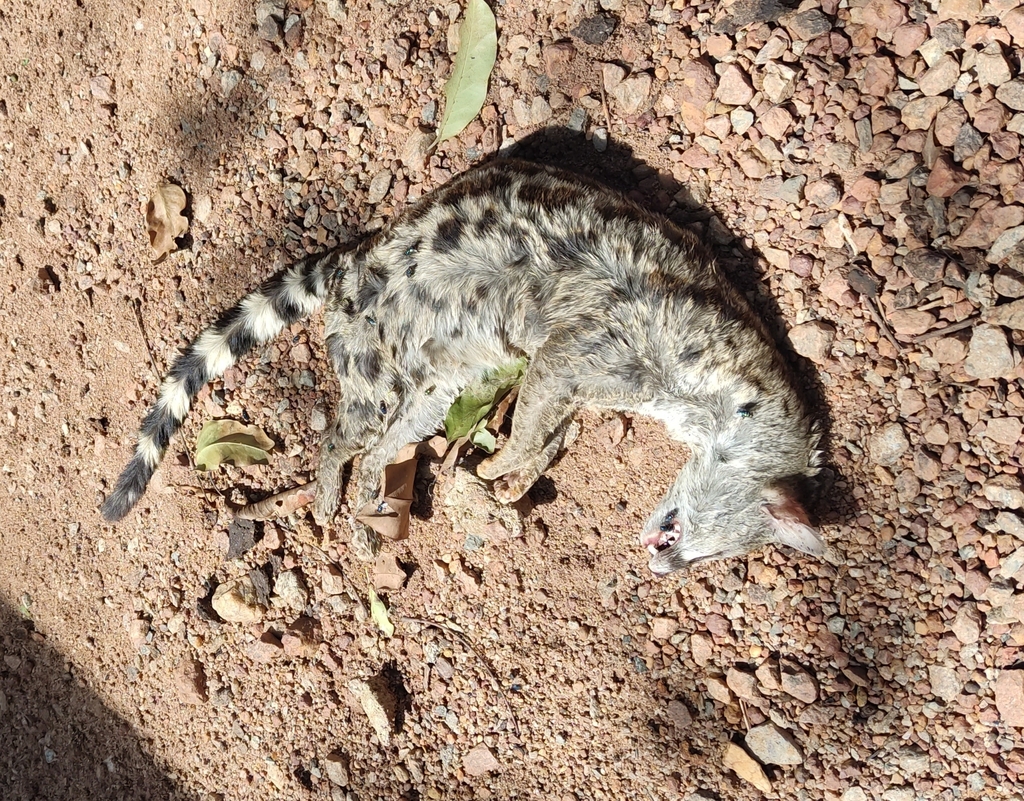
Genetta fieldiana
Photo © Viken
Photo © Viken — CC BY 4.0 — Source: iNaturalist #255959206Identification
The rusty-spotted genet is a small, elegantly spotted carnivore with distinctive markings that make it recognizable in the field. Its fur is short and coloured whitish grey to pale yellow, adorned with dark spots arranged in characteristic patterns. The spots of the upper two dorsal rows are particularly striking, appearing round or square with brown centres and darker outer edges. A continuous dark line runs across the back, adding to its distinctive appearance. The animal's long, ringed tail—which measures 40 to 53 cm—ends in a dark tip and provides excellent balance for this agile predator.
In terms of size, the rusty-spotted genet is a modest creature, with a head-to-body length ranging from 42 to 52 cm, and weighing between 1.3 to 3 kg. Its feet match the colour of its fur, contributing to a harmonious overall appearance. These proportions make it one of Africa's smaller carnivores, easily distinguished from larger predators but requiring patience and a keen eye to spot in the field.
Range & Habitat
The rusty-spotted genet is widely distributed across sub-Saharan Africa, making it accessible to wildlife enthusiasts across much of the continent. Its broad range reflects its adaptability to various African ecosystems and its success as a species. The genet is considered common throughout its range, a testament to its ecological resilience and ability to thrive in diverse environments.
Behaviour & Diet
The rusty-spotted genet is an omnivorous opportunist with a remarkably diverse diet. Research conducted in southeastern Nigeria has revealed the breadth of its feeding habits. It hunts small rodents including giant pouched rats, shrews, and various mouse species such as Temminck's mouse and Tullberg's soft-furred mouse. Beyond mammals, it also preys on birds, including the red-eyed dove, and reptiles such as common agamas and Mabuya skinks.
This dietary flexibility extends to invertebrates, with the genet consuming myriapods, spiders, and insects including orthopterans and beetles. It also supplements its diet with plant matter, feeding on eggs, fruits, berries, and seeds. This omnivorous approach allows the rusty-spotted genet to adapt to seasonal food availability and varying habitats, contributing significantly to its conservation success.
Best Time & Places to See It
As a nocturnal and crepuscular species, the rusty-spotted genet is most active during dawn, dusk, and night hours. Wildlife travellers seeking this elusive predator should plan evening or early morning excursions, with night drives or walks offering the best opportunities for encounters. Its wide distribution across sub-Saharan Africa means that visitors to many African destinations have a genuine chance of spotting one, particularly in protected areas and wildlife reserves where populations are established.
Photography Tips
Photographing the rusty-spotted genet presents an exciting challenge for wildlife photographers. Its nocturnal habits mean that headlamp or infrared lighting may be necessary, requiring appropriate camera settings for low-light conditions. The genet's spotted coat and ringed tail provide excellent compositional elements when captured in profile. Patience is essential, as encounters are often brief. A telephoto lens is recommended to maintain distance while capturing detailed shots of this small but striking predator in its natural environment.
Arusha National Park
Tanzania
+132 aves+30 mamíferos
Where the volcanic slopes of Mount Meru rise dramatically from Tanzania’s northern highlands, a landscape of extraordinary ecological diversity unfolds […]
VER PARQUE NACIONALRubondo Island National Park
Tanzania
+84 aves+14 mamíferos
Dawn breaks over Lake Victoria’s southwestern waters, revealing a primordial landscape where dense tropical forest cascades toward pristine shorelines. This […]
VER PARQUE NACIONALMapungubwe National Park
Musina Local Municipality, Botsuana
+132 aves+30 mamíferos
Where the Limpopo River carves a boundary between nations, ancient sandstone cliffs rise in sculptured isolation above riverine woodland and […]
VER PARQUE NACIONALVirunga National Park
Uganda
+132 aves+30 mamíferos
Where the Rwenzori Mountains pierce the equatorial sky and volcanic slopes descend toward the Congo Basin, one of Africa’s most […]
VER PARQUE NACIONALMurchison Falls National Park
Uganda
+129 aves+30 mamíferos
Where the Victoria Nile surges through a narrow rocky chasm and plummets 43 metres in a thunderous cascade, Uganda’s oldest […]
VER PARQUE NACIONALLake Mburo National Park
Uganda
+124 aves+30 mamíferos
Dawn breaks across a mosaic of acacia woodland, papyrus swamps, and open grassland where Uganda’s southwestern savanna meets the edge […]
VER PARQUE NACIONALKruger National Park
Ba-Phalaborwa Local Municipality, Sudáfrica
+132 aves+30 mamíferos
Where the Limpopo River forms a natural frontier, vast savannas sweep across nearly 20,000 square kilometers of pristine African wilderness. […]
VER PARQUE NACIONALAbijata-Shalla Lakes National Park
Etiopía
+135 aves+22 mamíferos
Where two soda lakes mirror the Ethiopian highlands, a landscape of stark volcanic beauty unfolds across the Rift Valley floor. […]
VER PARQUE NACIONALNech Sar National Park
Arba Minch, Etiopía
+109 aves+17 mamíferos
Where the East African Rift Valley plateaus drop dramatically toward the shore of Lake Abaya, a mosaic of habitats unfolds […]
VER PARQUE NACIONALAún no hay fotos de la comunidad. Inicia sesión para añadir la primera.
Aún no hay observaciones de la comunidad de esta especie.