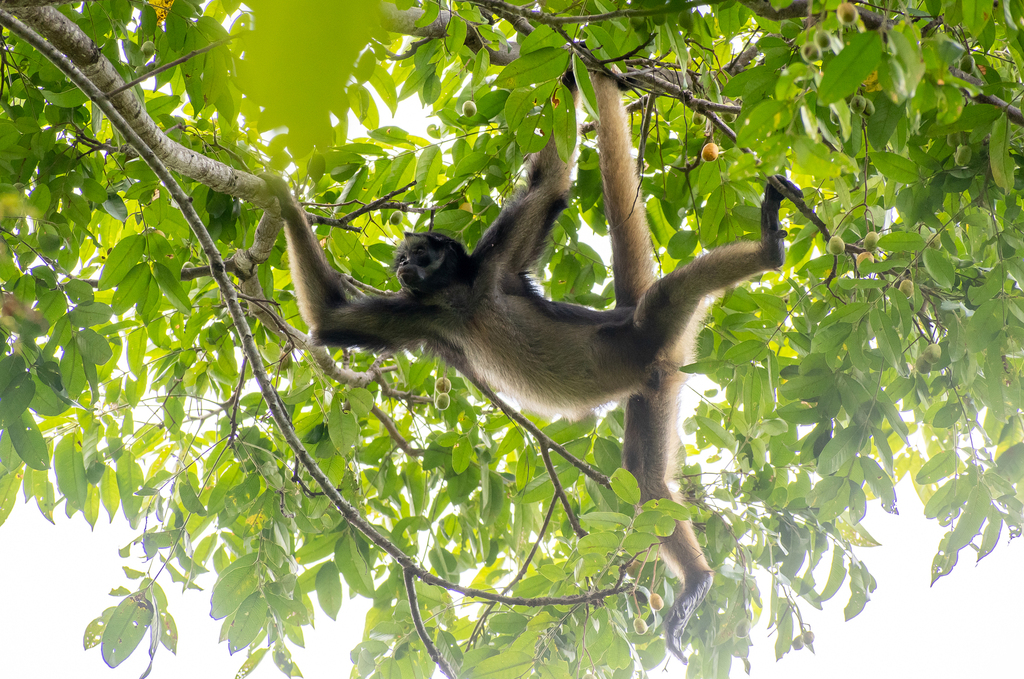
Mono araña de vientre amarillo
Photo © w_endo
Photo © w_endo — CC0 1.0 — Source: iNaturalist photo #225307668The white-bellied spider monkey (Ateles belzebuth), also known as the white-fronted or long-haired spider monkey, is an endangered species of spider monkey, a type of New World monkey. It is found in the north-western Amazon in Colombia, Ecuador, Venezuela, Peru and Brazil, ranging as far south as the lower Ucayali River and as far east as the Branco River. In the past, the Peruvian, brown and white-cheeked spider monkeys have been treated as subspecies of A. belzebuth. As presently defined, the white-bellied spider monkey is monotypic. It has a whitish belly and a pale patch on the forehead, which, despite its common name, often is orange-buff, though this might be due to dirt and other stainers. They live in groups of 20 to 40 individuals, splitting into small parties of 1 to 9 when in activity. Vernacular names include mono prieto, mico prieto and marimonda (Colombia). Over the last 45 years (3 generations), the population has declined by approximately 50% due to habitat loss and hunting. Because of this, A. belzebuth is listed as endangered by the IUCN. == Ecology == White-bellied spider monkeys are important long-distance seed dispersal agents for many fruit-bearing species. They are a dominant disperser for…
Yasuní National Park
Aguarico, Ecuador
+132 aves+30 mamíferos
Where the Napo and Curaray rivers carve through Ecuador’s vast Amazonian lowlands, one of Earth’s most biodiverse terrestrial ecosystems sprawls […]
VER PARQUE NACIONALSumaco Napo-Galeras National Park
Loreto, Ecuador
+113 aves+19 mamíferos
Where the eastern Andean slopes plunge into Amazonian lowlands, pristine cloud forests and montane rainforests cloak the volcanic Sumaco massif […]
VER PARQUE NACIONALNatural Sierra de Chiribiquete National Park
Solano, Colombia
+130 aves+23 mamíferos
Where tabletop mountains rise abruptly from the Colombian Amazon, a landscape of almost alien majesty unfolds across nearly 87,000 square […]
VER PARQUE NACIONALAún no hay fotos de la comunidad. Inicia sesión para añadir la primera.
Aún no hay observaciones de la comunidad de esta especie.