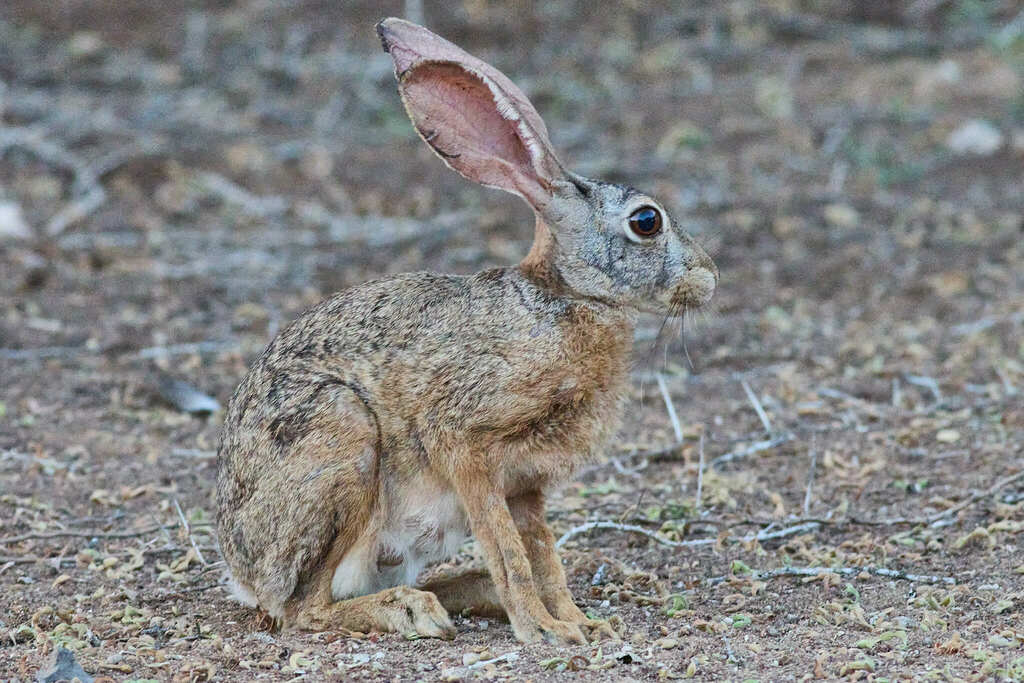
Abyssinian Hare
Photo © Nathan Mesnildrey
Photo © Nathan Mesnildrey — CC BY 4.0 — Source: iNaturalist #217724753Identification
The Abyssinian hare is a small, long-limbed hare with notably long, wide ears. Adults weigh roughly 1.4–2.4 kg and measure 40–55 cm in head-and-body length, with hind feet of 10–11.8 cm. The soft, dense fur varies geographically from sandy brown to grey — greyer animals in Ethiopia, sandier ones in Eritrea — a variation thought to improve camouflage against local soil colours. Upperparts are grizzled silvery grey with black on shoulder, back and rump; the flanks are paler, the underparts white, separated by a thin cinnamon band. The chin is whitish and some individuals show pale eyerings. The very large ears are silvery-brown outside, whitish-buff inside, with a black margin at the tips and a white fringe along the lower edge. The tail is black above and white below.
It closely resembles the Ethiopian highland hare, its closest relative, and was once treated as a subspecies of the Cape hare; large ears and skull and genetic differences now support its separate status.
Range & habitat
This species is essentially restricted to the Horn of Africa, occurring in Djibouti, Eritrea, Ethiopia, Somalia (excluding the extreme south) and Sudan, with some records from extreme northern Kenya. It inhabits savannah, grassland and steppe, as well as desert and semi-arid country where scrubby vegetation provides cover; it avoids areas of dense vegetation, where other hares tend to dominate. It is found at around 2,000 m across much of its range and up to about 2,500 m on the northeastern plateaus of Ethiopia and Eritrea.
Behaviour & diet
Little study has been made of this hare's life history, but it is presumed to behave much like the neighbouring Cape hare. It is nocturnal, using scrub for shade and protection from predators, and is susceptible to ticks. Its range may be expanding, possibly because land around it is overgrazed by domestic animals.
Best time & places to see it
Sightings are reported to be very common in Djibouti, and the species occurs in protected areas including Awash National Park and Mago National Park, and possibly Yangudi Rassa National Park. Because it is nocturnal and relies on scrub cover, search open semi-arid and steppe country at dawn, dusk and after dark, scanning edges of scrubby vegetation.
Photography tips
Its nocturnal habits and reliance on camouflage make this a low-light subject: favour fast lenses, high ISO and a beanbag or support for stability. Look for the huge silvery-brown ears with black-tipped margins and the black-and-white tail as identifying features in the field. Approach slowly along vehicle tracks and use the vehicle as a hide; keep disturbance minimal and avoid pushing animals from their scrub cover.
No community photos yet. Log in to add the first one.
No community observations of this species yet.