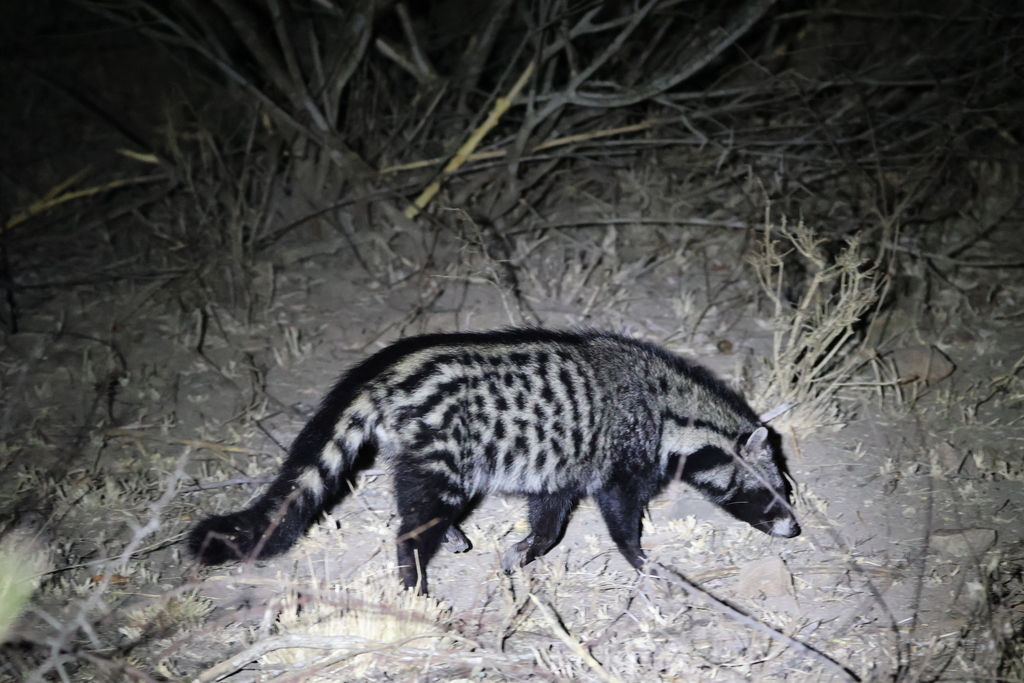
African Civet
Photo © Rebecca Ryen-Stols
Photo © Rebecca Ryen-Stols — CC BY-SA 4.0 — Source: iNaturalist photo #603577363The African civet (Civettictis civetta) is a large viverrid native to sub-Saharan Africa, where it is considered common and widely distributed in woodlands and secondary forests. It has been listed as least concern on the IUCN Red List since 2008. In some countries, it is threatened by hunting, and wild-caught individuals are kept for producing civetone for the perfume industry. The African civet is primarily nocturnal and spends the day sleeping in dense vegetation, but wakes up at sunset. It is a solitary mammal with a unique coloration: the black and white blotches covering its coarse pelage and rings on the tail are an effective cryptic pattern. The black bands surrounding its eyes closely resemble those of the raccoon. Other distinguishing features are its disproportionately large hindquarters and its erectile dorsal crest. It is an omnivorous generalist, preying on small vertebrates, invertebrates, eggs, carrion, and vegetable matter. It is one of the few carnivores capable of eating toxic invertebrates such as termites and millipedes. It detects prey primarily by smell and sound rather than by sight. It is the only living member of the genus Civettictis. == Taxonomy and evolution == Viverra civetta was the scientific name introduced in 1776…
Mapungubwe National Park
Musina Local Municipality, South Africa
+358 birds+29 mammals
Where the Limpopo River cuts through sandstone ridges at the convergence of South Africa, Botswana, and Zimbabwe, Mapungubwe National Park preserves a landscape of profound ecological…
VIEW NATIONAL PARKChobe National Park
Botswana
+446 birds+45 mammals
Where the Chobe River cuts a sinuous path through northern Botswana, the landscape transforms into one of Africa's most dynamic wetland-savanna mosaics. This national park encompasses…
VIEW NATIONAL PARKBwindi Impenetrable National Park
Kanyashogi, Uganda
+603 birds+26 mammals
Steep ridges cloaked in montane forest rise from Uganda's southwestern borderlands, where the landscape grows so dense and tangled that early explorers named it impenetrable. At…
VIEW NATIONAL PARKAmboseli National Park
Etonet/Lenkism ward, Kenya
+501 birds+43 mammals
Where the Amboseli basin opens toward the Tanzanian frontier, a shallow alkaline lake mirrors vast skies across one of East Africa's most iconic savanna landscapes. The…
VIEW NATIONAL PARKKruger National Park
Ba-Phalaborwa Local Municipality, South Africa
+540 birds+91 mammals
Across the low-lying savanna of northeastern South Africa unfolds one of Africa's largest and most ecologically intact protected areas, where acacia woodlands merge into mopane scrub…
VIEW NATIONAL PARKYabelo Wildlife Sanctuary
Bedewera, Ethiopia
+359 birds+5 mammals
Where acacia woodlands meet volcanic plateaus in southern Ethiopia, a landscape of austere beauty unfolds across nearly 2,500 square kilometers. Yabelo Wildlife Sanctuary sprawls across semi-arid…
VIEW WILDLIFE SANCTUARYChyulu Hills National Park
Kibwezi East, Kenya
+232 birds+30 mammals
Volcanic cones rise abruptly from the Kenyan savanna floor, their flanks clothed in dense acacia woodland and grassland that transforms the Chyulu Hills into an ecological…
VIEW NATIONAL PARKNo community photos yet. Log in to add the first one.
No community observations of this species yet.