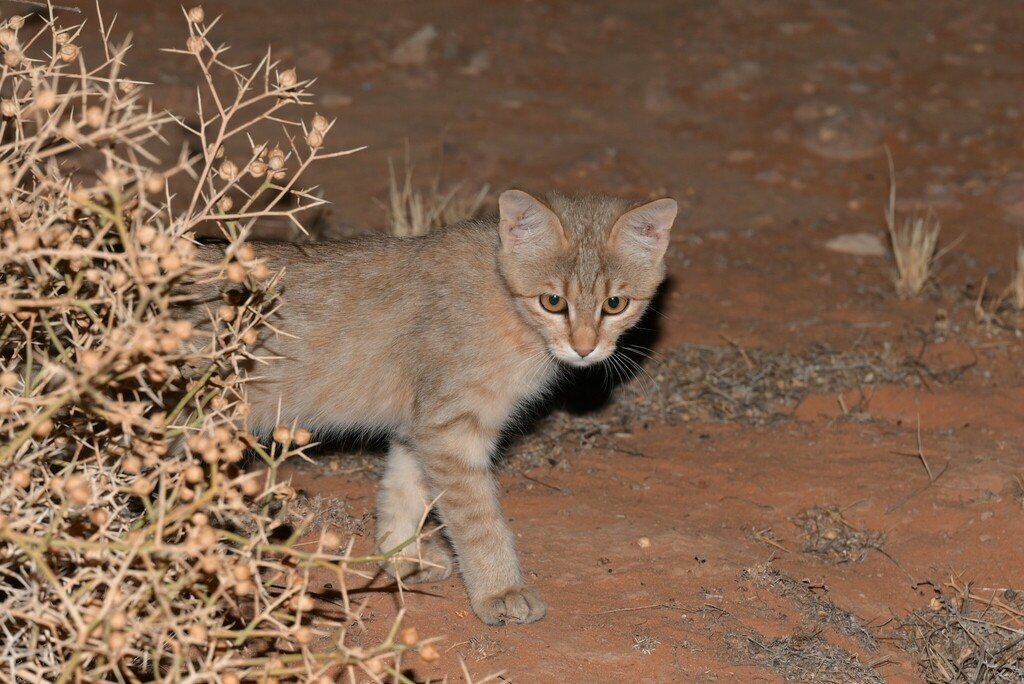
African Wildcat
Photo © Marius Burger
Photo © Marius Burger — CC0 1.0 — Source: iNaturalist photo #451562704Identification
The African wildcat is a small wildcat with sandy grey fur and distinctive pale vertical stripes on the sides and around the face. It has short black tufts on the ears and a ringed tail. In size, it resembles a domestic cat, though appearance varies across its range—some populations display reddish fur, while others may be more buffy white or greyish brown depending on their geographic location and subspecies.
Range & habitat
Native to Africa, West and Central Asia, the African wildcat is distributed across a vast territory spanning from North Africa and Sinai to Sudan, throughout Southern Africa, and eastward to Rajasthan in India and Xinjiang in China. The species is remarkably adaptable, inhabiting a broad variety of landscapes including deserts, savannas, shrublands, and grasslands, making it one of the most geographically widespread wildcat species.
Behaviour & diet
The African wildcat holds profound significance in human history as the ancestor of the domestic cat. About 10,000 years ago, some African wildcats were tamed in the Fertile Crescent, and later domesticated in ancient Egypt, eventually spreading throughout the Mediterranean Basin and beyond. Today, where the ranges of African wildcats and domestic cats overlap, interspecific hybrids between the two species are common, reflecting their close genetic relationship and shared evolutionary origin.
Best time & places to see it
The African wildcat's broad habitat tolerance makes it potentially visible across diverse African landscapes, from North African deserts to Southern African savannas and grasslands. However, as a small, elusive wild felid, sightings are unpredictable. Your best opportunities come in open habitats such as savannas and grasslands where visibility is greatest, though patience and luck remain essential for encountering this nocturnal and solitary species.
Photography tips
Photographing African wildcats presents significant challenges due to their elusive nature and small size. Use high-speed film or high ISO settings to capture images in low light, as they are primarily nocturnal. A telephoto lens is essential to maintain distance while achieving adequate framing. Look for them during dawn and dusk when they may be more active, and focus on open grasslands and scrubland edges where your chances of detection are highest.
Serengeti National Park
Tanzania
+558 birds+57 mammals
Across Tanzania's northern plateau, where volcanic soils meet acacia woodland and open grassland, unfolds one of Earth's most dynamic ecosystems. The Serengeti National Park sprawls across…
VIEW NATIONAL PARKChobe National Park
Botswana
+446 birds+45 mammals
Where the Chobe River cuts a sinuous path through northern Botswana, the landscape transforms into one of Africa's most dynamic wetland-savanna mosaics. This national park encompasses…
VIEW NATIONAL PARKTsavo West National Park
Mwatate, Kenya
+513 birds+49 mammals
Where volcanic ridges and weathered lava flows meet the semi-arid lowlands of south-central Kenya, Tsavo West National Park unfolds across a landscape sculpted by fire and…
VIEW NATIONAL PARKTarangire National Park
Tanzania
+527 birds+50 mammals
Acacia woodland and grassland sweep across the Manyara Region where the Tarangire River carves through low hills and volcanic soils, creating one of East Africa's most…
VIEW NATIONAL PARKNgorongoro Conservation Area
Tanzania
+626 birds+55 mammals
Volcanic calderas and open grassland dominate this high plateau in northern Tanzania, where the landscape rises above 2,000 metres and ancient geological forces have shaped both…
VIEW WILDLIFE MANAGEMENT AREAPilanesberg National Park
Moses Kotane Local Municipality, South Africa
+364 birds+49 mammals
Granite peaks and volcanic ridges rise unexpectedly from the savanna floor across this 734-square-kilometre expanse in the North West province, creating a landscape of profound ecological…
VIEW NATIONAL PARKKruger National Park
Ba-Phalaborwa Local Municipality, South Africa
+540 birds+91 mammals
Across the low-lying savanna of northeastern South Africa unfolds one of Africa's largest and most ecologically intact protected areas, where acacia woodlands merge into mopane scrub…
VIEW NATIONAL PARKTankwa-Karoo National Park
Hantam Local Municipality, South Africa
+201 birds+20 mammals
Across the semi-arid heartland of the Northern Cape, where winter rains carve ephemeral watercourses through endless ochre plains, Tankwa-Karoo National Park sprawls across more than 3,100…
VIEW NATIONAL PARKAugrabies Falls National Park
Kai !Garib Local Municipality, South Africa
+176 birds+20 mammals
Where the Orange River cuts a dramatic scar through the Northern Cape's arid interior, Augrabies Falls National Park sprawls across nearly 1,200 square kilometers of raw,…
VIEW NATIONAL PARKSperrgebiet National Park
Barcelona, Namibia
+181 birds+18 mammals
Where the Namib's ancient gravel plains meet the Atlantic coast, one of Africa's most remote and geologically austere landscapes unfolds across more than 56,000 square kilometres.…
VIEW NATIONAL PARKNamib-Naukluft National Park
Namibia
+217 birds+33 mammals
Across nearly 94,000 square kilometers of southwestern Namibia, a landscape of extremes unfolds where towering sand dunes meet rugged mountain ranges, and ancient riverbeds carve through…
VIEW NATIONAL PARKEtosha National Park
Namibia
+356 birds+58 mammals
Across northern Namibia's stark semi-arid plateau, a vast shallow depression transforms seasonally into one of Africa's most dramatic wildlife theaters. Etosha National Park, encompassing more than…
VIEW NATIONAL PARKMakgadikgadi Pans National Park
Gucta, Botswana
+272 birds+27 mammals
Where salt-crusted flatlands stretch endlessly toward a shimmering horizon, one of Africa's most extraordinary ecosystems awakens with the rains. The Makgadikgadi Pans comprise vast mineral-rich basins…
VIEW NATIONAL PARKNo community photos yet. Log in to add the first one.
No community observations of this species yet.