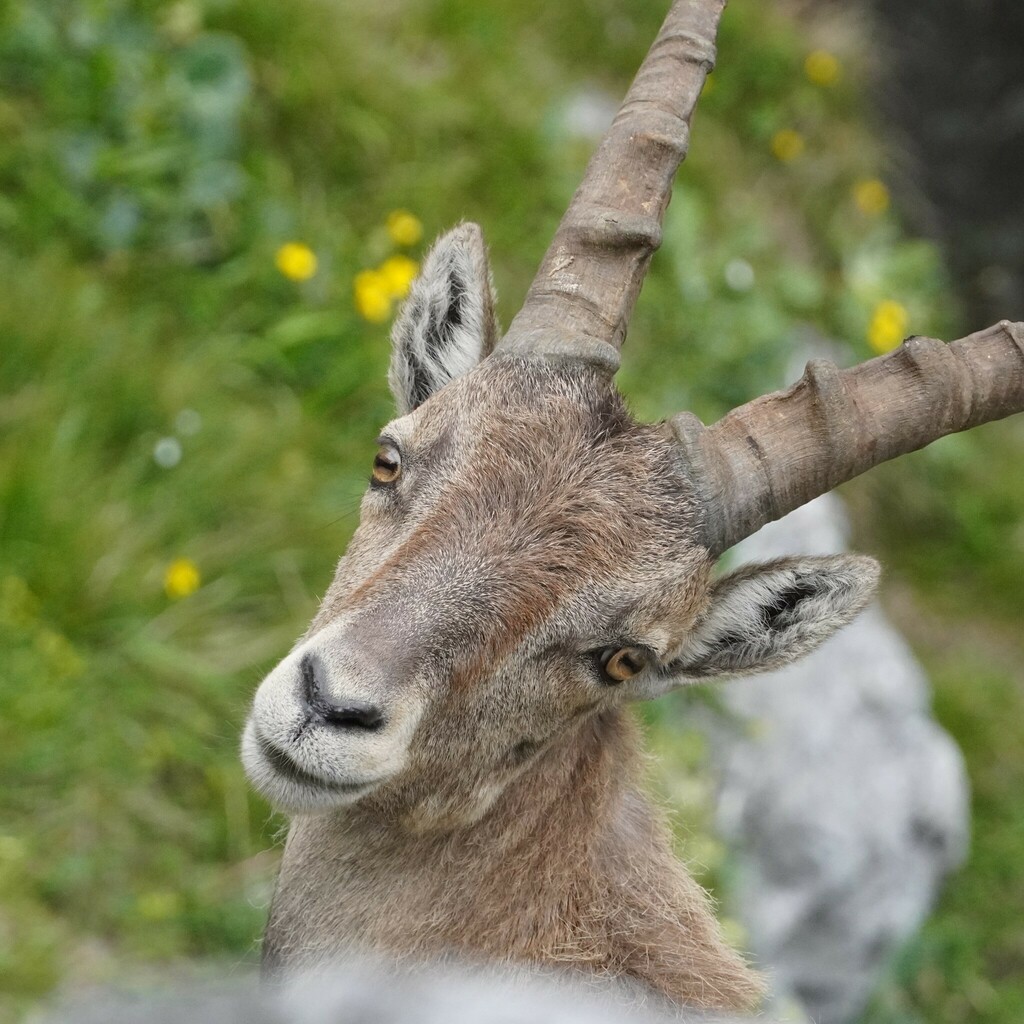
Alpine Ibex
Photo © nbasargin
Photo © nbasargin — CC BY 4.0 — Source: iNaturalist #224946840Identification
The Alpine ibex, also known as the steinbock, is a stocky European mountain goat with distinctive curved horns and sharp, separated hooves adapted for climbing steep terrain. Males are substantially larger than females, weighing 67–117 kg compared to females at 17–32 kg, and their horns are dramatically longer at 69–98 cm versus the females' 18–35 cm. Both sexes display backwards-curving horns with transverse ridges marking their surface.
The species sports brownish-grey hair across most of its body, with lighter coloring on the belly and distinctive dark markings on the chin and throat. The chest region appears nearly black with stripes along the back, and males are distinguished by a beard. Alpine ibexes molt seasonally, shedding their thick, woolly winter coat in spring for a short summer coat. The species is duller in color than most other wild goats in its genus.
Range & Habitat
The Alpine ibex is native to the Alps of central Europe, with range spanning France, Switzerland, Liechtenstein, Italy, Germany, and Austria. Once distributed far more widely—fossil evidence shows it lived as far south as Greece—the species was nearly driven to extinction by hunting. By the 19th century, only one surviving population remained in and around Gran Paradiso, Italy. Thanks to successful reintroduction efforts, the species now inhabits parts of its former range as well as new areas including Slovenia and Bulgaria.
These exceptional climbers occupy steep, rough alpine terrain between 1,800 and 3,300 meters elevation, preferring open areas and slopes of 30–45°. They seek refuge in small caves and overhangs, particularly during winter. Males and females segregate outside breeding season, with females favoring steep slopes while males prefer more level ground. Males move seasonally—to lowland meadows in spring for fresh grass and to alpine meadows in summer, then to steep, rocky slopes in early winter to avoid deep snow.
Behaviour & Diet
Alpine ibexes are strictly herbivorous, feeding primarily on grass and remaining active throughout the year. These social animals are notable for their strong sexual segregation; adult males and females live apart for most of the year, coming together only during the breeding season. During this competitive period, males employ their impressive long horns to fight for mating access to females.
The species faces few natural predators but remains vulnerable to parasites and diseases. Their sharp, highly separated hooves and rubbery calluses on the front feet provide crucial adaptations for navigating their steep, rocky mountain habitat.
Best Time & Places to See It
Gran Paradiso National Park in Italy represents the historical stronghold and best location for viewing Alpine ibexes, as the species was reintroduced from the surviving population there. The animals can be spotted throughout the year, though seasonal movements affect their distribution. Spring and early summer offer excellent opportunities when males move to alpine meadows and lowland areas with fresh grass growth.
Early winter can be particularly productive for observation, as both males and females concentrate on steep, rocky slopes to avoid heavy snow accumulation, making them more visible in these restricted habitats. The species' preference for open alpine areas means good visibility for patient observers willing to search appropriate elevations.
Photography Tips
Photograph Alpine ibexes against alpine meadow and rocky slope backgrounds to showcase their natural habitat and climbing prowess. The dramatic horn structure of males provides compelling compositional elements, particularly during the breeding season when males are more active and confrontational. Dawn and dusk light will enhance the details of their brownish-grey coat and highlight the distinctive dark markings on their chin, throat, and chest.
For maximum visual impact, focus on capturing the sexual dimorphism between males and females when they appear together. Shooting from lower angles emphasizes their impressive climbing ability on steep terrain, while tight portraits can reveal fine details like the transverse ridges on their horns and the remarkable separation of their hooves. The seasonal coat change provides varied photographic opportunities throughout the year.
Mercantour National Park
Isola, France
+146 birds+32 mammals
Where alpine meadows surrender to vertiginous limestone cliffs, the Mercantour's beating heart pulses with Mediterranean and Alpine rhythms. This 4,221-square-kilometre sanctuary straddles France's southeastern border, its…
VIEW NATIONAL PARKÉcrins National Park
La Chapelle-en-Valgaudémar, France
+143 birds+36 mammals
Where granite peaks and Alpine meadows converge across nearly 2,100 square kilometres, Écrins National Park forms one of the wildest mountainous strongholds of the French Alps.…
VIEW NATIONAL PARKVanoise National Park
Val-Cenis, France
+107 birds+29 mammals
Where the French Alps rise in serrated ranks above the Maurienne valley, Vanoise National Park sprawls across more than 1,700 square kilometres of high-altitude wilderness—a realm…
VIEW NATIONAL PARKStelvio National Park
Valfurva, Italy
+116 birds+17 mammals
Where granite peaks rise above three thousand metres and alpine meadows give way to rocky scree, Stelvio National Park guards one of Europe's most dramatically vertical…
VIEW NATIONAL PARKGran Paradiso National Park
Cogne, Italy
+120 birds+16 mammals
Where the western Alps rise steeply above the Aosta Valley, granite ridges and alpine meadows converge in a landscape shaped as much by glacial history as…
VIEW NATIONAL PARKNo community photos yet. Log in to add the first one.
No community observations of this species yet.