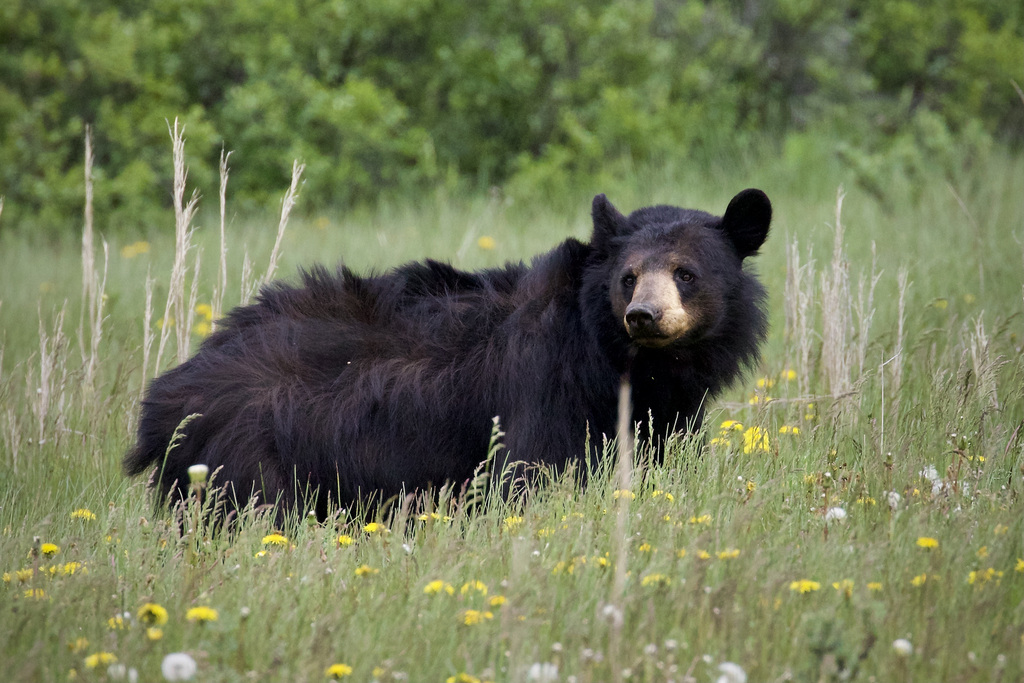
American Black Bear
Photo © John Krampl
Photo © John Krampl — CC BY 4.0 — Source: iNaturalist photo #211814634Identification
The American black bear is North America's smallest bear species, though the term "black" refers only to the typical coat color and is not always reliable for identification. Individuals vary considerably in appearance, with some displaying cinnamon, brown, or even blonde fur. The species is distinguished by a straight profile from forehead to nose—unlike the grizzly bear's pronounced shoulder hump and dished face—and by rounded ears positioned higher on the head. Black bears are medium-sized, powerfully built omnivores with strong claws suited for climbing and foraging.
Range & Habitat
American black bears are endemic to North America and the continent's most widely distributed bear species. Historically occupying most forested regions, they now inhabit sparsely settled, forested areas across much of their original Canadian range, the northeastern and Appalachian United States from Maine to northern Georgia, the northern Midwest, the Rocky Mountain region, the West Coast, and Alaska. Their range has recently expanded into previously unoccupied areas such as Ohio, Illinois, southern Indiana, and western Nebraska. Surveys from the mid-1990s estimated the Canadian population between 396,000 and 476,000 individuals across seven provinces, with populations remaining stable into the 2000s.
Behaviour & Diet
American black bears are omnivores with highly variable diets that shift seasonally and geographically. Their generalist foraging behavior allows them to exploit a wider variety of foods than more specialized bears, a trait that contributed to their survival through past ice ages while more carnivorous bear species became extinct. Bears primarily inhabit forested regions but readily venture beyond forest boundaries in search of food. Individuals are occasionally drawn to human settlements by easily accessible food sources, making proper waste management important in bear country.
Best Time & Places to See It
Black bears are most active during spring, summer, and autumn when food is abundant. Forested regions across Canada, the northeastern United States, Appalachian Mountains, northern Midwest, Rocky Mountains, and the West Coast offer the best opportunities for observation. Areas with recent range expansion, including Ohio, Illinois, and parts of Indiana and Nebraska, may offer viewing opportunities in less expected locations. Early morning and dusk periods are optimal for wildlife observation.
Photography Tips
Photograph black bears from a safe distance using telephoto lenses to capture natural behavior without disturbing the animal. The species' variable coat colors—from black to cinnamon to blonde—provide diverse photographic subjects. Capture the diagnostic straight facial profile and rounded ear placement that distinguish black bears from grizzlies. Forest and wilderness settings showcase the bear's natural habitat. Always prioritize safety and follow local wildlife viewing guidelines.
Tombstone Territorial Park
Acadia National Park
Alaska Maritime National Wildlife Refuge
Algonquin Provincial Park
Alligator River National Wildlife Refuge
Banff National Park
Big Bend National Park
Bosque del Apache National Wildlife Refuge
Canyonlands National Park
Nothing matches these filters.
No community photos yet. Log in to add the first one.
No community observations of this species yet.