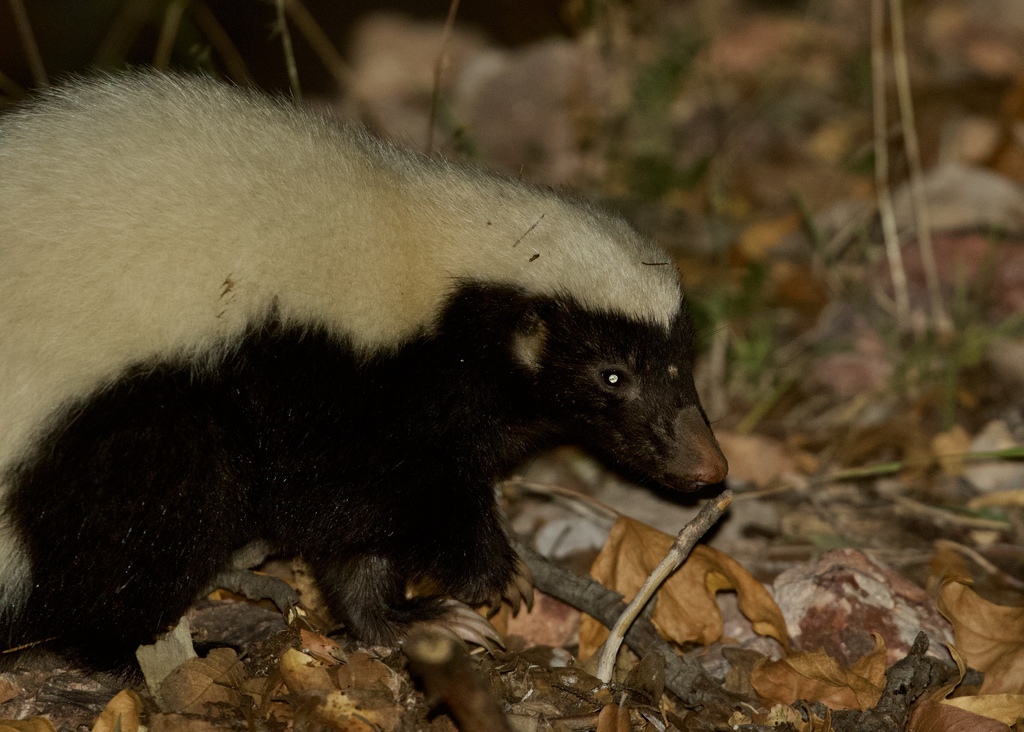
American Hog-nosed Skunk
Photo © RJ Baltierra
Photo © RJ Baltierra — CC BY 4.0 — Source: iNaturalist photo #249846226The American hog-nosed skunk (Conepatus leuconotus) is a species of hog-nosed skunk from Central and North America, and is one of the largest skunks in the world, growing to lengths of up to 2.7 feet (82 cm). Recent work has concluded the western hog-nosed skunk (formerly Conepatus mesoleucus) is the same species, and Conepatus leuconotus is the correct name of the merged populations. In Texas, it is commonly known as the rooter skunk for its habit of rooting and overturning rocks and debris in search of food. == Description == The distinguishing feature of the American hog-nosed skunk is it has a single, broad white stripe from the top of the head to the base of the tail, with the tail itself being completely white. It is the only skunk that lacks a white dot or medial bar between the eyes and has primarily black body fur. The snout of C. leuconotus is relatively long, with a naked nose pad, and resembles the nose of a small hog. The nose pad (20 mm wide by 25 mm long) is about three times wider than that of Mephitis mephitis. The ears are small and rounded, and the eyes are relatively small.…
Big Bend National Park
Brewster County, United States
+345 birds+34 mammals
Where the Chisos Mountains rise abruptly from the Sonoran Desert floor, Big Bend National Park spans over 7,300 square kilometers of one of North America's most…
VIEW NATIONAL PARKSaguaro National Park
Rincon Valley, United States
+354 birds+40 mammals
Where the Sonoran Desert meets sky-island mountains, two geographically separated districts of Saguaro National Park sprawl across nearly two thousand square kilometers of Arizona's most iconic…
VIEW NATIONAL PARKParque Nacional Grutas de Cacahuamilpa
Pilcaya, Mexico
+97 birds+12 mammals
Where limestone ridges rise abruptly from the tropical deciduous forests of central Guerrero, the Grutas de Cacahuamilpa National Park shelters one of Mexico's most extensive cave…
VIEW NATIONAL PARKTutuaca
Tosanachi, Mexico
+147 birds+13 mammals
Where copper canyons plunge deeper than the Grand Canyon itself, Mexico's remote Sierra Madre Occidental unfolds in dramatic vertical relief. Tutuaca anchors this wilderness realm, a…
VIEW PROTECTED LANDSCAPENo community photos yet. Log in to add the first one.
No community observations of this species yet.