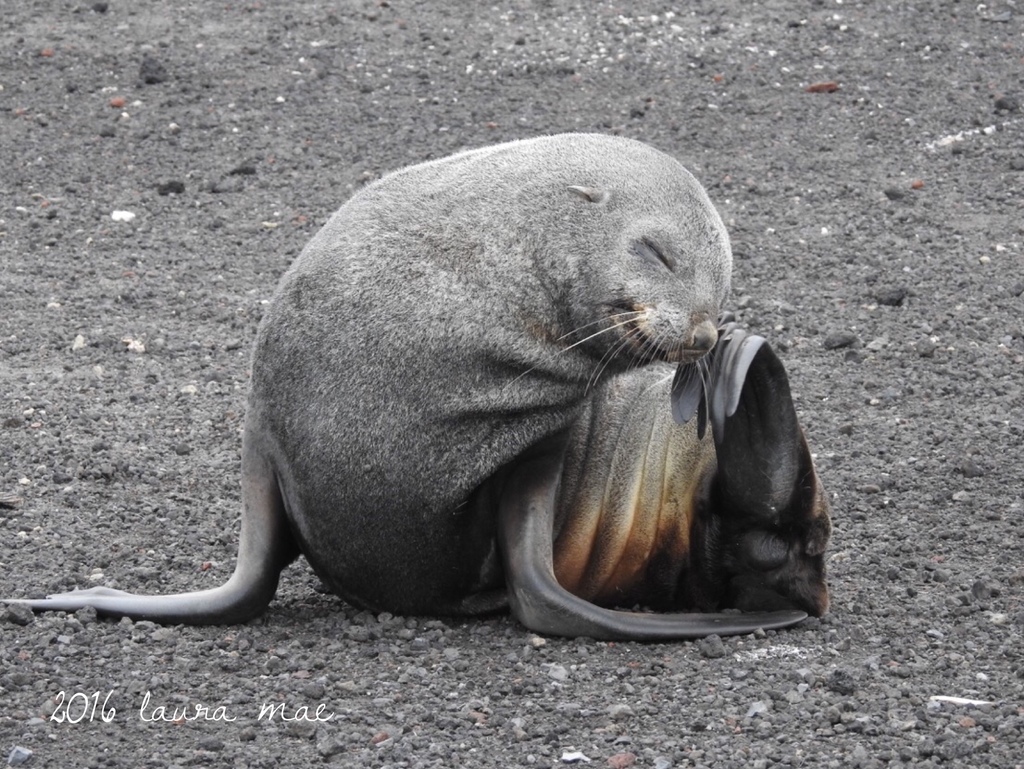
Antarctic Fur Seal
Photo © Laura Mae
Photo © Laura Mae — CC BY 4.0 — Source: iNaturalist #17276855Identification
The Antarctic fur seal is a midsized pinniped with a distinctive long neck and pointed muzzle. Its most prominent features include long, naked external ears and exceptionally long vibrissae (whiskers), particularly in males, which can reach 35–50 cm. The relatively short nose does not extend far past the mouth, and both fore and hind flippers are proportionally long compared to other seals. Adult males are dark brown, while females and juveniles are considerably paler, appearing almost grey with lighter undersides. Pups are born nearly black but lighten as they mature. Sexual dimorphism is striking: males grow up to 2 m long and weigh approximately 133 kg on average, while females reach only 1.4 m and average 34 kg. Despite occasional individual variation in coloration, including rare partially leucistic individuals, these features make Antarctic fur seals identifiable among other Southern Ocean pinnipeds.
Range & Habitat
Antarctic fur seals are circumpolar in distribution and are believed to be the most abundant fur seal species globally. Remarkably, approximately 95% of the world population congregates on South Georgia in the southern Atlantic Ocean, with an estimated population between 4.5 and 6.2 million animals. Breeding colonies are scattered across subantarctic islands: South Georgia, the South Sandwich Islands, South Orkney Islands, South Shetland Islands, and Bouvet Island in the Atlantic; Marion Island, Crozet Islands, Kerguelen, and Heard Island in the Indian Ocean; and Macquarie Island in the Pacific. During winter months, they range widely across the Southern Ocean, from the Antarctic continent northward to the Falkland Islands and southern Argentina. Population trends vary by region, with some colonies increasing while others remain stable or decline.
Behaviour & Diet
Antarctic fur seals are highly polygynous breeders, with dominant males mating with as many as 20 females in a successful season. Males establish breeding territories from October to early November, while females arrive in December and give birth to single pups shortly thereafter. Gestation lasts 8–9 months, and remarkably high breeding synchrony concentrates 90% of pup births within a single 10-day window. Pups are weaned at approximately four months old. These seals are generally solitary foragers and migrants, though adult males may form loose groups while moulting along the Antarctic Peninsula. In the Atlantic region, Antarctic krill (Euphausia superba) is the primary food source, while in the Indian Ocean, fish and squid dominate the diet. Fish prey include myctophids, icefish, and Notothenids, with skates and rays also consumed. Penguins are occasionally preyed upon by males outside the breeding season. Nursing females near South Georgia depend heavily on krill availability for reproductive success.
Best Time & Places to See It
The breeding season from October through February offers the best opportunity to observe Antarctic fur seals in large congregations on their subantarctic island colonies. South Georgia is the premier destination, hosting the vast majority of the global population. For a more accessible experience in the Atlantic, the South Shetland Islands and South Orkney Islands are frequently visited by polar expeditions. Indian Ocean locations such as Kerguelen and Crozet Islands also support substantial colonies. During winter months, individuals disperse widely across the Southern Ocean, making them less predictable to observe outside breeding areas, though they may occasionally appear along southern continental coasts and the Falkland Islands.
Photography Tips
The gregarious nature of Antarctic fur seals during breeding season makes South Georgia an exceptional location for photography, with opportunities to capture hundreds or thousands of animals in single frame compositions. The dark males provide strong contrast against rocky substrates and lighter-coloured females, creating dynamic compositional opportunities. Early morning and late afternoon light at these high latitudes enhances texture and detail in their dense fur. Capture the distinctive features that identify the species: the long, prominent ears, elongated whiskers, and pointed muzzle. Action shots of pups nursing, playing, or interacting with mothers tell compelling stories. Wide-angle photography conveys the scale of massive breeding colonies, while telephoto lenses isolate individuals and reveal facial expressions and behavioral details. Exercise caution when approaching—maintain safe distances and respect wildlife protocols, as Antarctic fur seals are large, powerful animals capable of unexpected aggression.
Brown Bluff
Cooper Bay
Cuverville Island
Danco Island
Deception Island
Elsehul Bay
Fortuna Bay
Garden Route National Park
Half Moon Island
Nothing matches these filters.
No community photos yet. Log in to add the first one.
No community observations of this species yet.