Arctic Fox
Photo © wildatlasguide
Photo © wildatlasguide — Used with permissionIdentification
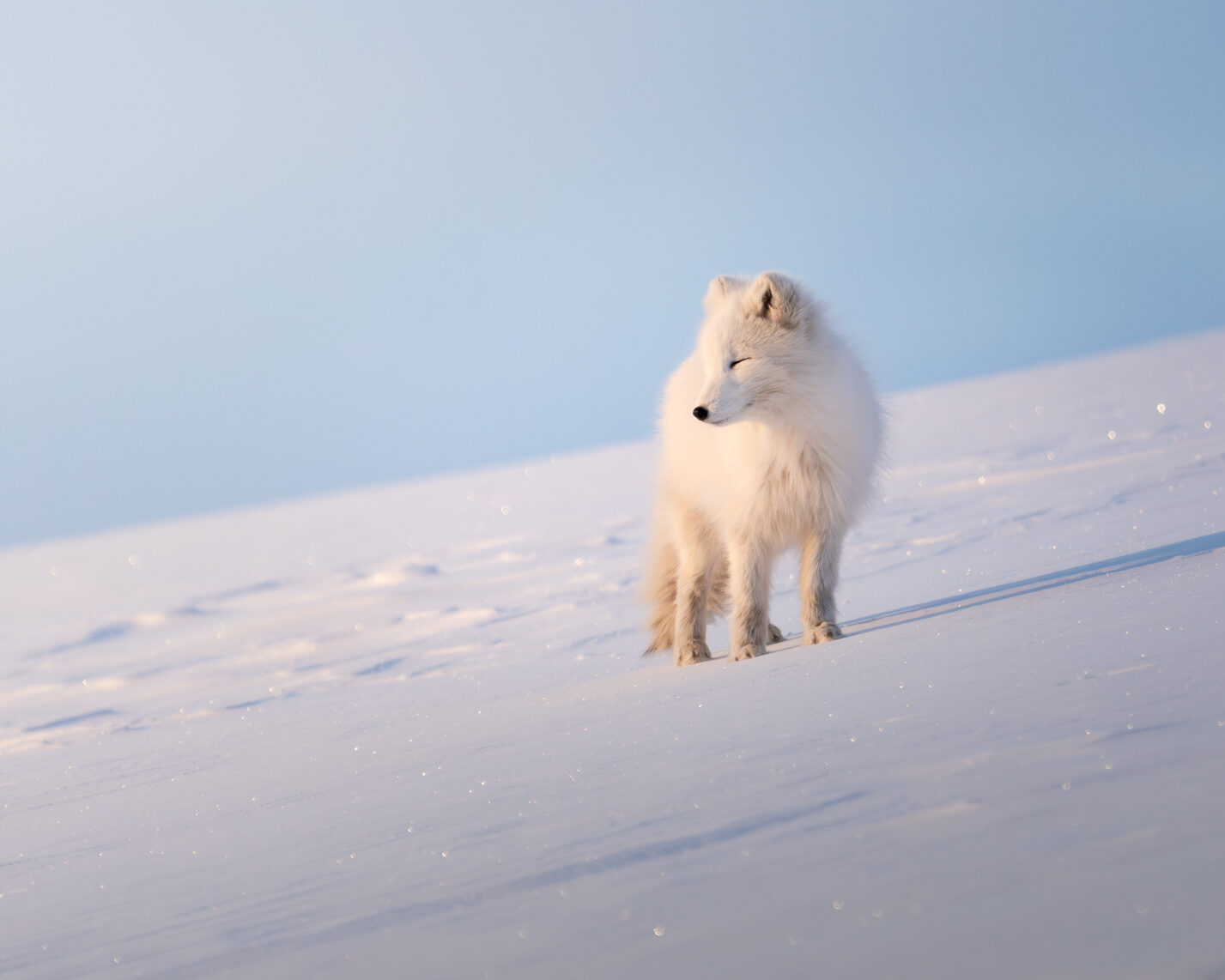
The Arctic fox is a small canid, noticeably smaller than the red fox, standing only 25–30 cm tall at the shoulder. Males average 3.5 kg in weight, while females are typically lighter at 2.9 kg. The body length ranges from 46 to 68 cm, with a characteristically large and fluffy tail comprising about one third of the body length. The species exhibits a compact, rounded body shape designed to minimize heat loss—a key adaptation to its harsh environment.
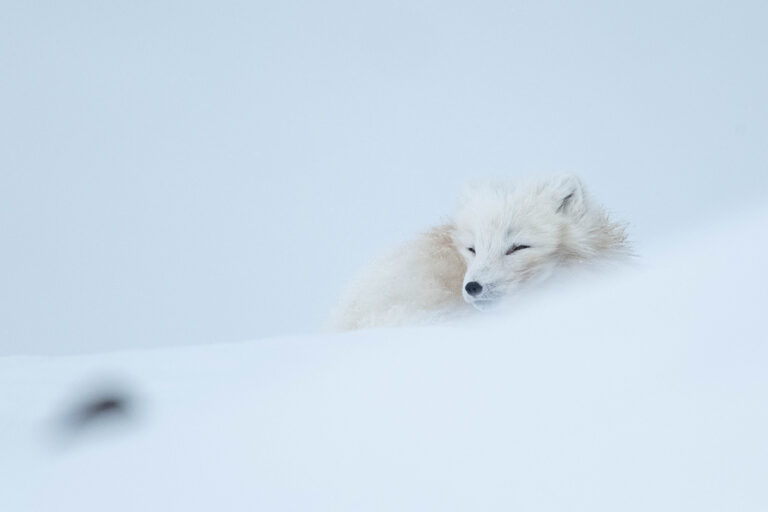
Arctic foxes display two genetically distinct coat color morphs: white and blue. The white morph, which comprises roughly 90% of the global population, is brown with lighter cream-colored sides and belly in summer, transforming to pure white in winter. The blue morph appears black, brown, or grey in summer, becoming slightly lighter in winter. Both morphs undergo dramatic seasonal changes, shedding twice yearly between a short summer coat and a luxuriously thick winter coat that is twice as long, providing unmatched insulation among all mammals.
Range & Habitat
The Arctic fox is native to the Arctic regions of the Northern Hemisphere and is common throughout the Arctic tundra. The species exhibits interesting geographic variation: foxes living further north tend to be smaller than their more southern counterparts. The blue morph shows particular geographic clustering, being most common in Iceland and Fennoscandia, where it comprises 65–70% and 25–30% of populations respectively, compared to just 10% globally.
Behaviour & Diet
Arctic foxes are carnivorous hunters that prey on small creatures including lemmings, voles, ringed seal pups, fish, waterfowl, and seabirds. They are opportunistic feeders, also consuming carrion, berries, seaweed, insects, and other small invertebrates. During breeding season, Arctic foxes form monogamous pairs that remain together to raise their young in complex underground dens. Family members occasionally assist in caring for offspring, demonstrating cooperative breeding behavior.
In the wild, most Arctic foxes do not survive their first year, though exceptional individuals may live up to 11 years. The species faces predation from golden eagles, Arctic wolves, polar bears, wolverines, red foxes, and brown bears. Arctic foxes possess specialized physiological adaptations for extreme cold, including countercurrent heat exchange in their leg blood vessels that keeps their feet above the freezing point while standing on snow, and the ability to lower their metabolic rate significantly in winter to conserve energy.
Best Time & Places to See It
Arctic foxes are widespread throughout Arctic tundra habitats across the Northern Hemisphere, making them accessible to wildlife travelers visiting circumpolar regions. The seasonal coat changes offer distinct viewing experiences: winter visits reward observers with the striking white morph foxes against snowy landscapes, while summer visits showcase the darker summer plumage and more active hunting behavior. Travelers to Iceland and Fennoscandia have enhanced opportunities to observe the blue morph variant.
Photography Tips
The Arctic fox's dramatic seasonal transformation provides outstanding photographic opportunities. Winter photography captures the fox's stunning white camouflage against snow and ice, while the large, fluffy tail and compact body create striking compositional elements. The species' small stature and rounded proportions should be framed to emphasize their distinctive shape. Summer visits allow photographers to capture the darker coat morphs and active hunting behavior across tundra landscapes. Patient observation near denning sites during breeding season may yield family group images, though maintaining appropriate distance is essential for animal welfare.
Arctic Ecology and Ecosystem Conservation Tour
South Spitsbergen National Park
Norway
+41 birds+15 mammals
Glaciers and tundra meet in Norway's high Arctic, where South Spitsbergen National Park sprawls across the southernmost reaches of the Svalbard archipelago. Here, massive valley glaciers…
VIEW NATIONAL PARKNorthwest Spitsbergen National Park
Norway
+58 birds+17 mammals
Where the High Arctic converges with the Norwegian mainland, Northwest Spitsbergen National Park sprawls across one of Earth's most extreme and pristine wildernesses. Crowned by jagged…
VIEW NATIONAL PARKNorthern Isfjorden National Park
Norway
+40 birds+12 mammals
Where the Arctic fjord system cuts deep into Svalbard's northwestern coast, Northern Isfjorden National Park protects a landscape of stark geological drama—towering cliff faces, tidewater glaciers,…
VIEW NATIONAL PARKSirmilik National Park
Qikiqtaaluk Region, Canada
+58 birds+4 mammals
Where the Canadian Arctic archipelago fractures into a labyrinth of islands, Sirmilik National Park protects one of the High North's most pristine marine and terrestrial ecosystems.…
VIEW NATIONAL PARKWapusk National Park
Unorganized Division No. 23, Canada
+140 birds+6 mammals
Across the subarctic lowlands of northern Manitoba, where permafrost underlies a mosaic of stunted boreal forest, open muskeg, and coastal tundra, Wapusk National Park sprawls across…
VIEW NATIONAL PARKSassen-Bünsow Land National Park
Soere, Norway
+30 birds+10 mammals
Where Arctic tundra sprawls across glaciated plateaus in the remote Svalbard archipelago, a realm of raw geological drama unfolds. Sassen-Bünsow Land National Park encompasses a landscape…
VIEW NATIONAL PARKForlandet National Park
Vera, Norway
+38 birds+12 mammals
Windswept Arctic tundra meets jagged coastal cliffs where the Barents Sea crashes against Norway's northernmost wilderness. This sliver of protected terrain on the Nordkapp Peninsula comprises…
VIEW NATIONAL PARKSt. Paul Island
Saint Paul, United States
+255 birds+8 mammals
Windswept tundra rolls across this remote Pribilof island, where volcanic basalt cliffs plunge into the Bering Sea and fog rolls in thick enough to erase the…
VIEW PROTECTED LANDSCAPEDisko Bay
Kitsissuarsuit, Greenland
+46 birds+9 mammals
Where Arctic fjords carve deep into Greenland's western coast, Disko Bay creates a protected landscape of extraordinary ecological complexity. The waters here merge temperate Atlantic currents…
VIEW PROTECTED LANDSCAPEScoresby Sund
Vandreblok, Greenland
+43 birds+9 mammals
Where granite peaks pierce an Arctic sky and the world's largest fjord system carves deep into northeastern Greenland, a primordial landscape unfolds in shades of ice-blue…
VIEW PROTECTED LANDSCAPENortheast Greenland National Park
Northeast Greenland National Park, Greenland
+34 birds+10 mammals
Where granite peaks plunge into the Arctic Ocean and pack ice dominates a landscape of incomparable vastness, one of Earth's most remote wildernesses reveals itself. Spanning…
VIEW NATIONAL PARKKangerlussuaq
Kangerlussuaq, Greenland
+26 birds+4 mammals
Arctic tundra stretches endlessly beneath a crystalline sky where the Søren Kierkegaard fjord carves through a landscape of stunted willow, dwarf birch, and lichen-covered bedrock. This…
VIEW PROTECTED LANDSCAPENuuk Fjord System
Nuuk, Greenland
+54 birds+3 mammals
Where granite peaks plunge directly into the Arctic Ocean, a labyrinth of deep fjords carves through Greenland's southwestern coast, their waters eternally shadowed by towering rock…
VIEW PROTECTED LANDSCAPEArctic National Wildlife Refuge
Arctic Village, United States
+132 birds+15 mammals
Across the northernmost reaches of Alaska's Unorganized Borough, where the Brooks Range rises from the coastal plain and tundra spreads endlessly toward the Arctic Ocean, lies…
VIEW WILDLIFE SANCTUARYAlaska Maritime National Wildlife Refuge
Alaska, United States
+391 birds+58 mammals
Where the North Pacific collides with Alaska's rugged coastline, a sprawling archipelago of islands, rocky outcrops, and coastal headlands forms one of North America's most remote…
VIEW WILDLIFE SANCTUARYNo community observations of this species yet.