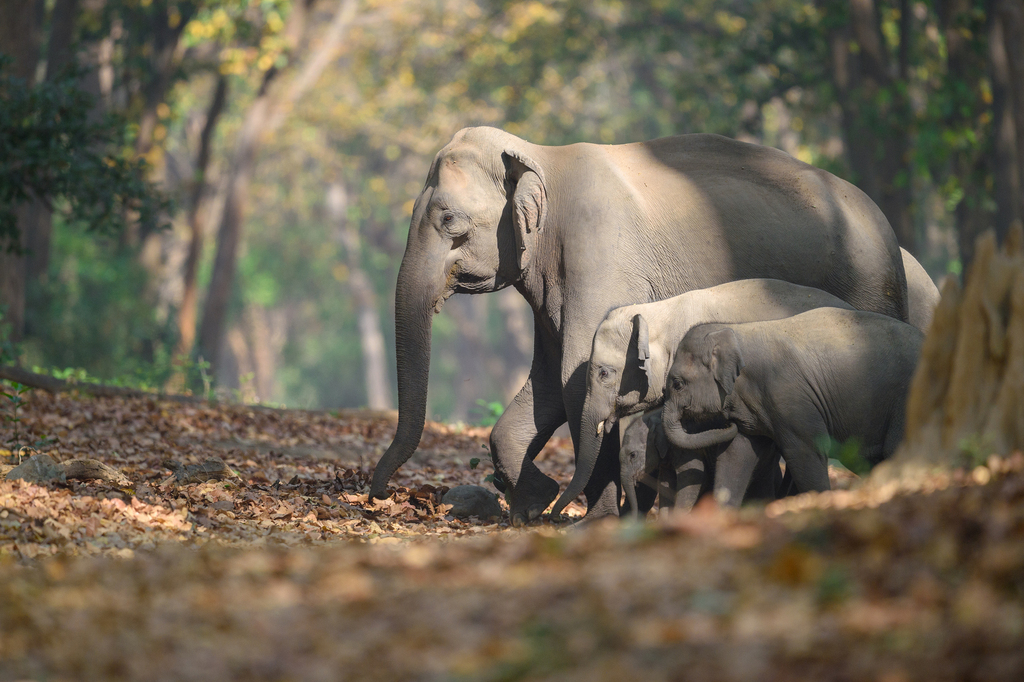
Asian Elephant
Photo © Morten Ross
Photo © Morten Ross — CC BY 4.0 — Source: iNaturalist photo #219306743Identification
The Asian elephant is the largest living land animal in Asia and the second largest living elephantid in the world. It is distinguished by its long trunk with a single finger-like process at the tip, large tusks in males, and characteristically laterally folded large ears. The skin is wrinkled and grey, with patches of depigmentation on the trunk, ears, and neck. Adult males weigh approximately 4 tonnes, while females are smaller at around 2.7 tonnes.
Three subspecies are recognised. The Sri Lankan elephant is the largest subspecies, with darker skin and larger, more distinct patches of depigmentation on the ears, face, trunk and belly. The Indian elephant has generally grey skin, lighter than the Sri Lankan form but darker than the Sumatran subspecies. Borneo elephants, found in northeastern Borneo, are smaller than all other subspecies but possess notably larger ears, longer tails, and straighter tusks.
Range & Habitat
Asian elephants are distributed across the Indian subcontinent and Southeast Asia, ranging from India in the west to Borneo in the east, and from Nepal in the north to Sumatra in the south. They inhabit a diverse range of forest and grassland ecosystems, including tropical evergreen forests, semi-evergreen forests, moist deciduous forests, dry deciduous forests, and dry thorn forests, as well as grasslands.
Behaviour & Diet
Asian elephants are highly intelligent and self-aware animals, with a large and well-developed neocortex. They display complex behaviours associated with grief, learning, and greeting. Socially, females and calves form tight-knit groups, while adult males typically remain solitary or congregate in bachelor groups with other males. During breeding season, males temporarily join female groups to mate. In the wild, these elephants live to approximately 60 years old.
As strict herbivores, Asian elephants consume about 150 kilograms of vegetation daily. Regrettably, the species has been listed as Endangered on the IUCN Red List since 1986, as populations have declined by at least 50% over the last three elephant generations—a period of approximately 60 to 75 years. The primary threats are habitat loss, degradation, fragmentation, and poaching. Captive populations are particularly concerning, declining due to low birth rates and high mortality, with captive Asian elephants dying at much younger ages than their wild counterparts.
Best Time & Places to See It
Asian elephants can be encountered across their range in India, Nepal, Southeast Asia, Sumatra, and Borneo. The specific best times and locations vary by region and habitat type, with grasslands and forest edges typically offering the most reliable sightings. Travellers should consult local guides and conservation areas for region-specific timing and location information.
Photography Tips
The Asian elephant's distinctive features—its long trunk, large ears, and wrinkled grey skin with depigmented patches—provide excellent photographic subjects. Males with their prominent tusks offer particularly striking images. Photographing these intelligent animals in their natural habitats, whether in grasslands or amongst forest vegetation, captures the majesty of Asia's largest terrestrial animal. Wide-angle lenses work well for capturing their impressive size in context, while longer lenses allow detailed portraits of facial features and tusks.
Lunugamvehera National Park
Sri Lanka
+204 birds+14 mammals
Dry scrubland and shallow wetlands converge in Sri Lanka's southeastern lowlands, where Lunugamvehera National Park anchors one of the island's most ecologically vital landscapes. The park's…
VIEW NATIONAL PARKMinneriya National Park
Sri Lanka
+158 birds+9 mammals
Across the dry zone of Sri Lanka's North Central Province spreads a landscape of shallow tanks, grassland margins, and scattered dry forest—a mosaic of water and…
VIEW NATIONAL PARKWasgamuwa National Park
Sri Lanka
+156 birds+8 mammals
Dry deciduous forest and open grassland sweep across the North Central lowlands where Wasgamuwa National Park protects one of Sri Lanka's largest remaining tracts of this…
VIEW NATIONAL PARKAngamedilla National Park
Polonnaruwa, Sri Lanka
+40 birds+2 mammals
Ancient tanks and sal forests define this water-rich sanctuary in Sri Lanka's North Central heartland, where seasonal wetlands and dry deciduous woodland create a mosaic of…
VIEW NATIONAL PARKMaduru Oya National Park
Sri Lanka
+74 birds+1 mammals
Granite ridges rise abruptly from the humid lowlands of Sri Lanka's Uva Province, their weathered slopes clothed in dry monsoon forest and scattered woodland where deciduous…
VIEW NATIONAL PARKHat Noppharat Thara-Mu Ko Phi Phi National Park
Ao Nang, Thailand
+253 birds+9 mammals
Where limestone karsts rise dramatically from turquoise waters, Hat Noppharat Thara-Mu Ko Phi Phi National Park unfolds across a mosaic of beach, mangrove forest, and island…
VIEW NATIONAL PARKKhao Yai National Park
Prachantakham District, Thailand
+377 birds+46 mammals
Evergreen dipterocarp forest blankets the rolling terrain of this national park in eastern Thailand, where limestone hills rise abruptly from the forest floor and seasonal streams…
VIEW NATIONAL PARKKanha Tiger Reserve
Kanha Kisli F.V., India
+321 birds+23 mammals
Where sal forests give way to emerald meadows and crystalline streams carve through ancient valleys, one of India's finest wilderness reserves unfolds across the Maikal Range.…
VIEW NATIONAL PARKBandhavgarh National Park
Garhpuri, India
+285 birds+17 mammals
Where granite ridges rise dramatically above sal and bamboo forests, one of India's most pristine tiger reserves unfolds across the Vindhyan plateau. Ancient rock formations tower…
VIEW NATIONAL PARKKaziranga National Park
Kohora, India
+422 birds+26 mammals
Dawn breaks over the floodplains of the Brahmaputra, where tall grasslands stretch endlessly beneath monsoon-heavy skies. This sprawling wilderness of northeastern Assam is a mosaic of…
VIEW NATIONAL PARKPeriyar National Park
Mlappara, India
+232 birds+4 mammals
Dawn breaks over mist-shrouded ridges where the Western Ghats tumble toward Kerala's spice-scented lowlands. Here, ancient tropical forests envelope a glittering artificial lake, creating a mosaic…
VIEW NATIONAL PARKPampadum Shola National Park
Vattavada, India
+258 birds+14 mammals
Where misty shola forests cling to the high plateaus of the Nilgiri Mountains, ancient evergreen remnants create a world apart. This 2,316-hectare reserve protects one of…
VIEW NATIONAL PARKBandipur National Park
Hirehalli, India
+302 birds+19 mammals
Where the Western Ghats descend into the Deccan plateau, ancient deciduous forests blanket a landscape carved by the Nugu River. Bandipur unfolds across 880 square kilometres…
VIEW NATIONAL PARKNagarahole Tiger Reserve
Nalkeri Forest, India
+323 birds+23 mammals
Where granite escarpments rise above dense deciduous forests and the Kabini River carves through pristine wilderness, one of India's most biodiverse landscapes unfolds across the Western…
VIEW NATIONAL PARKTaman Negara National Park
Kampong Samas, Malaysia
+393 birds+48 mammals
Where ancient rainforest meets limestone peaks, one of Southeast Asia's oldest protected wilderness preserves sprawls across 4,343 square kilometers of primordial landscape. Dipterocarp giants tower overhead,…
VIEW NATIONAL PARKWay Kambas National Park
Lampung Timur, Indonesia
+237 birds+20 mammals
Across the low swamplands of eastern Lampung, where freshwater wetlands merge into tidal mangrove forests along the Sunda Strait, sprawls one of Sumatra's most vital sanctuaries.…
VIEW NATIONAL PARKNo community photos yet. Log in to add the first one.