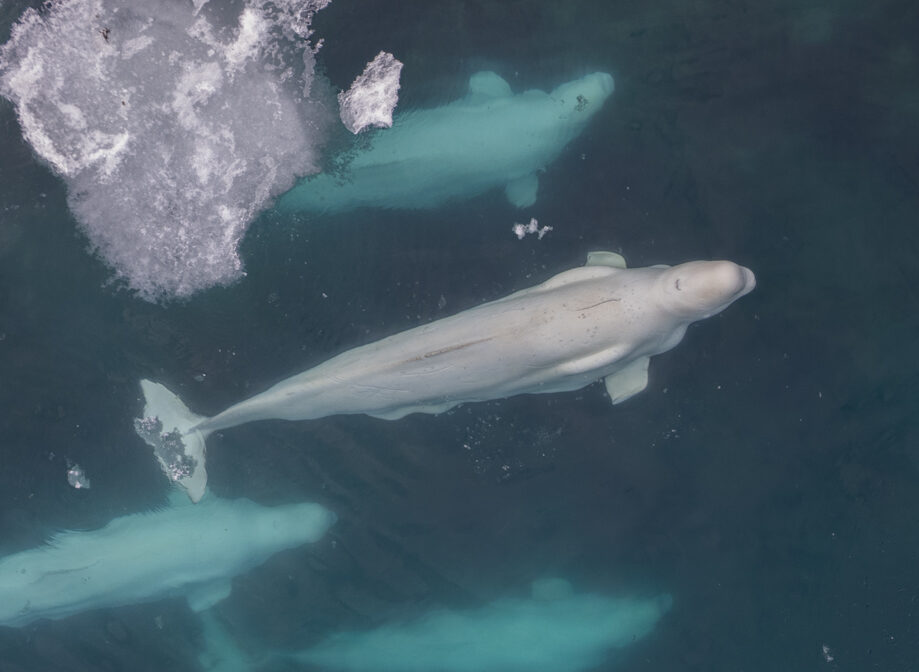
Beluga
Photo © wildatlasguide
Photo © wildatlasguide — Used with permissionIdentification
The beluga whale is unmistakable in the Arctic, being the only cetacean to regularly display an all-white coloration. This striking appearance, combined with the absence of a dorsal fin, makes it instantly recognizable. The beluga's most distinctive feature is a large, rounded, deformable protuberance on its head called the melon, which houses its echolocation organ and gives the species its alternative nickname "melonhead." The whale has a stocky body and a characteristic gentle expression often described as a smile, contributing to its reputation as a charismatic marine mammal.
Adult males grow up to 5.5 meters (18 feet) long and weigh up to 1,600 kilograms (3,530 pounds), making the beluga intermediate in size between dolphins and larger whale species. Like many cetaceans, belugas possess substantial blubber reserves beneath their skin—an essential adaptation for surviving in frigid Arctic waters. Their hearing is exceptionally well-developed, enabling sophisticated echolocation that allows them to navigate and hunt effectively even beneath sheet ice.
Range & Habitat
Belugas are Arctic and sub-Arctic cetaceans found primarily around the Arctic Ocean and the waters surrounding North America, Russia, and Greenland. The worldwide population is estimated at around 200,000 individuals. These whales are highly migratory, with the majority of groups spending winters near the Arctic ice cap and moving to warmer river estuaries and shallow coastal areas during summer months when sea ice melts. However, some populations are sedentary and do not undertake significant seasonal migrations.
During summer, belugas gather in impressive numbers, sometimes congregating in the hundreds or even thousands in estuaries and shallow coastal waters. This gregarious behavior, combined with their specific habitat preferences, makes certain locations particularly valuable for observation during peak seasons.
Behaviour & Diet
Belugas are highly social animals, typically forming groups of around 10 individuals, though larger aggregations occur seasonally. Despite their gregarious nature, they are relatively slow swimmers, yet they are capable divers that can descend to depths of 700 meters (2,300 feet). Their vocalizations are legendary—they produce high-pitched squeaks, squeals, clucks, and whistles that earned them the nickname "sea canary," and their sophisticated communication abilities contribute significantly to their appeal to observers.
As opportunistic feeders, belugas consume a varied diet that shifts seasonally and geographically depending on local prey availability. Their flexible feeding strategy allows them to thrive across different Arctic and sub-Arctic environments.
Best Time & Places to See It
Summer is the optimal season for beluga watching, when these whales migrate to warmer river estuaries and coastal areas as sea ice melts. During this period, the possibility of encountering large groups in shallow waters significantly increases. The aggregations that form in these summer habitats provide exceptional opportunities for nature travelers and photographers to observe belugas in their natural environment.
However, specific locations and accessibility details require local research, as beluga distribution spans vast Arctic and sub-Arctic regions across multiple countries and territories.
Photography Tips
The beluga's striking all-white coloration and distinctive rounded head profile make it visually distinctive, but photographing them requires patience and proper timing. Summer gatherings in estuaries and shallow coastal areas provide the best opportunities for close-range shots. The absence of a dorsal fin means belugas present a different silhouette than other cetaceans—focus on capturing the characteristic melon and the gentle facial expression that makes this species so appealing.
Light conditions in Arctic regions during summer months are favorable for extended shooting periods. Approach locations quietly to avoid disturbing these sensitive animals, and position yourself downwind when possible. The contrast between the white whale and water, ice, and rocky shorelines can create compelling compositional opportunities.
South Spitsbergen National Park
Norway
+41 birds+15 mammals
Glaciers and tundra meet in Norway's high Arctic, where South Spitsbergen National Park sprawls across the southernmost reaches of the Svalbard archipelago. Here, massive valley glaciers…
VIEW NATIONAL PARKNorthwest Spitsbergen National Park
Norway
+58 birds+17 mammals
Where the High Arctic converges with the Norwegian mainland, Northwest Spitsbergen National Park sprawls across one of Earth's most extreme and pristine wildernesses. Crowned by jagged…
VIEW NATIONAL PARKNorthern Isfjorden National Park
Norway
+40 birds+12 mammals
Where the Arctic fjord system cuts deep into Svalbard's northwestern coast, Northern Isfjorden National Park protects a landscape of stark geological drama—towering cliff faces, tidewater glaciers,…
VIEW NATIONAL PARKSassen-Bünsow Land National Park
Soere, Norway
+30 birds+10 mammals
Where Arctic tundra sprawls across glaciated plateaus in the remote Svalbard archipelago, a realm of raw geological drama unfolds. Sassen-Bünsow Land National Park encompasses a landscape…
VIEW NATIONAL PARKForlandet National Park
Vera, Norway
+38 birds+12 mammals
Windswept Arctic tundra meets jagged coastal cliffs where the Barents Sea crashes against Norway's northernmost wilderness. This sliver of protected terrain on the Nordkapp Peninsula comprises…
VIEW NATIONAL PARKAlaska Maritime National Wildlife Refuge
Alaska, United States
+391 birds+58 mammals
Where the North Pacific collides with Alaska's rugged coastline, a sprawling archipelago of islands, rocky outcrops, and coastal headlands forms one of North America's most remote…
VIEW WILDLIFE SANCTUARYNo community observations of this species yet.