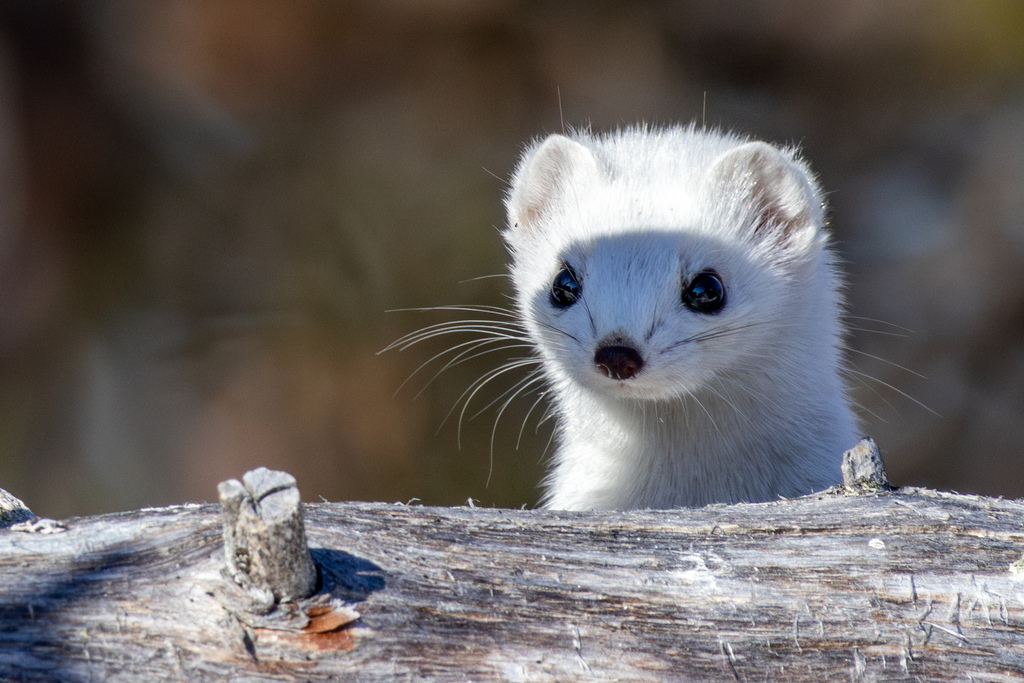
Stoat
Photo © Diego González Dopico
Photo © Diego González Dopico — CC BY 4.0 — Source: iNaturalist photo #489011269Identification
The stoat, also known as the Eurasian ermine or short-tailed weasel in North America, is a small mustelid with a characteristically elongated body and relatively long tail. Males are noticeably larger than females—roughly 25% longer and 1.5–2.0 times heavier—with males averaging around 258 g and females typically weighing less than 180 g. The animal's most distinctive features include its long, slender cylindrical trunk, exceptionally long whiskers (brown or white), short rounded ears that lie flat against the skull, and round black eyes that protrude slightly. The tail, though shorter than the long-tailed weasel's, always exceeds a third of the body length. In winter, stoats in northern regions develop a pure white coat, which historically was called ermine and became prized for ceremonial robes and royal regalia.
The stoat's body structure is perfectly adapted for its lifestyle: non-retractable claws are large in proportion to the digits, each foot has five toes, and the head is set exceptionally far forward on the shoulders. The skull is relatively longer than that of the similar least weasel, with a narrower braincase, though the skull projections and teeth remain weakly developed compared to some other carnivores.
Range & Habitat
The stoat is native to Eurasia and the northern regions of North America, with a wide circumpolar distribution that has resulted in its classification as Least Concern on the IUCN Red List. A 2021 study split what was formerly considered a single species into three distinct species: M. erminea sensu stricto inhabits Eurasia and Alaska, M. richardsonii occupies most of North America, and M. haidarum is found on several islands off the Pacific Northwest coast. As of 2021, 21 subspecies are recognized across this vast range.
Notably, the stoat was introduced to New Zealand in the late 19th century in an attempt to control rabbit populations. However, the species thrived in its new environment with devastating consequences for native bird populations, leading to its nomination as one of the world's top 100 "worst invaders."
Behaviour & Diet
The stoat's elongated body and small size make it superbly adapted for hunting in burrows and beneath snow, abilities that allowed it to thrive during the Ice Age. Its evolutionary history reveals how the species adapted to changing environments: the stoat's ancestors were larger than the current form but underwent significant size reduction beginning 5–7 million years ago when northern forests gave way to open grassland, prompting explosive evolution of small burrowing rodents that became the stoat's primary prey. This small, streamlined body shape remains its greatest hunting advantage, allowing access to prey in spaces larger predators cannot reach.
Stoats possess large anal scent glands, which they use for communication. Males are called dogs, hobs, or jacks, while females are called jills; groups of stoats are referred to collectively as either a gang or a pack.
Best Time & Places to See It
Stoats are found across their wide circumpolar range in suitable habitats throughout Eurasia and northern North America. In northern regions, they are most conspicuous during winter months when their white coat contrasts sharply with the landscape, though this seasonal color change does not occur uniformly across all populations. The species' preference for small rodent populations means it thrives in open grasslands, meadows, and areas with abundant burrowing rodents.
Photography Tips
The stoat's small size and rapid, sinewy movements present a challenge for photographers. Their elongated body and long tail create dynamic compositional possibilities—capture images that emphasize the characteristic stretched posture and the tail's length relative to the body. In winter, white-coated stoats offer striking contrast opportunities against dark backgrounds. The animal's round, protruding black eyes and long whiskers are distinctive features worth highlighting. Early morning or late afternoon light will best reveal the texture of fur and the animal's characteristic alert posture as it hunts through grass or snow.
Tombstone Territorial Park
Abel Tasman National Park
Alaska Maritime National Wildlife Refuge
Aoraki / Mount Cook National Park
Avesnois Regional Nature Park
Bannau Brycheiniog National Park
Biebrza National Park
Burren National Park
Cairngorms National Park
Nothing matches these filters.
No community photos yet. Log in to add the first one.
No community observations of this species yet.