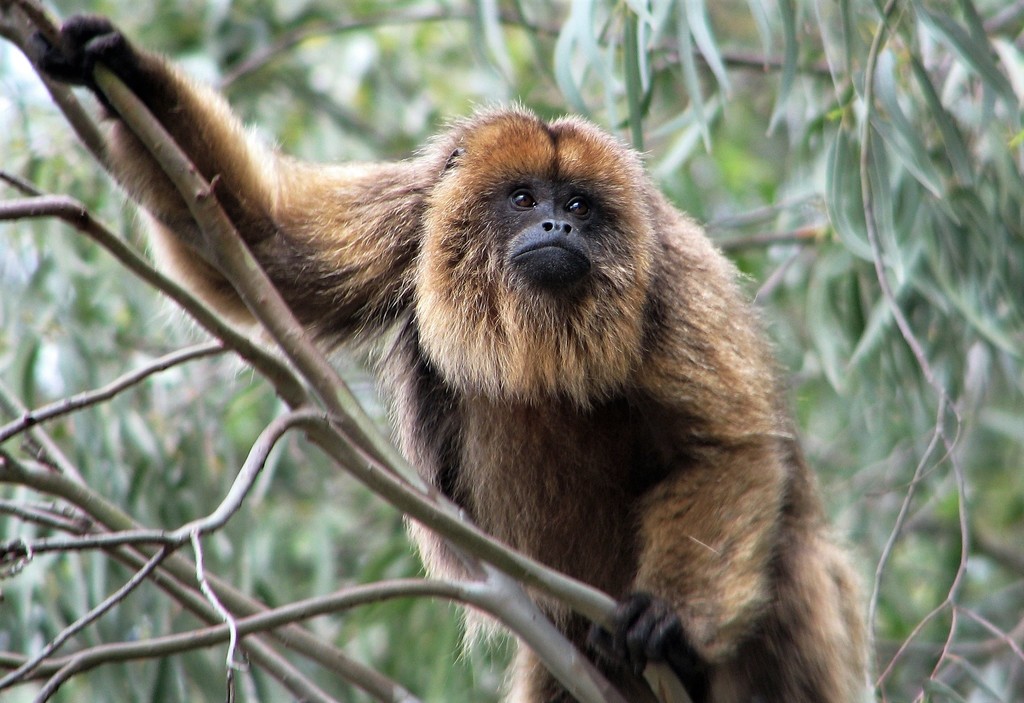
Black-and-gold Howler
Photo © Hugo Hulsberg
Photo © Hugo Hulsberg — CC0 1.0 — Source: iNaturalist photo #99667722Identification
The black howler is among the largest New World monkeys and one of nine species in the Alouatta genus. This species is strikingly sexually dimorphic: adult males are entirely black, while females and infants of both sexes display golden colouring, creating the distinctive black-and-gold appearance reflected in their name. Males are considerably heavier than females, weighing 6–7.7 kg compared to their lighter-weight counterparts. A notable anatomical feature is the enlarged hyoid bone in males, which functions as a resonating chamber for their famous vocalizations.
Range & Habitat
Black howlers are distributed across South America, occurring in Paraguay, southern Brazil, eastern Bolivia, northern Argentina, and occasionally Uruguay. They are predominantly arboreal, rarely descending to the ground. Well-conserved forests, such as those along the Paraná River in Brazil, support higher densities of these monkeys. They typically inhabit forested canopies where their prehensile tails—featuring bare patches of skin underneath—provide excellent climbing versatility and secure anchoring among branches.
Behaviour & Diet
Black howlers are renowned for their powerful vocalizations, with their distinctive howls audible up to two kilometres away. These calls serve as territorial displays and help regulate spacing between groups. The monkeys vocalize primarily around dawn. They are among the least active primates, spending 60–70% of their day resting or sleeping, though activity levels vary seasonally. Their diet is primarily folivorous, supplemented with fruits, figs, mosses, bark, seeds, and flowers. Howlers possess specialized digestive systems and strong molars enabling them to process mature leaves efficiently. During winter months, when fruit is scarce, they consume more leaves and are correspondingly less active.
Best Time & Places to See It
Listen for black howlers at dawn, when their vocalizations are most frequent and carry considerable distances through the forest. The Upper Paraná River region of southern Brazil offers excellent opportunities for observation, as well-conserved forests there support stable populations. Group sizes typically range from 6–18 individuals in optimal habitat. Patience and early morning expeditions significantly increase your chances of encountering these remarkable primates.
Photography Tips
The striking sexual dimorphism of black howlers offers compelling photographic contrast: capture the jet-black males alongside golden females and infants for dramatic compositional variety. Early light at dawn, when howling occurs, provides optimal conditions for both photography and audio recording. Their largely sedentary nature—spending most hours resting—offers patient photographers extended opportunities for sharp, detailed shots in the canopy. A telephoto lens is essential, as these arboreal monkeys remain elevated in forest layers.
Iguaçu National Park
Brazil
+387 birds+17 mammals
Where the Paraná Plateau plunges toward the Atlantic watershed, six thousand square kilometers of subtropical rainforest cling to steep gorges and river valleys in this corner…
VIEW NATIONAL PARKSerra da Capivara National Park
Brazil
+156 birds+6 mammals
Across the semi-arid plateaus and deeply incised canyons of northeastern Brazil, where Piauí's ancient sandstone formations rise and fall in weathered waves, Serra da Capivara National…
VIEW NATIONAL PARKPantanal Matogrossense National Park
Brazil
+322 birds+17 mammals
Where the flooded forests of central Brazil meet vast seasonally inundated grasslands, Pantanal Matogrossense National Park sprawls across nearly 2,900 square kilometers of one of the…
VIEW NATIONAL PARKRío Pilcomayo National Park
Argentina
+271 birds+13 mammals
Where the Río Pilcomayo cuts through northeastern Argentina's subtropical lowlands, a sprawling mosaic of wetlands, grasslands, and seasonally flooded forests creates one of South America's most…
VIEW NATIONAL PARKChaco National Park
Municipio de Presidencia de la Plaza, Argentina
+258 birds+7 mammals
Across the humid subtropical lowlands of northeastern Argentina, where the Paraná River basin feeds vast seasonal wetlands and gallery forests, Chaco National Park protects one of…
VIEW NATIONAL PARKNo community photos yet. Log in to add the first one.
No community observations of this species yet.