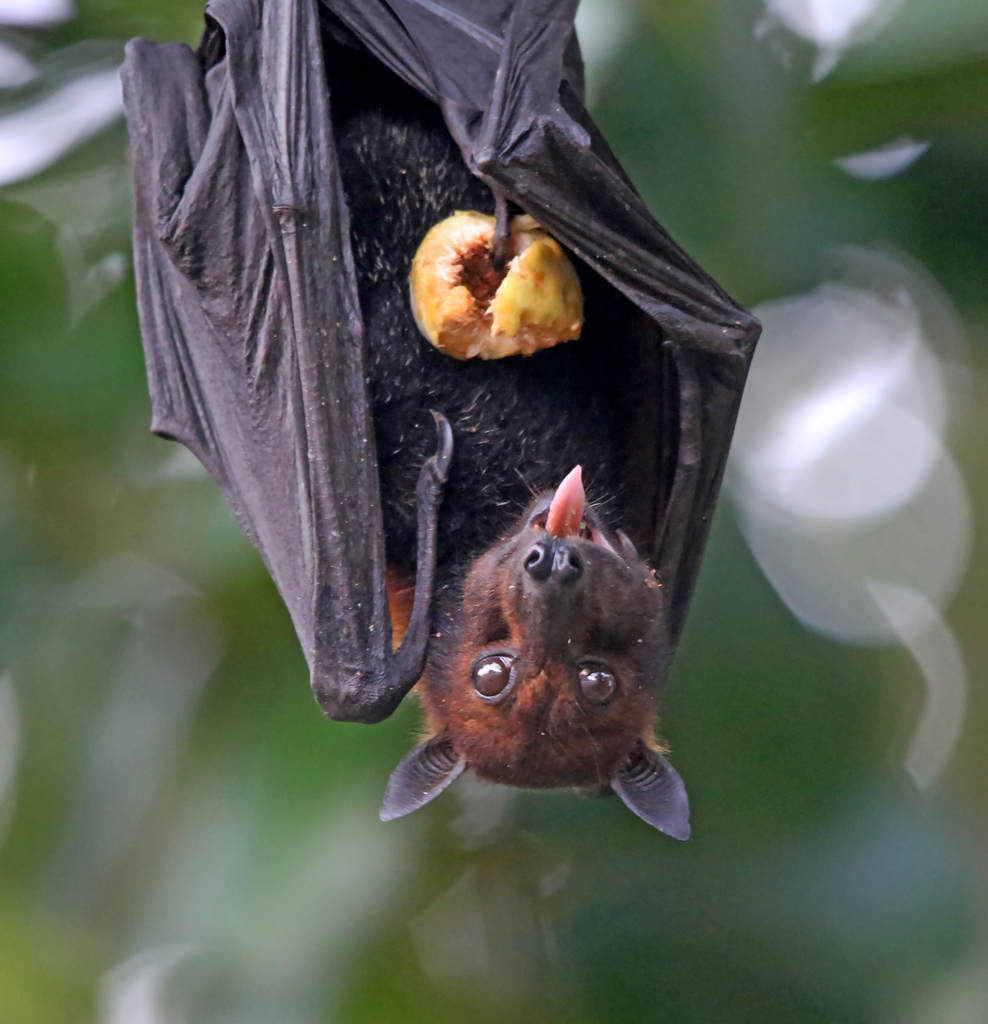
Black Flying Fox
Photo © Tony Eales
Photo © Tony Eales — CC BY-SA 4.0 — Source: iNaturalist #285912220Identification
The black flying fox is one of the world's largest bat species, instantly recognizable by its distinctive appearance. Its short, black fur contrasts sharply with a striking reddish-brown mantle across its shoulders and back. With a mean forearm length of 164 mm and a mean weight of 710 g, this is a substantial animal with a wingspan exceeding 1 metre, making it an impressive sight in flight despite being considerably smaller than the largest members of its genus, Pteropus.
Range & Habitat
The black flying fox is native to Australia, Papua New Guinea, and Indonesia. In Australia, the species occurs across New South Wales, Queensland, Northern Territory, and Western Australia. Its range extends to the Western Province of Papua New Guinea and parts of Indonesia including West Papua, Sulawesi, Sumba, and Savu.
These bats favour roost sites in mangroves, paperbark swamps, patches of rainforest, and bamboo forests, though they rarely shelter in caves or under overhangs. By day, they gather in enormous colonies known as camps, ranging from hundreds to tens of thousands of individuals. These roosts are sometimes shared with other flying fox species including the grey-headed flying fox, spectacled flying fox, and little red flying fox.
Behaviour & Diet
Black flying foxes breed once annually, with females giving birth to a single young. Mothers carry their offspring for the first month before leaving them in the roost during nightly foraging expeditions. These bats are highly mobile feeders, known to travel up to 50 km in a single night in search of food.
They are specialist pollen and nectar feeders, preferring native eucalyptus, lilypillies, paperbark, and turpentine trees. During drought or when native foods are scarce, they readily adapt to introduced fruits such as mangos and apples. In residential areas, they have increasingly turned to cocos palm trees, which now account for around 30% of their diet, though the high acidity of these fruits can prove toxic.
Best Time & Places to See It
The black flying fox is not a threatened species, making sightings relatively reliable across its range in suitable habitat. Your best opportunities come at dawn and dusk when bats leave or return to their day roosts. Mangrove forests, paperbark swamps, and rainforest patches are your most promising locations. Visiting known camp sites in Queensland and New South Wales offers the highest probability of encounters with large aggregations, particularly during breeding season.
Photography Tips
Photograph black flying foxes at their roosts during early morning or late afternoon light when activity levels are highest and lighting is most favourable. The strong contrast between black fur and reddish-brown mantle provides excellent colour definition. A telephoto lens is essential, as these bats are often high in trees and easily disturbed. Approach quietly and avoid flash photography, which can stress the animals. Wide-angle shots capturing multiple individuals clustered in roost trees are particularly striking, while close-ups can reveal the species' distinctive facial features and fur colouration.
Kakadu National Park
Kakadu, Australia
+273 birds+46 mammals
Kakadu National Park is Australia’s largest national park and one of the world’s most remarkable protected areas, covering nearly 20,000 square kilometres in the tropical north…
VIEW NATIONAL PARKDaintree National Park
Dedin, Australia
+362 birds+37 mammals
Daintree National Park is one of the world’s oldest and most biologically diverse tropical rainforests, protecting an extraordinary landscape where ancient forests meet the Great Barrier…
VIEW NATIONAL PARKSpringbrook National Park
Australia
+195 birds+25 mammals
Subtropical rainforest meets open eucalypt woodland across a mountainous terrain where the McPherson Range rises sharply from the Queensland coast, creating a patchwork of microclimates and…
VIEW NATIONAL PARKGheebulum Kunungai National Park
Moreton Island, Australia
+168 birds+7 mammals
Sand dunes rise and fall across Moreton Island's eastern shore, a landscape sculpted by wind and ocean currents into one of Australia's most dynamic coastal ecosystems.…
VIEW NATIONAL PARKBribie Island National Park
Brisbane, Australia
+284 birds+20 mammals
Across tidal flats and shallow waterways north of Brisbane, Bribie Island National Park spreads across nearly four hundred square kilometres of subtropical coastal wilderness—a patchwork of…
VIEW NATIONAL PARKWhitsunday Islands National Park
Whitsundays, Australia
+163 birds+9 mammals
Crystalline waters lap against seventy-four islands where rainforest canopies tumble down to pristine beaches and coral gardens flourish in the shallows. This archipelago off Queensland's coast…
VIEW NATIONAL PARKLitchfield National Park
Australia
+175 birds+15 mammals
Where weathered sandstone plateaus rise above the savanna woodlands of Australia's Top End, Litchfield National Park unfolds as a landscape of dramatic contrasts shaped by a…
VIEW NATIONAL PARKNitmiluk National Park
Australia
+186 birds+27 mammals
Dramatic sandstone gorges carved by the Katherine River slice through the tropical savanna of Australia's Top End, creating a landscape where escarpments tower above crystalline pools…
VIEW NATIONAL PARKGreat Sandy National Park
Australia
+306 birds+40 mammals
Where coastal dunes rise inland from the Queensland coastline, Great Sandy National Park encompasses a landscape of remarkable ecological diversity shaped by subtropical humid conditions year-round.…
VIEW NATIONAL PARKKarijini National Park
Australia
+117 birds+5 mammals
Ochre ridges and rust-coloured gorges slice through the Pilbara's ancient landscape, where Karijini National Park sprawls across a wilderness of iron-rich plateaus and plunging ravines carved…
VIEW NATIONAL PARKCape Range National Park
Australia
+159 birds+15 mammals
Where arid limestone ridges plunge toward turquoise waters, Cape Range National Park frames one of Australia's most dramatic desert-ocean interfaces. The park's spine—a stark, weathered range…
VIEW NATIONAL PARKNo community photos yet. Log in to add the first one.
No community observations of this species yet.