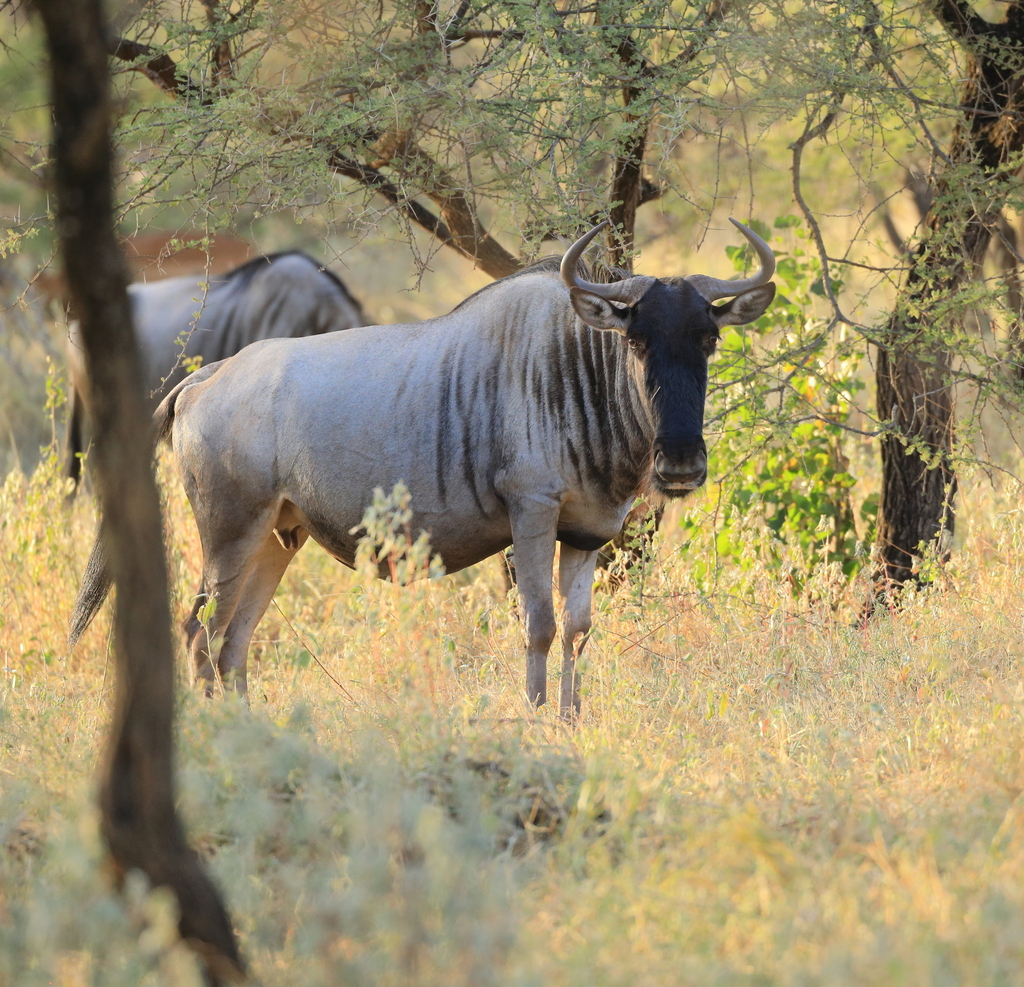
Blue Wildebeest
Photo © Darren Obbard
Photo © Darren Obbard — CC BY 4.0 — Source: iNaturalist #201035331
Wildlife SafariEasy
Wildlife SafariEasy
Nothing matches these filters.
The blue wildebeest is a large, broad-shouldered antelope with a distinctive, robust muzzle and muscular, front-heavy build. Its most striking feature is the silvery-blue or slate-gray sheen of its coat, which ranges from deep slate-blue to light gray or grayish-brown depending on the individual. Both males and females bear a pair of large, curved horns. Young calves are born tawny brown and gradually acquire adult coloration by around two months of age.
The blue wildebeest is native to southern and eastern Africa, occurring in Angola, Botswana, Eswatini, Kenya, Mozambique, South Africa, Tanzania, Zambia, and Zimbabwe. The species has been successfully reintroduced to Namibia, though it is now extinct in Malawi. Blue wildebeest inhabit short-grass plains that border acacia savannas—environments that are neither too wet nor too arid, providing the nutrient-rich forage essential for survival and reproduction.
These herbivores are exclusively grass-feeders, preferring short grasses available on the plains where they live. Blue wildebeest are highly social animals, forming loose herds and are known for being extremely wary and fast runners. The mating season coincides with the end of the rainy season, and after a gestation of approximately 8.5 months, females give birth to a single calf. Calves remain with their mothers for eight months before joining juvenile herds. Three African populations undertake long-distance migrations timed to track rainfall and grass growth patterns.
With a stable population estimated at around 1.5 million individuals, blue wildebeest are widespread and readily encountered throughout their range. They are particularly abundant in short-grass plains and are increasingly found in private game farms, reserves, and conservancies across southern and eastern Africa. The species is rated as Least Concern by conservation authorities.
The blue wildebeest's distinctive silvery-blue coat and curved horns make it a compelling photographic subject. Its wary nature and tendency to move in herds mean patience and long lenses are often necessary. The animal's characteristic front-heavy posture and robust build are best captured from ground level to emphasize its powerful shoulders. Early morning and late afternoon light will enhance the subtle blue-gray tones of the coat.
Nothing matches these filters.
Nothing matches these filters.
No community photos yet. Log in to add the first one.
No community observations of this species yet.
We'd love to hear from you. We'll reply as soon as possible.
Found an error? Have a suggestion? We read every message.
A compact view of how this species lives, moves and responds to its environment.
Select a card to explore the details.
Please confirm the photo rights and credit terms first.
I'm the author of this photo or hold the rights to it, and I keep full ownership. I grant Wild Atlas Guide a free, non-exclusive licence to display it on the site and in Wild Atlas Guide's own channels, including social media, always credited to me by my display name or the Instagram handle I choose to provide. I confirm it does not reveal a sensitive wildlife location or a recognisable person without their permission. I can withdraw future social use for this photo or ask for it to be removed at any time.
Please accept the photo rights and credit terms to continue.
Uploading…
We use cookies to measure traffic and improve Wild Atlas Guide. You decide. Privacy policy