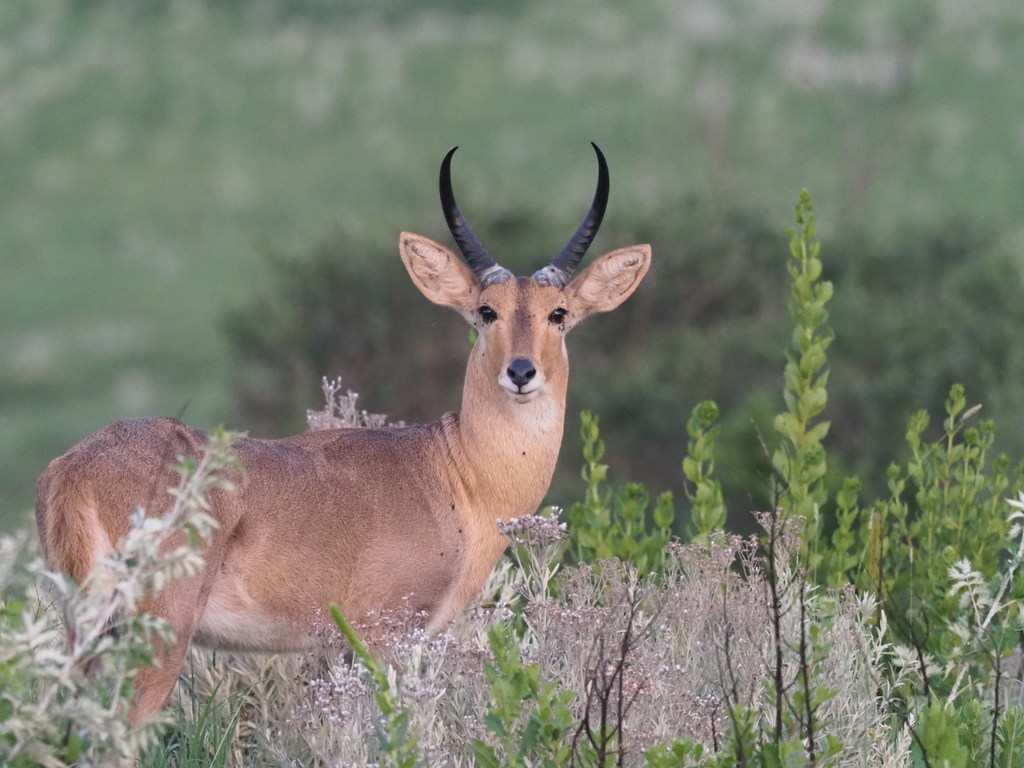
Bohor Reedbuck
Photo © Nathan Earley
Photo © Nathan Earley — CC BY 4.0 — Source: iNaturalist photo #62145750The bohor reedbuck (Redunca redunca) is an antelope native to central Africa. The animal is placed under the genus Redunca and in the family Bovidae. It was first described by German zoologist and botanist Peter Simon Pallas in 1767. The bohor reedbuck has five subspecies. The head-and-body length of this medium-sized antelope is typically between 100–135 cm (39–53 in). Males reach approximately 75–89 cm (30–35 in) at the shoulder, while females reach 69–76 cm (27–30 in). Males typically weigh 43–65 kg (95–143 lb) and females 35–45 kg (77–99 lb). This sturdily built antelope has a yellow to grayish brown coat. Only the males possess horns which measure about 25–35 cm (9.8–13.8 in) long. A herbivore, the bohor reedbuck prefers grasses and tender reed shoots with high protein and low fiber content. This reedbuck is dependent on water, though green pastures can fulfill its water requirement. The social structure of the bohor reedbuck is highly flexible. Large aggregations are observed during the dry season, when hundreds of bohor reedbuck assemble near a river. Males become sexually mature at the age of three to four years, while females can conceive at just one year of age, reproducing every nine to fourteen months.…
Serengeti National Park
Tanzania
+558 birds+57 mammals
Across Tanzania's northern plateau, where volcanic soils meet acacia woodland and open grassland, unfolds one of Earth's most dynamic ecosystems. The Serengeti National Park sprawls across…
VIEW NATIONAL PARKMurchison Falls National Park
Uganda
+608 birds+33 mammals
Where the Victoria Nile compresses through a narrow gorge and explodes across a 45-meter precipice, the landscape speaks in thunder. Murchison Falls National Park sprawls across…
VIEW NATIONAL PARKAmboseli National Park
Etonet/Lenkism ward, Kenya
+501 birds+43 mammals
Where the Amboseli basin opens toward the Tanzanian frontier, a shallow alkaline lake mirrors vast skies across one of East Africa's most iconic savanna landscapes. The…
VIEW NATIONAL PARKTarangire National Park
Tanzania
+527 birds+50 mammals
Acacia woodland and grassland sweep across the Manyara Region where the Tarangire River carves through low hills and volcanic soils, creating one of East Africa's most…
VIEW NATIONAL PARKNgorongoro Conservation Area
Tanzania
+626 birds+55 mammals
Volcanic calderas and open grassland dominate this high plateau in northern Tanzania, where the landscape rises above 2,000 metres and ancient geological forces have shaped both…
VIEW WILDLIFE MANAGEMENT AREAAbijata-Shalla Lakes National Park
Ethiopia
+438 birds+7 mammals
Two crater lakes of contrasting chemistry define this remote corner of Ethiopia's Rift Valley, where soda lakes and freshwater basins create a mosaic of distinct aquatic…
VIEW NATIONAL PARKBale Mountains National Park
Ethiopia
+397 birds+20 mammals
Where the Ethiopian highlands rise above 4,000 metres, the Bale Mountains create a landscape of stunning ecological extremes—from afroalpine grasslands swept by wind and mist to…
VIEW NATIONAL PARKNairobi National Park
Nairobi, Kenya
+515 birds+35 mammals
Just minutes from Kenya's capital, where the Nairobi River winds through acacia woodland and open grassland, lies one of Africa's most paradoxical wildlife sanctuaries. The park's…
VIEW NATIONAL PARKHell’s Gate National Park
Olkaria ward, Kenya
+388 birds+18 mammals
Volcanic scarps and geothermal vents dominate the floor of Hell's Gate, where the East African Rift has carved a dramatic gorge through crystalline rock formations. The…
VIEW NATIONAL PARKChyulu Hills National Park
Kibwezi East, Kenya
+232 birds+30 mammals
Volcanic cones rise abruptly from the Kenyan savanna floor, their flanks clothed in dense acacia woodland and grassland that transforms the Chyulu Hills into an ecological…
VIEW NATIONAL PARKNo community photos yet. Log in to add the first one.
No community observations of this species yet.