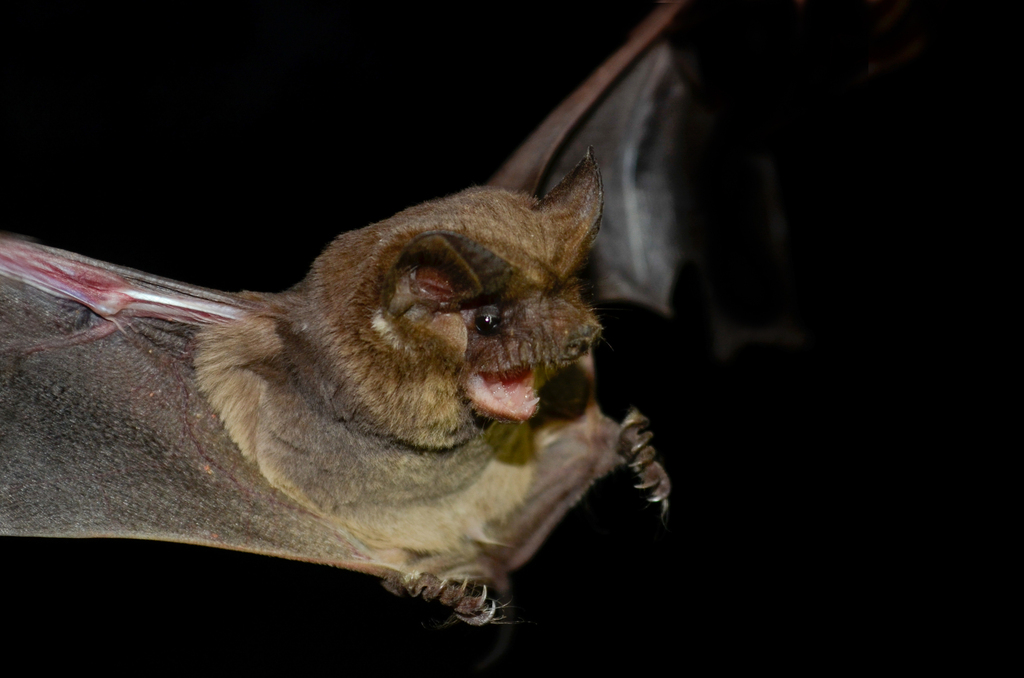
Brazilian Free-tailed Bat
Photo © Pablo G. Fernández
Photo © Pablo G. Fernández — CC BY 4.0 — Source: iNaturalist photo #231198006The Mexican free-tailed bat or Brazilian free-tailed bat (Tadarida brasiliensis) is a medium-sized bat native to North, Central, and South America and the Caribbean, so named because its tail can be almost half its total length and is not attached to its uropatagium. It has been claimed to have the fastest horizontal speed of any animal, reaching top ground speeds over 99 mph (160 km/h). It also flies the highest among bats, at altitudes around 3,300 m (10,800 ft). It is regarded as one of the most abundant mammals in North America. Its proclivity towards roosting in huge numbers at relatively few locations makes it vulnerable to habitat destruction in spite of its abundance. For instance, up to 1.5 million bats reside under just one bridge in Austin. The Texas Legislature recognized the Mexican free-tailed bat as the "Official Flying Mammal" of the State of Texas in 1995. == Taxonomy == The Mexican free-tailed bat was described as a new species in 1824 by French zoologist Isidore Geoffroy Saint-Hilaire. Geoffroy placed it in the now-defunct genus Nyctinomus with a binomial name of Nyctinomus brasiliensis. The holotype had been collected in Brazil. Molecular sequence data indicate T. brasiliensis's closest relatives are…
Big Bend National Park
Bitter Lake National Wildlife Refuge
Carlsbad Caverns National Park
Cave Creek Canyon
Chiricahua Mountains
Death Valley National Park
El Palmar National Park
Everglades National Park
Farallon National Wildlife Refuge
Nothing matches these filters.
No community photos yet. Log in to add the first one.
No community observations of this species yet.