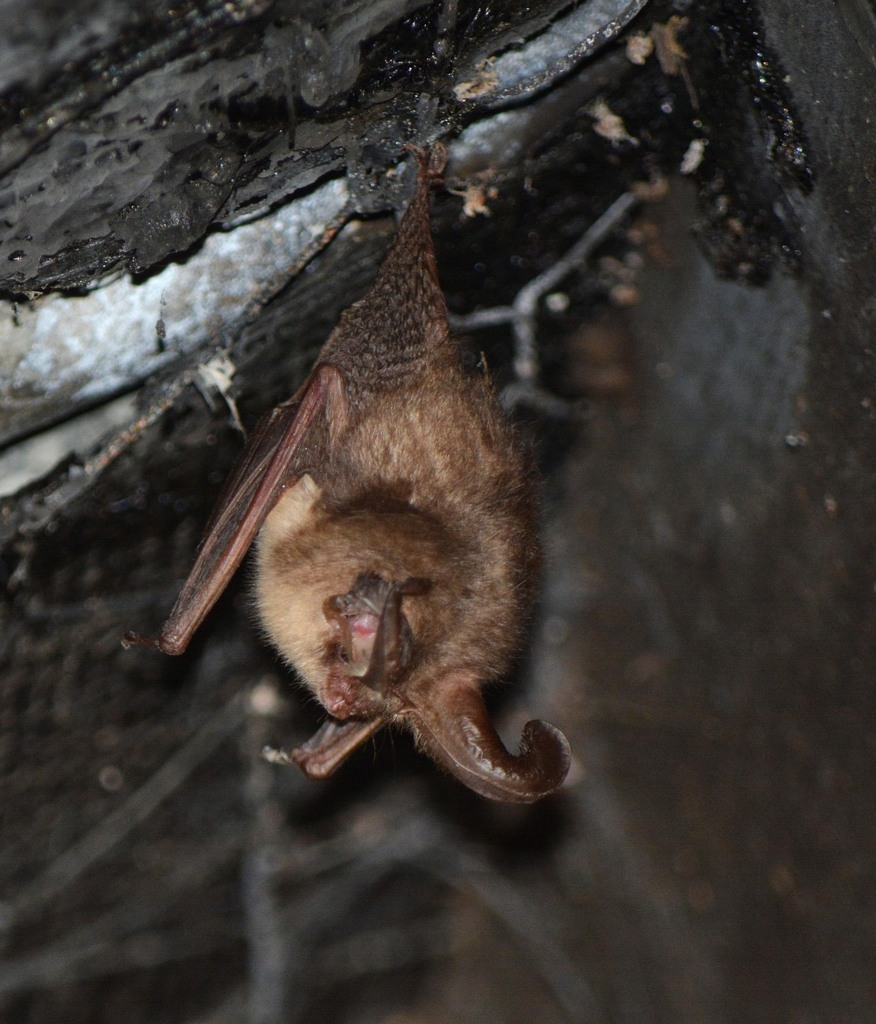
Brown Long-eared Bat
Photo © Chris walker
Photo © Chris walker — CC BY 4.0 — Source: iNaturalist #181027749Identification
The brown long-eared bat is one of Europe's most distinctive bat species, instantly recognizable by its remarkably long ears measuring 3.3–3.9 cm in length. These ears bear a characteristic fold that sets them apart from nearly all other bat species in their range. It is extremely similar in appearance to the much rarer grey long-eared bat, which was only validated as a distinct species in the 1960s, so careful observation may be needed to distinguish between the two. An adult brown long-eared bat is quite small, with a body length of 4.5–4.8 cm, a tail of 4.1–4.6 cm, and a forearm length of 4–4.2 cm, making it a truly diminutive creature.
Compared to other bat species, brown long-eared bats are relatively slow flyers. They possess relatively large eyes as well as their prominent ears, reflecting their unusual hunting strategy that relies heavily on vision and hearing rather than echolocation alone.
Range & Habitat
The brown long-eared bat is found throughout Europe, with the notable exception of Greece, southern Italy, and southern Spain. Its range extends eastward to the Urals and Caucasus mountains. This widespread Eurasian species occupies diverse roosting habitats, regularly utilizing undisturbed roof spaces in buildings, where they may roost singly in crevices and timber or cluster around chimneys and ridge ends. They also make use of treeholes, bat boxes, and caves, with cave roosts being particularly important as winter hibernation sites.
These bats hunt above woodland, often during daylight hours, taking advantage of their visual hunting abilities. They typically emerge from their roost sites only after dark, generally around an hour after sunset.
Behaviour & Diet
The brown long-eared bat employs a highly unusual hunting strategy for a bat species. Rather than relying primarily on echolocation to locate prey, this species hunts by sight and sound, using its large eyes and ears to detect insects. A 2003 study by Eklöf and Jones demonstrated that brown long-eared bats can visually detect prey and actually showed a preference for hunting situations where both sonar and visual cues were available. Remarkably, visual cues proved more important than sonar cues, and the bats were unable to detect prey using only echolocation.
The diet consists primarily of moths, though earwigs, flies, and beetles are also taken, typically gleaned directly from leaves and bark. Their hearing is exceptionally sensitive—acute enough to hear a moth in flight—allowing them to hunt effectively by passive listening alone. This specialized hunting strategy likely evolved because their moth prey evolved the ability to hear echolocation calls and take evasive action.
Best Time & Places to See It
Brown long-eared bats are most active during the hours just after sunset, when they emerge from their roosts to hunt. Observers should look for them above woodland habitats, where they hunt both day and night. Buildings with undisturbed roof spaces, particularly older structures, may harbor roosting individuals. In winter, cave systems become important sites where these bats hibernate.
Photography Tips
Photographing brown long-eared bats in flight presents significant challenges due to their emergence in darkness and their relatively slow, maneuverable flight. Patient observers stationed near known roost sites during the twilight emergence period may have the best opportunities. The distinctive ears make positive identification straightforward in photographs, though distinguishing them from the rare grey long-eared bat requires careful attention to detail. Their hunting behavior close to vegetation in woodland settings offers potential opportunities for capturing them in their natural foraging habitat.
Stenshuvuds National Park
Skåne län, Sweden
+224 birds+19 mammals
Where limestone cliffs rise sharply above the Øresund Strait, Stenshuvuds National Park commands the southeastern tip of Skåne, a landscape carved by glaciation into rolling beech…
VIEW NATIONAL PARKFärnebofjärden National Park
Gävleborgs län, Sweden
+170 birds+20 mammals
Where the Gävle River widens into a sprawling delta before meeting the Gulf of Bothnia, Färnebofjärden National Park unfolds across a landscape of exceptional ecological complexity.…
VIEW NATIONAL PARKSöderåsens National Park
Skåne län, Sweden
+136 birds+18 mammals
Steep beech-clad ravines and limestone escarpments carve through the landscape of southern Sweden's Skåne region, creating Söderåsens—a textbook example of temperate woodland gorge habitat. The park's…
VIEW NATIONAL PARKHarz National Park
Harz (LK Goslar), Germany
+141 birds+38 mammals
Where granite peaks rise above beech and spruce forests, the Harz unfolds as one of Germany's most biodiverse upland landscapes. Straddling the border between Lower Saxony…
VIEW NATIONAL PARKLower Oder Valley National Park
Schwedt/Oder, Germany
+216 birds+21 mammals
Where the Oder River winds through northeastern Brandenburg, the Lower Oder Valley National Park protects one of Central Europe's most vital wetland systems. This sprawling mosaic…
VIEW NATIONAL PARKExmoor National Park
Somerset, United Kingdom
+159 birds+32 mammals
Where the Bristol Channel wind scours windswept moorland into rolling open heath, Exmoor rises from the Somerset coast as one of England's most rugged upland landscapes.…
VIEW NATIONAL PARKPembrokeshire Coast National Park
Pembrokeshire, United Kingdom
+250 birds+41 mammals
Where the Cambrian coastline meets the Celtic Sea, cliff-top moorland and hidden coves define a landscape carved by 300 million years of geological drama. Pembrokeshire Coast…
VIEW NATIONAL PARKEryri National Park
Gwynedd, United Kingdom
+199 birds+36 mammals
Where granite peaks rise abruptly from the Snowdonia landscape, Eryri National Park encompasses one of Britain's most dramatic mountain terrain. The park's rugged plateaus, deep glacial…
VIEW NATIONAL PARKLake District National Park
Westmorland and Furness, United Kingdom
+209 birds+36 mammals
Where slate fells rise steeply from mirror-still waters, the Lake District unfolds as one of Britain's most ecologically intricate mountain landscapes. The park's patchwork of deep…
VIEW NATIONAL PARKYorkshire Dales National Park
North Yorkshire, United Kingdom
+169 birds+25 mammals
Limestone pavements and deep limestone gorges carved by glaciation dominate the landscape of the Yorkshire Dales, creating a landscape of exceptional geological drama where moorland plateaus…
VIEW NATIONAL PARKBannau Brycheiniog National Park
Powys, United Kingdom
+178 birds+36 mammals
Where sandstone ridges rise above the rolling moorlands of mid-Wales, Bannau Brycheiniog National Park protects one of Britain's most compelling upland landscapes. The park's dramatic peaks,…
VIEW NATIONAL PARKNorth York Moors National Park
North Yorkshire, United Kingdom
+234 birds+32 mammals
Across the high moorlands of North Yorkshire, where heather and bilberry sprawl beneath vast skies, the landscape rises and falls in gentle undulation—a patchwork of open…
VIEW NATIONAL PARKNorthumberland National Park
Northumberland, United Kingdom
+133 birds+20 mammals
Granite ridges and moorland sweep across the Cheviot Hills in northern England, where windswept uplands give way to deep river valleys carved through ancient bedrock. Northumberland…
VIEW NATIONAL PARKSouth Downs National Park
Chichester, United Kingdom
+298 birds+45 mammals
Chalk downland ridges rise and fall across the South Downs, their open grasslands and beech hangers creating a mosaic of habitats that has shaped human settlement…
VIEW NATIONAL PARKDartmoor National Park
West Devon, United Kingdom
+162 birds+33 mammals
Across the high moorlands of Devon, where granite tors pierce through rolling heather and acid grassland, Dartmoor rises as one of Britain's most expansive upland wilderness…
VIEW NATIONAL PARKCévennes National Park
Vebron, France
+187 birds+63 mammals
Where granite gorges slice through the limestone plateaux of southern France, the Cévennes Cœur National Park unfolds across nearly 3,500 square kilometres of one of Europe's…
VIEW NATIONAL PARKÉcrins National Park
La Chapelle-en-Valgaudémar, France
+143 birds+36 mammals
Where granite peaks and Alpine meadows converge across nearly 2,100 square kilometres, Écrins National Park forms one of the wildest mountainous strongholds of the French Alps.…
VIEW NATIONAL PARKVanoise National Park
Val-Cenis, France
+107 birds+29 mammals
Where the French Alps rise in serrated ranks above the Maurienne valley, Vanoise National Park sprawls across more than 1,700 square kilometres of high-altitude wilderness—a realm…
VIEW NATIONAL PARKForêts National Park
Lucey, France
+140 birds+50 mammals
Across the rolling plateaux of central Burgundy, where limestone uplands give way to deep valleys carved by time and water, lies a landscape of profound ecological…
VIEW NATIONAL PARKValles Occidentales Natural Park
Siresa, Spain
+168 birds+20 mammals
Where granite gorges slice through the western Pyrenean foothills, steep valleys carved by ancient rivers create a mosaic of Mediterranean scrubland, beech forests, and alpine meadows.…
VIEW NATURAL PARKRegional Park of the Catalan Pyrenees
Olette, France
+244 birds+63 mammals
Where granite peaks thrust skyward above cloud-laden valleys, a wild tapestry of Mediterranean and alpine ecosystems interweaves across the Franco-Spanish frontier. These Pyrenean slopes harbour extraordinary…
VIEW NATURE RESERVECairngorms National Park
Muir, United Kingdom
+192 birds+31 mammals
Where ancient granite massifs rise above the Scottish Highlands, a subarctic wilderness unfolds across 1,748 square kilometres of raw, elemental terrain. Windswept plateaus give way to…
VIEW NATIONAL PARKLoch Lomond & the Trossachs National Park
Duchray, United Kingdom
+188 birds+40 mammals
Where ancient woodlands rise from glassy lochs and rugged Highland peaks pierce the lowland horizon, Scotland's most biodiverse landscape unfolds across 720 square kilometres of wild…
VIEW NATIONAL PARKPirin National Park
Bansko, Bulgaria
+124 birds+10 mammals
Where jagged limestone peaks pierce the Macedonian sky, ancient glacial valleys cradle some of Bulgaria's most pristine wilderness. This southwestern corner of the Balkans rises to…
VIEW NATIONAL PARKPyrénées National Park
Hautes Pyrenees, France
+150 birds+35 mammals
Where alpine meadows give way to limestone cliffs and rushing torrents carve through ancient stone, the Pyrénées National Park spans a landscape of austere beauty along…
VIEW NATIONAL PARKMuir of Dinnet National Nature Reserve
Dinnet, United Kingdom
+87 birds+12 mammals
Across the Aberdeenshire moorlands east of the Cairngorms, rolling heathland and scattered Scots pine forest meet marshy ground fed by year-round precipitation—a temperate landscape where water…
VIEW NATURE RESERVEDyfi National Nature Reserve
Aberdyfi, United Kingdom
+148 birds+25 mammals
Where the River Dyfi widens into a broad coastal basin, a 2,400-hectare mosaic of saltmarsh, reedbed, mudflat and freshwater wetland spreads across the Cardigan Bay estuary…
VIEW NATURE RESERVECors Fochno National Nature Reserve
Borth, United Kingdom
+179 birds+27 mammals
Where the Dovey Estuary opens to the Irish Sea, a sprawling wetland mosaic of reedbed, fen and mire transforms the coastal flats of mid-Wales into one…
VIEW NATURE RESERVEKielderhead National Nature Reserve
Catcleugh, United Kingdom
+108 birds+21 mammals
High moorland sweeps across the Pennines at Kielderhead, where blanket bog and heathland dominate a landscape shaped by cool, moist Atlantic winds and the reserve's temperate…
VIEW NATURE RESERVENo community photos yet. Log in to add the first one.
No community observations of this species yet.