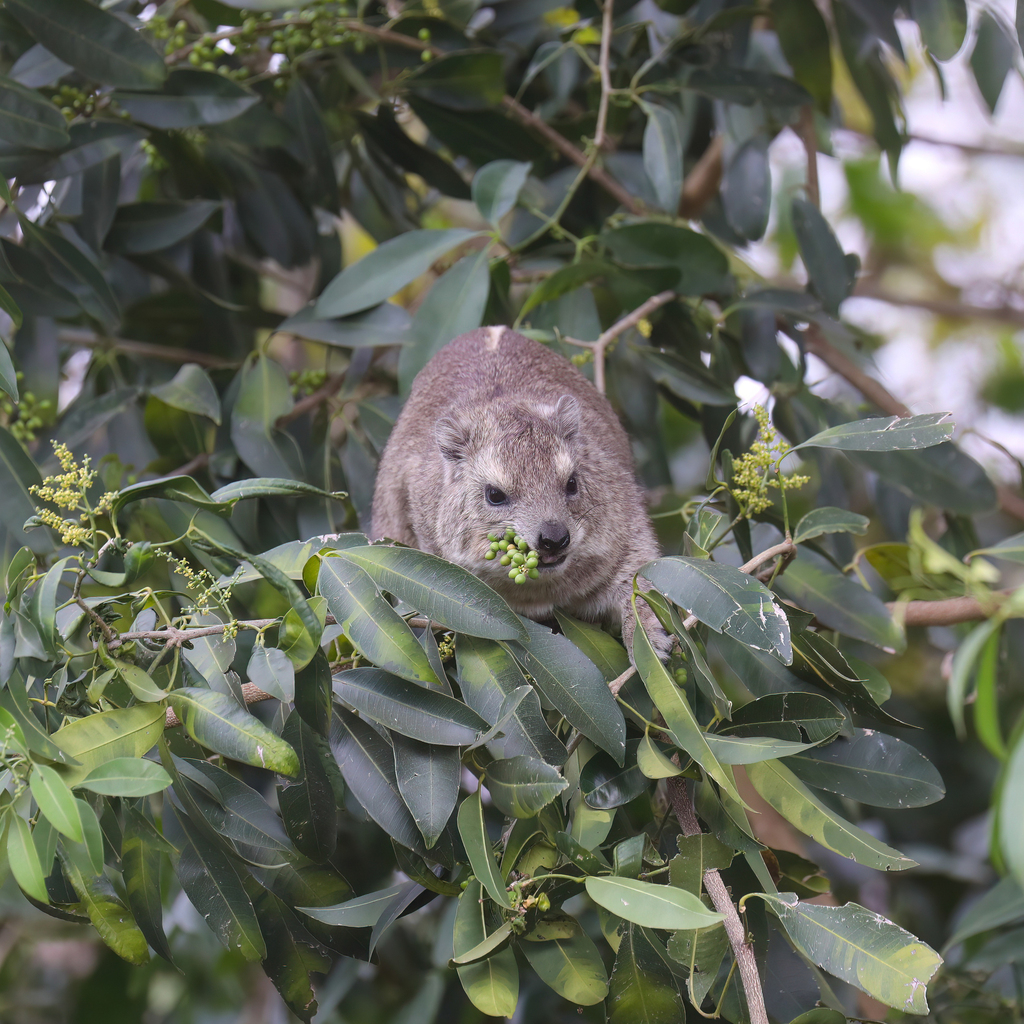
Bush Hyrax
Photo © Thomas Galewski
Photo © Thomas Galewski — CC BY 4.0 — Source: iNaturalist #261102115Identification
The bush hyrax is a small, sturdy mammal weighing between 1.3 and 3.6 kg, with a stocky build, short legs, and a rudimentary tail. It is smaller and less heavily built than the rock hyrax, with a notably narrower muzzle. The animal's most distinctive feature is a dorsal gland on the lower back, marked by a raised skin patch about 1.5 cm long surrounded by erectile hairs that typically stain yellow or reddish-ochre. A pale patch of hair above the eyes contains additional glandular tissue. Coloration varies by habitat: grey in arid regions and dark reddish-brown in wetter areas. The bush hyrax has thick, coarse fur with guard hairs up to 30 mm long, round ears, and prominent whiskers up to 90 mm.
The bush hyrax belongs to Afrotheria, a remarkable mammalian clade that also includes elephants, aardvarks, and elephant shrews—a fascinating evolutionary lineage distant from more familiar rodents despite superficial similarities.
Range & Habitat
This species is widely distributed across sub-Saharan Africa, found from Sudan and Eritrea in the north through the Horn of Africa, and south to the Limpopo Province in South Africa. Isolated populations also occur in Angola and the southwestern Democratic Republic of Congo. The bush hyrax is strictly associated with rocky habitats: rocky kopjes, sheer rock faces (krantzes), and boulder piles. These rocky areas provide essential crevices for nesting and shelter from weather and predators. The species inhabits elevations ranging from sea level to 3,800 meters and prefers openings with at least 1 square meter of accessible space.
Behaviour & Diet
Bush hyraxes are highly social animals living in colonies that can number in the hundreds, with population densities between 20 and 53 individuals per hectare. Family groups are typically polygynous, comprising one dominant male, three to seven females, and numerous juveniles, while subordinate males occupy peripheral territories. The species frequently shares rocky habitats with rock hyraxes and sometimes with other hyrax species, even sharing nurseries and rock crevices. Interestingly, different hyrax species do not interbreed due to significant anatomical differences in their reproductive organs.
The dorsal gland plays dual roles in communication and reproduction, associated with sexual arousal and helping young recognize their mothers. Locally hunted in some regions—particularly in Matobo National Park in Zimbabwe, where communities rely on hyraxes as a protein source—populations remain stable overall and are listed as Least Concern by the IUCN.
Best Time & Places to See It
The bush hyrax is widespread across rocky regions of eastern and southern Africa, making it accessible in numerous protected areas. Matobo National Park in Zimbabwe is a notable location, though populations there have declined since 1978 due to droughts and predation. The Serengeti National Park in Tanzania offers excellent viewing opportunities. Look for these animals in rocky outcrops and boulder fields in dry savanna habitats, particularly where rock formations create the crevices they depend upon. Early morning and late afternoon are often best for spotting them as they move between shelter and foraging areas.
Photography Tips
The bush hyrax's small size and preference for rocky, shadowed crevices make photography challenging but rewarding. Use a telephoto lens to capture individuals from a distance without disturbing colonies. The distinctive yellow dorsal gland and pale eye patches are key identifying features worth highlighting in close-up shots. The animal's thick, textured fur shows beautifully in side-lit images that emphasize its coarse guard hairs and long whiskers. Photographing family groups in their natural rocky habitat provides excellent context for storytelling.
Early morning light often provides the best conditions for capturing the subtle coloration differences, particularly the grey tones in arid-region populations versus the darker reddish-brown of wetter habitats. Patient observation of colonies may reward you with behavioral shots showing social interactions or maternal care, adding narrative depth to your portfolio.
Serengeti National Park
Tanzania
+558 birds+57 mammals
Across Tanzania's northern plateau, where volcanic soils meet acacia woodland and open grassland, unfolds one of Earth's most dynamic ecosystems. The Serengeti National Park sprawls across…
VIEW NATIONAL PARKMapungubwe National Park
Musina Local Municipality, South Africa
+358 birds+29 mammals
Where the Limpopo River cuts through sandstone ridges at the convergence of South Africa, Botswana, and Zimbabwe, Mapungubwe National Park preserves a landscape of profound ecological…
VIEW NATIONAL PARKKidepo Valley National Park
Uganda
+478 birds+24 mammals
Where the Narus and Kidepo rivers carve through northeastern Uganda's semi-arid lowlands, a landscape of sparse acacia woodland, grassland, and riverine thickets creates one of East…
VIEW NATIONAL PARKTsavo East National Park
Athi ward, Kenya
+468 birds+50 mammals
Across the semi-arid lowlands of southeastern Kenya, where acacia woodland fragments into scrubland and the landscape rolls toward the Indian Ocean horizon, lies one of Africa's…
VIEW NATIONAL PARKTsavo West National Park
Mwatate, Kenya
+513 birds+49 mammals
Where volcanic ridges and weathered lava flows meet the semi-arid lowlands of south-central Kenya, Tsavo West National Park unfolds across a landscape sculpted by fire and…
VIEW NATIONAL PARKTarangire National Park
Tanzania
+527 birds+50 mammals
Acacia woodland and grassland sweep across the Manyara Region where the Tarangire River carves through low hills and volcanic soils, creating one of East Africa's most…
VIEW NATIONAL PARKNgorongoro Conservation Area
Tanzania
+626 birds+55 mammals
Volcanic calderas and open grassland dominate this high plateau in northern Tanzania, where the landscape rises above 2,000 metres and ancient geological forces have shaped both…
VIEW WILDLIFE MANAGEMENT AREAKruger National Park
Ba-Phalaborwa Local Municipality, South Africa
+540 birds+91 mammals
Across the low-lying savanna of northeastern South Africa unfolds one of Africa's largest and most ecologically intact protected areas, where acacia woodlands merge into mopane scrub…
VIEW NATIONAL PARKNairobi National Park
Nairobi, Kenya
+515 birds+35 mammals
Just minutes from Kenya's capital, where the Nairobi River winds through acacia woodland and open grassland, lies one of Africa's most paradoxical wildlife sanctuaries. The park's…
VIEW NATIONAL PARKMeru National Park
Igembe Central, Kenya
+408 birds+38 mammals
Granite outcrops and acacia woodland rise across the northern reaches of Meru, where semi-arid savanna transitions into drier scrubland under the fierce equatorial sun. The park's…
VIEW NATIONAL PARKSamburu National Reserve
Samburu, Kenya
+430 birds+42 mammals
Across the arid plains of northern Kenya, where scattered acacia woodland gives way to rocky outcrops and dry riverbeds, Samburu National Park unfolds as one of…
VIEW NATURE RESERVENo community photos yet. Log in to add the first one.
No community observations of this species yet.