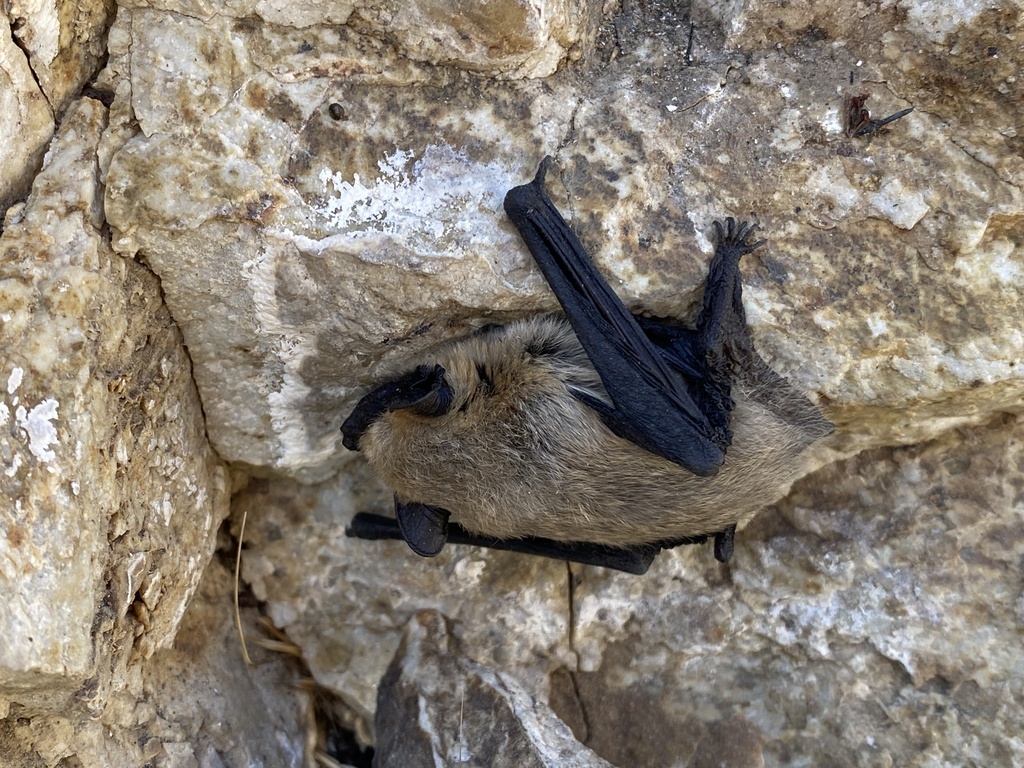
Canyon Bat
Photo © Pinnacles National Park
Photo © Pinnacles National Park — CC BY 4.0 — Source: iNaturalist #152171877Identification
The canyon bat is the smallest bat species in the United States, with a wingspan of 190–215 millimetres and a body length of 62–80 millimetres. Weighing just 3–6 grams, these diminutive mammals display distinctive counter-shading: dark coloring above and lighter below, with faces, ears, feet, and flight membranes that are usually very dark, almost black. Their coloration ranges from white to pale yellow to dark brown, with soft, full pelage 3–4 millimetres long. The species has a characteristically short, broad head and short ears with a small, club-shaped tragus. Their short, broad wings give them a low-aspect ratio, enabling them to fly at speeds as low as 8 kilometres per hour—a key adaptation for their hunting lifestyle.
Range & Habitat
Canyon bats are found throughout the deserts and lowlands of the western United States and Mexico, ranging from Washington State in the north to the Mexican states of Michoacán and Hidalgo in the south, with an isolated population in north-central Texas and Oklahoma. They prefer lowland areas, typically staying below 5,000 feet elevation. These bats roost primarily in rock crevices during the day, though some shelter in mine crevices, buildings, under rocks, or dense sedge growths. Due to their vulnerability to dehydration, canyon bats depend heavily on appropriately sheltered roosts in barren desert areas—a challenge that may sometimes lead them to seek shelter in unexpected locations such as kangaroo rat burrows or rock piles along embankments.
Behaviour & Diet
Canyon bats are insectivorous and typically emerge first among bats in the evening and last to disappear after sunrise, remaining most active during twilight hours rather than the overnight period. Their erratic, fluttery flight style is perfectly adapted to hunting flying insects in open areas above small trees, with their low-aspect wings providing the maneuverability necessary for precision aerial hunting. During winter, they enter hibernation in mines, caves, and rocky crevices, typically alone rather than in groups, though some individuals may emerge during warmer winter nights to hunt. Females give birth in June, usually producing two young, though occasionally just one. Young reach flight capability within 2–3 weeks of birth and are raised either singly or in small maternity colonies of up to a dozen individuals.
Best Time & Places to See It
Canyon bats are easiest to observe during twilight hours—shortly after sunset or just before sunrise—when they are most active. The southwestern U.S. deserts offer the best opportunities for encounters, though their range extends throughout western lowland desert habitats from Washington to Mexico. Look for them foraging in open areas above low vegetation in desert and semi-arid regions. These bats are so active during twilight that patient observers positioned near suitable foraging habitat during these times stand a good chance of witnessing their characteristic fluttery, erratic flight.
Photography Tips
Photographing canyon bats presents a genuine challenge given their small size, rapid and erratic flight, and twilight activity patterns. Success requires fast shutter speeds (at least 1/1000th of a second) to freeze their fluttery wing beats, combined with high ISO settings to compensate for low-light conditions. Position yourself near open foraging areas above shrubs and small trees during the golden hour around sunset, when these bats emerge. Using continuous autofocus and burst mode increases your chances of capturing sharp images of these swift, maneuverable fliers. Backlighting during twilight can help silhouette their distinctive wing shape and body profile against the lighter sky.
Big Bend National Park
Brewster County, United States
+345 birds+34 mammals
Where the Chisos Mountains rise abruptly from the Sonoran Desert floor, Big Bend National Park spans over 7,300 square kilometers of one of North America's most…
VIEW NATIONAL PARKSaguaro National Park
Rincon Valley, United States
+354 birds+40 mammals
Where the Sonoran Desert meets sky-island mountains, two geographically separated districts of Saguaro National Park sprawl across nearly two thousand square kilometers of Arizona's most iconic…
VIEW NATIONAL PARKPinnacles National Park
San Benito County, United States
+197 birds+33 mammals
Jagged volcanic spires thrust from chaparral-covered ridges across 222 square kilometers of central California's inner Coast Ranges, their pale stone crowns catching the afternoon light like…
VIEW NATIONAL PARKJoshua Tree National Park
Riverside County, United States
+221 birds+23 mammals
Across 5,610 square kilometers of Riverside County's high desert, a landscape of geological drama unfolds where granite monoliths pierce through bajadas of creosote scrub and Joshua…
VIEW NATIONAL PARKArches National Park
Grand County, United States
+185 birds+20 mammals
Where rust-red sandstone fins rise abruptly from high desert scrubland, Arches National Park spans 548 square kilometers of one of North America's most sculptural landscapes. The…
VIEW NATIONAL PARKZion National Park
Washington County, United States
+244 birds+30 mammals
Towering sandstone cliffs in shades of crimson, rust, and cream rise abruptly from the Virgin River's winding canyon floor, their sculpted faces bearing witness to millions…
VIEW NATIONAL PARKCapitol Reef National Park
Garfield County, United States
+196 birds+22 mammals
Wrinkled ridges of crimson and gold sandstone rise from the floor of south-central Utah, their weathered faces carved by the Fremont River into one of the…
VIEW NATIONAL PARKSequoia National Park
Tulare County, United States
+187 birds+27 mammals
Granite peaks rising above 3,600 meters dominate the southern Sierra Nevada, where Sequoia National Park sprawls across one of North America's most vertically compressed wilderness zones.…
VIEW NATIONAL PARKDeath Valley National Park
Inyo County, United States
+339 birds+25 mammals
Across nearly 3.5 million acres of southeastern California's Inyo County, vast salt flats meet sculpted badlands and alluvial fans in a landscape so extreme it defines…
VIEW NATIONAL PARKGrand Canyon National Park
United States
+277 birds+35 mammals
A mile-deep chasm of rust-red rock and purple shadow cuts through the high desert plateau of northern Arizona, revealing nearly two billion years of geological history…
VIEW NATIONAL PARKPetrified Forest National Park
Apache County, United States
+206 birds+23 mammals
Across the high desert plateau of northeastern Arizona, where the climate swings between scorching summer days and frost-laden winters, badlands of raw earth and timber-turned-to-stone dominate…
VIEW NATIONAL PARKNo community photos yet. Log in to add the first one.
No community observations of this species yet.